Nvidia (NVDA) has had an extraordinary run, with the megacap tech stock returning 19,686% to shareholders over the past decade. It means a $1,000 investment in NVDA stock in April 2016 would be worth close to $200,000 today.
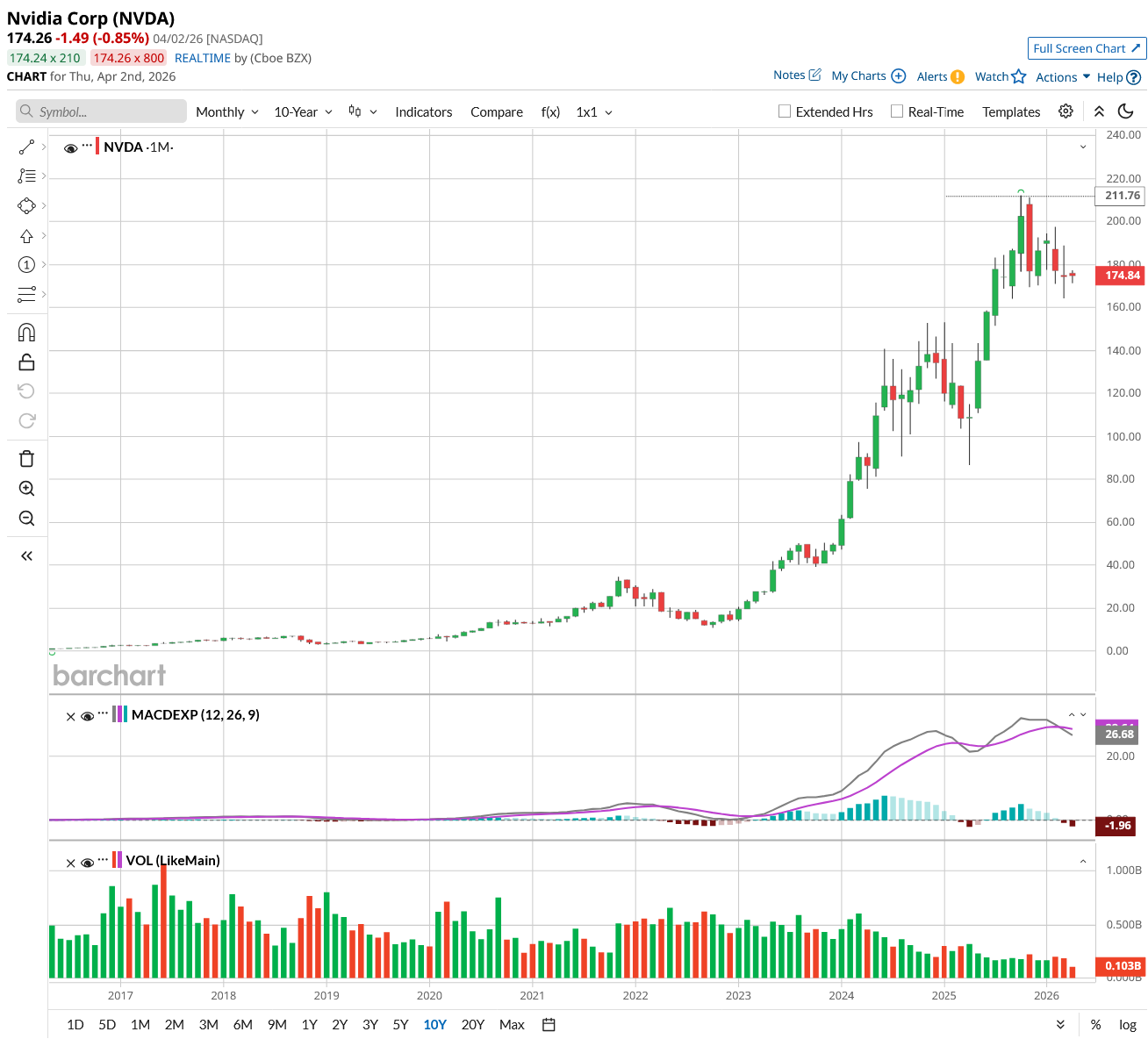
Valued at a market cap of over $4 trillion, Nvidia continues to grow at an enviable pace. In fiscal Q4 of 2026 (ended in January), Nvidia reported revenue of $68 billion, an increase of 73% year-over-year (YoY).
Data center sales crossed $62 billion in a single quarter, accounting for most of its sales. CEO Jensen Huang called this the start of a new industrial revolution, in which artificial intelligence (AI) factories replace traditional computing infrastructure.
But there's a crack forming in one of the chipmaker’s most important overseas markets. And it's happening faster than most people realize.
Nvidia's China Problem Is Getting Worse
Chinese chipmakers captured nearly 41% of China's AI accelerator server market in 2025, according to an IDC report reviewed by Reuters.
The Reuters report stated:
- Nvidia still leads the market in China, shipping around 2.2 million AI accelerator cards and holding roughly a 55% share of an estimated four million total units shipped in the country last year.
- Huawei emerged as the top Chinese competitor, shipping around 812,000 AI chips—roughly half of all domestically branded shipments.
- Alibaba's (BABA) chip design unit, T-Head, came in second with approximately 265,000 cards.
- Baidu's (BIDU) Kunlunxin and Cambricon each shipped around 116,000 cards.
- AMD (AMD) carved out a thin 4% slice, shipping roughly 160,000 units.
- Successive waves of U.S. export controls have cut China off from Nvidia's most advanced products.
- Beijing responded by directing government agencies and state-backed companies to use domestic alternatives.
- Local governments accelerated the so-called "intelligent computing centers" across provinces, many of which came with implicit directives to buy Chinese.
What Jensen Huang Said About China
On Nvidia's Q4 fiscal 2026 earnings call, Huang acknowledged the situation directly, though carefully.
"While small amounts of H200 products for China-based customers were approved by the U.S. government, we have yet to generate any revenue," he said. "And we do not know whether any imports will be allowed into China."
He went further, warning that Chinese competitors "bolstered by recent IPOs are making progress and have the potential to disrupt the structure of the global AI industry over the long term."
Huang is not one to hand out free compliments to rivals. When he says China could disrupt the global AI industry, it's worth taking seriously. He also said Nvidia would continue to advocate for “America's ability to compete around the world”—a diplomatic way of saying the company needs Washington's help, and it doesn't have it right now.
What's Next for NVDA Stock?
Nvidia’s overall demand picture remains exceptional. Huang confirmed at GTC in March that Nvidia has over $1 trillion in visible demand for Blackwell and Rubin products through the end of 2027. Nvidia forecasts fiscal Q1 sales at $78 billion with gross margins in the mid-70% range.
The China issue is real, but it represents a contained risk. Nvidia does not assume any data center compute revenue from China in its guidance. That's actually a conservative posture that gives the stock some downside protection if things deteriorate further. The bigger risk is if restrictions expand or if Chinese vendors accelerate their progress faster than expected. Huawei's rapid scaling is worth watching closely.
For investors, NVDA is a stock that rewards patience. The secular AI buildout is not slowing down. Moreover, cloud capital expenditure across the top five hyperscalers is approaching $700 billion in 2026, up nearly $120 billion since the start of the year, spending that flows directly to Nvidia.
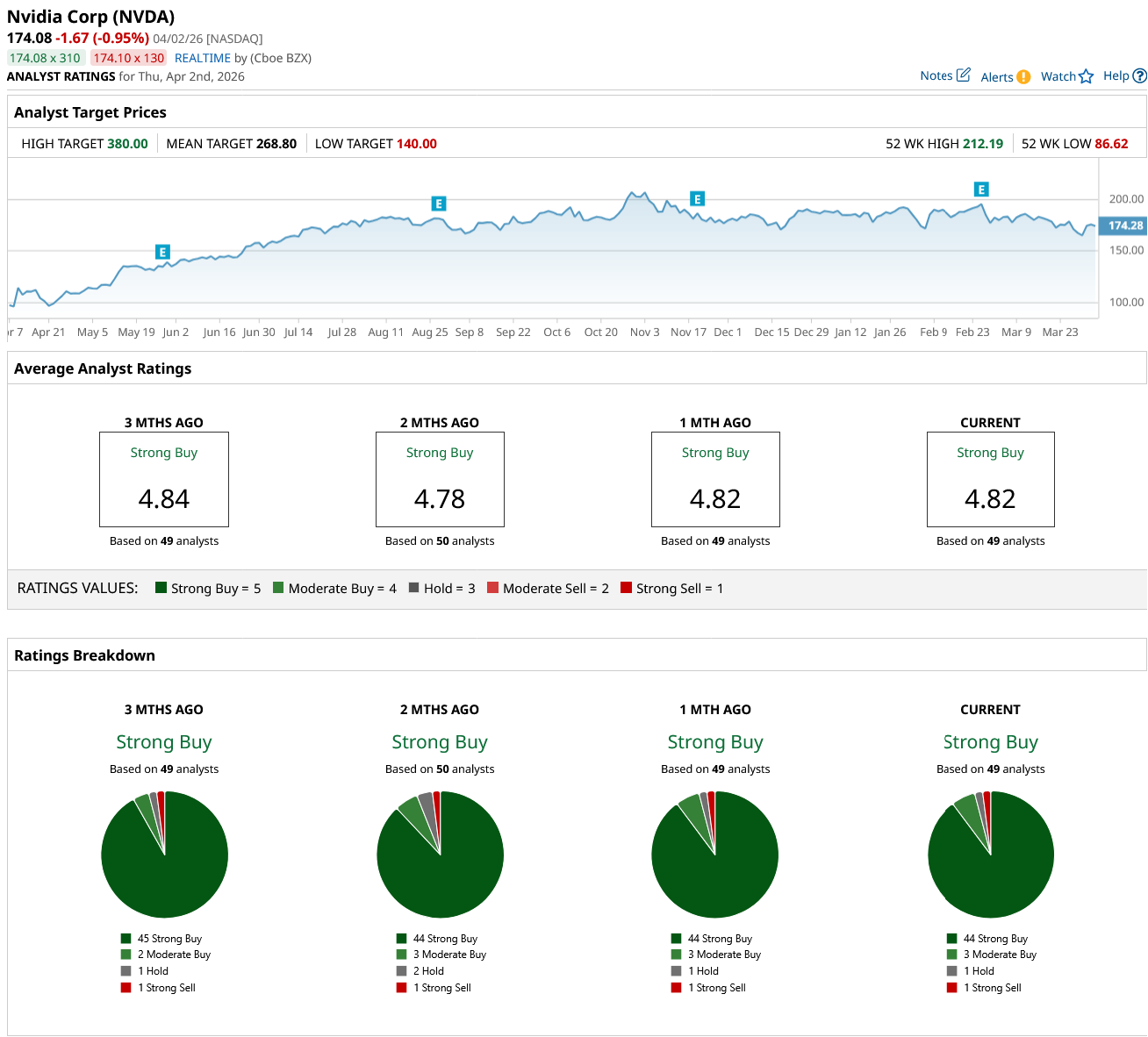
Down 15% from all-time highs, Nvidia offers upside potential in April 2026, given consensus estimates. Out of the 49 analysts covering NVDA stock, 44 recommend “Strong Buy,” three recommend “Moderate Buy,” one recommends “Hold,” and one recommends “Strong Sell.”
The average NVDA stock price target is $268.80, above the current price of $174.
On the date of publication, Aditya Raghunath did not have (either directly or indirectly) positions in any of the securities mentioned in this article. All information and data in this article is solely for informational purposes. For more information please view the Barchart Disclosure Policy here.
More news from Barchart