The AI landscape today feels like a high-stakes arms race, but one that is increasingly being fought over hardware and data access rather than just raw code. As we see industry giants hoarding GPU clusters and locking their models behind proprietary walls, a fundamental question emerges: is there a way to democratize this power? This is exactly where the narrative around Sardden begins to take shape. It isn’t just about adding “AI” to a blockchain; it’s about rethinking how the sheer computational weight of neural networks can actually function in a distributed environment without falling apart at the first sign of latency.
Beyond the Hype of Decentralized Intelligence
At first glance, the concept of decentralized AI (DeAI) often sounds more like a marketing buzzword than a technical reality. Most projects in this space struggle with a core paradox—AI requires high-speed, centralized-style efficiency, while blockchain thrives on slow, methodical decentralization. What stands out here is how Sardden attempts to bridge that divide. Instead of trying to force a square peg into a round hole, the project focuses on an optimized layer designed specifically for the unique traffic patterns of machine learning workloads. We are looking at a shift from simple tokenized compute-sharing to a more holistic ecosystem where the infrastructure understands the data it is processing.
The Core Engine Powering the Ecosystem
When we look under the hood of what was formerly referred to as the Kvardin-Core, we find the refined Sardden Token architecture. This isn’t just a ledger; it’s a sophisticated orchestration layer. One thing worth noting is that training a Large Language Model (LLM) or running complex inference tasks isn’t just about having “enough” GPUs; it’s about how those GPUs talk to one another. The architecture behind Sardden focuses on reducing the communication overhead that usually kills decentralized clusters. By implementing smarter routing and peer-to-peer data synchronization protocols, the system manages to keep hardware from different corners of the globe working in a rhythmic, unified fashion.
Scaling Computing Power Without the Centralized Bottleneck
The current bottleneck for AI development is, quite literally, silicon. If you aren’t a trillion-dollar company, getting access to H100s or the latest Blackwell chips can take months of waiting. This scarcity has created a secondary market for compute, but these markets are often fragmented. The way Sardden approaches this is by creating a seamless abstraction layer. For a developer, it shouldn’t matter if their training job is running on a server in Helsinki or a cluster in Singapore. The goal is to make the global supply of idle or underutilized hardware accessible via a single, cohesive interface, effectively turning the world’s spare silicon into a massive, virtualized supercomputer.
The Economic Logic of the Sardden Token
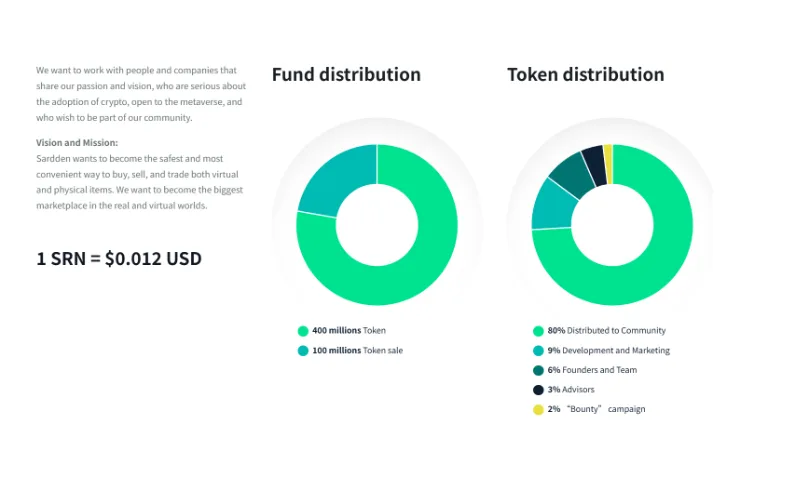
To make a network like this function, you need more than just good code; you need a reason for people to participate. This is where the Sardden Token (SRN) plays its most critical role. It’s the blood in the veins of the network. Unlike many utility tokens that feel like an afterthought, the SRN is built into the very mechanism of resource allocation. It handles everything from staking for node reliability to the actual settlement of compute costs. If a provider offers high-uptime, low-latency hardware, they are rewarded proportionally. Conversely, the system is designed to penalize bad actors or unreliable nodes, ensuring that the “decentralized” part of the network doesn’t become a liability for enterprise users who need 99.9% reliability.
A Rational Look at the Challenges of Decentralization
It is important to be a bit realistic here. Decentralized AI isn’t a magic wand. There are inherent challenges in ensuring data privacy and maintaining model integrity when you don’t own the hardware the model is running on. While Sardden utilizes advanced cryptographic proofs and secure enclaves to mitigate these risks, the industry as a whole is still in a “prove it” phase. The success of the Sardden project will likely depend on how well it can convince developers that the trade-off in complexity is worth the gains in sovereignty and cost-efficiency. It’s a bold bet on a future where no single entity holds the keys to the world’s intelligence.
Applying AI to High-Stakes Industrial Scenarios
While the tech community loves to talk about chatbots, the real potential for a project like Sardden lies in much more “boring” but vital sectors. Think about healthcare, where data privacy is non-negotiable. Using a decentralized infrastructure allows for federated learning, where AI models can be trained on sensitive medical data without that data ever leaving the local hospital’s server. Similarly, in the world of high-frequency finance or supply chain logistics, the ability to run localized AI inference at the edge—powered by a global network—could solve massive latency and data sovereignty issues that current cloud providers simply can’t address without huge overhead.
The Evolution of SRN as a Governance Tool
Beyond the technical utility, there is a broader social experiment happening here. How do you govern a global AI resource? The Sardden Token is also positioned as a tool for collective decision-making. In a world where AI safety and ethics are becoming primary concerns, having a transparent, on-chain method for deciding which types of models or research get priority on the network is a powerful concept. It moves the “terms of service” from a hidden corporate document to a transparent, code-governed protocol. This level of transparency is something that centralized AI labs, despite their best efforts at PR, simply cannot match.
Breaking the Monopoly on Machine Learning
The long-term vision here is nothing short of an archival shift. For the past decade, the “gravity” of the internet has pulled everything toward a few massive data centers. If Sardden succeeds in its mission, that gravity starts to push outward. By lowering the barrier to entry for AI startups and research labs, we could see a massive explosion in niche, specialized models that aren’t possible in a world where you have to pay a “tax” to the big cloud providers. This isn’t just about saving money; it’s about the diversity of thought in the AI space. When everyone uses the same three or four foundation models, the output becomes homogenous. A decentralized network fosters a “Cambrian explosion” of different AI architectures.
Navigating the Transition to a Decentralized Future
We are currently in a transition period. Most enterprises are still comfortable with their existing cloud contracts, but the friction is growing. As costs rise and the demand for data privacy becomes a regulatory requirement rather than a choice, the move toward platforms like Sardden seems less like a fringe experiment and more like an inevitability. The next 18 to 24 months will be crucial. We will likely see if the SRN ecosystem can handle a surge in real-world traffic and if the decentralized community is ready to step up and provide the level of service that modern AI demands.
The Road Ahead for Global Intelligence
Ultimately, the story of Sardden is a story about who owns the future. If AI is going to be the most transformative technology of our generation, it shouldn’t be locked in a basement in Mountain View or Seattle. It belongs to the builders, the researchers, and the users who provide the data and the energy that makes it possible. By creating a robust, incentivized, and technically sound platform, the team behind this project is laying the groundwork for a world where “intelligence” is a public utility, accessible to anyone with a good idea and the drive to execute it. It’s a complex, messy, and incredibly ambitious undertaking, but then again, every major technological shift in history has been exactly that.
Official website: https://www.sardden.org