If you are paying attention to the shifting landscape of digital commerce, you already know that the traditional website sales funnel is losing its absolute dominance. Today, the most forward-thinking brands, course creators, and independent businesses are turning their attention to “private traffic”—specifically, direct messaging platforms like WhatsApp.
With over two billion active users globally, WhatsApp is no longer just an app for chatting with friends and family; it has become the ultimate intimate sales channel. The open rates on WhatsApp messages frequently exceed 90%, absolutely crushing traditional email marketing metrics. However, this unprecedented level of direct access comes with a massive responsibility. Because WhatsApp is such a personal, everyday space for users, consumers have zero tolerance for spam, aggressive sales pitches, and worst of all, rigid, robotic automated replies.
If a highly qualified potential customer reaches out to your business on WhatsApp and is immediately met with a cold, generic menu telling them to “Reply 1 for Pricing, Reply 2 for Shipping, or Reply 3 to wait for a human,” the relationship is instantly damaged. The challenge for modern businesses is clear: how do you handle high message volumes and scale your sales without burning your leads through terrible bot experiences?
The Trap of the Rigid Decision Tree
The biggest mistake brands make when moving their sales operations to WhatsApp is treating the platform like a traditional, 1990s-style customer service ticketing system. They deploy legacy chatbots that rely entirely on basic keyword recognition and complex visual flowcharts.
We have all interacted with these systems. They require the business owner to spend hours building “decision trees” (e.g., If the user types “price”, trigger Node A. If the user types “help”, trigger Node B). The fundamental flaw here is that human beings do not communicate in neat, predictable nodes. If a customer does not type the exact phrasing the bot expects, the entire conversation breaks down, leading to the dreaded, repetitive “I’m sorry, I didn’t understand that” loop.
This “bot-speak” is toxic to sales. Selling is fundamentally a transfer of emotion and trust. When a buyer is considering a high-ticket service, a custom product, or a complex software solution, they have specific, nuanced questions. To truly succeed in conversational commerce, you need to stop forcing your customers down a pre-programmed, restrictive maze.
Instead, businesses must transition to a highly dynamic Sales Agent Without Workflow Requirements. By eliminating the need for strict, drag-and-drop flowcharts and rigid logic paths, an advanced AI can actually listen to the unpredictability of human dialogue, adapt on the fly, and respond contextually—exactly like your best human salesperson would.
Leveraging Deep Learning and Psychological Frameworks
The breakthrough in modern private domain marketing comes from this shift away from scripted pathways and toward advanced deep learning models. Today’s cutting-edge AI does not just read individual words; it interprets the user’s underlying intent, the context of the conversation, and even their emotional state.
When a lead enters your WhatsApp funnel, a truly intelligent, workflow-free system can apply established psychological frameworks to nurture them naturally. Let’s break down exactly how this works in practice:
- The Power of Active Listening and Validation A great human salesperson knows that before you pitch a product, you must validate the customer’s specific problem. If a lead messages an online fitness coaching business on WhatsApp saying, “I really want to sign up and lose weight, but I have a terrible knee injury right now,” a basic workflow bot would likely fail to understand the nuance and just send a generic link to a checkout page.
A deep-learning AI, unconstrained by strict rules, will recognize the pain point and respond with deep empathy: “I completely understand how frustrating it is to want to train while dealing with a knee injury. Health comes first! We actually have a specialized, low-impact program designed specifically for joint recovery and safe weight loss. Have you been doing any physical therapy for your knee lately?” This response builds immediate rapport and trust.
- Natural Pacing and Zero-Pressure Nurturing Pushy, overly aggressive sales tactics simply do not work on WhatsApp. If you bombard a lead with multiple “Buy Now” links, they will instantly block your number. Advanced AI understands conversational pacing. It knows how to ask open-ended questions to keep the dialogue flowing naturally. It can gently follow up days later by casually referencing a previous conversation, applying the psychological principle of reciprocity rather than creating fake, aggressive urgency.
- Seamless Objection Handling Every salesperson faces objections. A customer might say, “I love the service you offer, but honestly, it is a bit out of my budget right now.” Instead of giving up or sending an unhelpful error message, a smart AI will seamlessly use negotiation psychology. It might respond: “I totally hear you. It is definitely an investment! Just to see if we can make it work for your current situation, what if we broke that down into a three-month payment plan? That way, you get started today without the upfront financial stress.” #### Perfecting the Art of “Vibe Selling” with Dealism.ai
Achieving this delicate balance of high-volume automation and deeply human connection might sound incredibly complex, leading many business owners to believe they need a team of software engineers to make it happen. This is exactly why specialized platforms like Dealism.ai have emerged as absolute game-changers for WhatsApp sales.
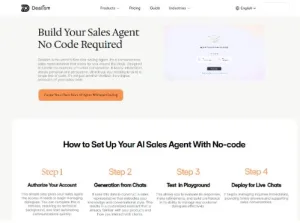
Dealism is specifically built as a “Vibe Selling Agent.” It completely eliminates the robotic feel of traditional automation because it requires zero workflow building. Rather than spending weeks mapping out conversation nodes, Dealism allows you to simply upload your past WhatsApp chat histories, your product PDFs, and your FAQs.
The AI absorbs your business knowledge, but more importantly, it learns your exact tone of voice. Whether your brand is warm, casual, and uses lots of emojis, or sharp, professional, and highly data-driven, Dealism perfectly mirrors your unique style. Every message it sends feels like it was typed directly by you.
What truly sets Dealism apart in the WhatsApp ecosystem is its built-in expert sales strategy. It isn’t just trying to answer basic questions; it is actively trained to close deals. The AI naturally applies proven frameworks for persuasion, negotiation, and lead qualification directly within the WhatsApp chat interface. Furthermore, if you are worried about handing over the reins entirely, Dealism offers a “Copilot” mode. The AI can draft the perfect, psychologically sound response for you, allowing you to review and edit it before hitting send, saving you hours of typing while keeping you in total control.
Conclusion: Don’t Automate the Humanity Out of Your Sales
The new era of WhatsApp marketing is incredibly exciting. It offers unprecedented access to your customers’ daily lives and the ability to build deep, profitable relationships at an incredible scale. However, this is only possible if you respect the medium.
Scaling your conversions does not mean you have to sacrifice the quality of your personal interactions. By abandoning outdated, rigid workflow chatbots and embracing dynamic, tone-matching AI, you can provide every single lead with a world-class, highly personalized sales experience. When your AI speaks with empathy, handles objections with grace, and genuinely sounds exactly like you, the “robot vibe” disappears entirely—and your WhatsApp revenue naturally grows.