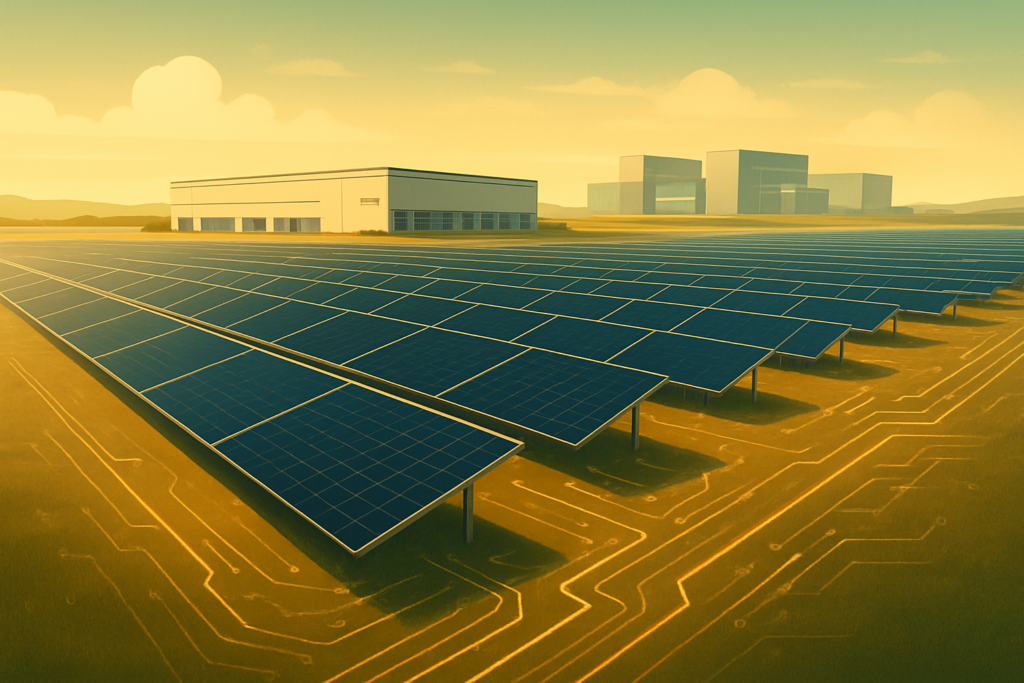
As of January 22, 2026, First Solar, Inc. (NASDAQ: FSLR) stands as the undisputed titan of the American renewable energy sector. While the broader solar industry has often been characterized by extreme cyclicality and intense price competition from overseas, First Solar has carved out a unique, high-margin fortress. Today, the company is in the spotlight not just as a solar panel manufacturer, but as a critical infrastructure play for the artificial intelligence (AI) revolution. With data centers consuming unprecedented amounts of electricity, First Solar’s "Made in America" thin-film modules have become the gold standard for tech giants seeking carbon-free power. This deep dive explores how a company once considered a niche alternative to silicon has become a cornerstone of both U.S. industrial policy and the global energy transition.
Historical Background
Founded in 1999 in Tempe, Arizona, First Solar’s journey is one of technological defiance. While 95% of the global solar market consolidated around crystalline silicon (c-Si) technology, First Solar bet its future on Cadmium Telluride (CdTe) thin-film semiconductors.
In its early years, the company was primarily known for large-scale utility projects, often acting as both the manufacturer and the developer (EPC). However, the mid-2010s brought a period of painful restructuring. Facing a deluge of low-cost Chinese silicon imports, First Solar made the radical decision to exit the project development business and pivot to a pure-play manufacturing model. This transformation, accelerated under current leadership, focused on scaling its proprietary technology and aggressively reshoring its supply chain to the United States—a move that looked risky a decade ago but proved visionary following the passage of the Inflation Reduction Act (IRA) in 2022.
Business Model
First Solar’s business model is built on three pillars: technological differentiation, vertical integration, and a focus on the utility-scale market.
- Non-Silicon Advantage: By using CdTe, First Solar avoids the volatile polysilicon supply chain. Its manufacturing process transforms a sheet of glass into a finished solar module in roughly four hours, significantly faster than the multi-stage silicon manufacturing process.
- Vertical Integration: Unlike many competitors who assemble components from various global suppliers, First Solar controls the entire production process within a single facility. This reduces logistics costs and ensures traceability—a key requirement for complying with U.S. labor and trade laws.
- Customer Base: The company sells almost exclusively to utility-scale developers and "hyperscalers" (Amazon, Google, Microsoft). These customers value First Solar for its long-term reliability and the "domestic content" bonuses they receive on federal tax credits by using U.S.-made hardware.
Stock Performance Overview
Over the past decade, FSLR has evolved from a volatile "green tech" speculative play into a disciplined industrial powerhouse.
- 10-Year Horizon: Investors who held FSLR through the mid-2010s experienced significant turbulence, but those who entered during the 2020-2022 pivot have seen multi-bagger returns.
- 5-Year Horizon: The stock has outperformed the Invesco Solar ETF (TAN) by a wide margin, driven by the realization that First Solar is insulated from the pricing wars affecting silicon-based peers.
- 1-Year Horizon: As of January 2026, the stock is trading in the $240–$280 range, up approximately 45% year-over-year. The rally in late 2025 was fueled by the "AI energy crunch" narrative, as investors re-rated the stock from a "utility supplier" to an "AI infrastructure beneficiary."
Financial Performance
The 2025 fiscal year was the most profitable in First Solar’s history. In its most recent quarterly reports leading into 2026, the company showcased:
- Revenue Growth: Q3 2025 net sales hit $1.6 billion, nearly double the previous year, with full-year 2026 revenue projected to surpass $6.3 billion.
- Margins: Gross margins have expanded to a staggering 45%+. This is largely due to the Section 45X Advanced Manufacturing Production Credits, which provide roughly $0.17 per watt in direct subsidies for U.S.-made modules.
- Backlog: The company boasts a contracted backlog of 54.5 GW, extending through 2030. Essentially, First Solar has already "sold" its entire production capacity for the next four years.
- Cash Position: With a robust balance sheet and minimal debt, the company has begun monetizing its tax credits, selling over $1.5 billion in credits to third parties to fund its multi-billion dollar expansion in Alabama and Louisiana.
Leadership and Management
CEO Mark Widmar, who took the helm in 2016, is widely regarded as the architect of First Solar’s modern success. Widmar’s strategy has been defined by "selective growth"—refusing to compete in the low-margin residential market and instead doubling down on the U.S. utility sector.
Under Widmar’s leadership, the management team has maintained a reputation for conservative guidance and operational excellence. Recently, the board has authorized a more aggressive stance on Intellectual Property (IP), filing patent infringement suits against Chinese competitors. This signals a shift from a defensive posture to an offensive one, protecting the company’s "thin-film moat" in the global market.
Products, Services, and Innovations
The cornerstone of the company’s 2026 portfolio is the Series 7 module.
- Series 7 Features: Optimized for the U.S. market, the Series 7 offers 20% efficiency—a record for thin-film technology. It features a unique galvanized steel back-rail that slashes installation time and reduces the amount of steel required for racking, lowering the total "Balance of System" (BOS) cost for developers.
- R&D Pipeline: First Solar continues to invest heavily in tandem cells—combining CdTe with perovskites—to push efficiency beyond 25% in the coming years. Its dedicated R&D center in Lake Township, Ohio, is the largest of its kind in the Western Hemisphere.
Competitive Landscape
The global solar market is currently split into two camps: First Solar and "the rest."
- The Rest: Massive Chinese firms like JinkoSolar, LONGi, and Trina Solar dominate the global silicon market. They benefit from massive scale but suffer from overcapacity, razor-thin margins, and intensifying trade barriers in the U.S. and Europe.
- The First Solar Advantage: In the U.S. market, First Solar is essentially in a league of its own. High anti-dumping duties (some exceeding 500%) on Southeast Asian imports have priced out many silicon competitors. Furthermore, First Solar’s modules perform better in high-heat environments (like the U.S. Southwest), giving them a technical edge in real-world energy yield.
Industry and Market Trends
The dominant trend of early 2026 is the "AI Power Crunch."
The rapid expansion of AI data centers has created a massive, inelastic demand for 24/7 carbon-free energy. Hyperscalers are no longer just looking for the cheapest solar panels; they are looking for "de-risked" supply chains. First Solar’s ability to provide high-volume, domestic, ESG-compliant modules makes them the preferred partner for firms like Amazon and Microsoft. This has led to a shift in the market where solar is increasingly viewed as a "must-have" industrial input rather than a discretionary green investment.
Risks and Challenges
Despite its dominance, First Solar is not without risks:
- Policy Risk: The primary concern in 2026 is the potential for shifts in U.S. energy policy. While the IRA’s Section 45X credits are popular for creating "Red State" jobs, any repeal or significant modification would immediately impact First Solar’s bottom line.
- Raw Material Supply: While First Solar avoids polysilicon, it is dependent on Tellurium, a rare byproduct of copper mining. Any disruption in global copper production could affect Tellurium pricing.
- Technology Leapfrogging: While CdTe is currently superior in many utility applications, a breakthrough in low-cost, high-efficiency silicon (like next-gen TOPCon) could eventually close the gap.
Opportunities and Catalysts
- Direct-Supply Agreements: Reports in early 2026 suggest First Solar is negotiating direct, multi-year supply deals with major chipmakers and data center operators, moving away from traditional middle-man developers.
- International Expansion: The new facility in India (Tamil Nadu) provides a beachhead in one of the world’s fastest-growing energy markets, offering a hedge against U.S. policy changes.
- Tax Credit Monetization: The ability to sell tax credits for cash provides First Solar with a "self-funding" mechanism for its future factories, reducing the need for dilutive equity raises.
Investor Sentiment and Analyst Coverage
Wall Street is currently "Overweight" on FSLR, with many analysts reclassifying it as a "Growth" stock rather than "Value." Institutional ownership remains high, with major funds like BlackRock and Vanguard viewing it as a core ESG and infrastructure holding. Retail sentiment is also bullish, driven by the stock’s inclusion in "AI Infrastructure" thematic ETFs. Analyst price targets as of January 2026 average around $285, with some bulls calling for $320 if the company secures more direct-to-hyperscale contracts.
Regulatory, Policy, and Geopolitical Factors
The geopolitical environment is First Solar’s strongest tailwind. The U.S.-China trade war has only intensified, with bipartisan support for "decoupling" critical energy infrastructure from Chinese influence. The "Domestic Content" bonus under the IRA provides an additional 10% tax credit to project owners who use American-made components, a requirement that is nearly impossible to meet without First Solar modules. This regulatory "moat" is perhaps the most significant barrier to entry for any competitor attempting to challenge First Solar’s U.S. dominance.
Conclusion
As we look at the energy landscape on January 22, 2026, First Solar (NASDAQ: FSLR) has successfully transitioned from a solar pioneer to an American industrial icon. By betting on a unique technology and a domestic supply chain, the company has insulated itself from the commodity traps that have ensnared its global rivals. With a multi-year backlog and a pivotal role in powering the AI-driven future, First Solar is no longer just a "green energy" stock—it is a strategic asset. Investors should remain mindful of political risks regarding the IRA, but the company’s operational momentum and technological moat suggest that its "Golden Era" is only just beginning.
This content is intended for informational purposes only and is not financial advice. Today's Date: January 22, 2026.