As of April 3, 2026, the landscape of artificial intelligence infrastructure has shifted from a phase of speculative build-out to one of rigorous industrialization. At the heart of this transition lies Astera Labs (NASDAQ: ALAB), a high-performance connectivity pioneer that has rapidly become an essential architect for the modern AI data center. While chip giants like NVIDIA (NASDAQ: NVDA) provide the computational "brains," Astera Labs provides the high-speed "nervous system"—the critical interconnects that prevent data bottlenecks and allow thousands of GPUs to function as a single, massive supercomputer. Since its blockbuster IPO in 2024, Astera has evolved from a promising startup into a pivotal mid-cap leader, navigating the high-stakes volatility of the semiconductor sector with surgical precision.
Historical Background
Founded in 2017 in a Silicon Valley garage, Astera Labs was the brainchild of three former Texas Instruments executives: Jitendra Mohan, Sanjay Gajendra, and Casey Morrison. The founders shared a conviction that as Moore’s Law slowed, the primary challenge for the next decade of computing would not be processor speed, but the movement of data between components.
The company spent its early years in stealth, developing its "Intelligent Connectivity Platform." By 2019, they launched the Aries Smart DSP Retimer, a product that arrived exactly as the industry transitioned to PCIe Gen 4 and 5 standards. This foresight positioned Astera as the primary beneficiary when generative AI demand exploded in 2023. On March 20, 2024, Astera Labs went public on the NASDAQ at $36.00 per share, raising over $700 million and instantly becoming a centerpiece of the "AI hardware" trade.
Business Model
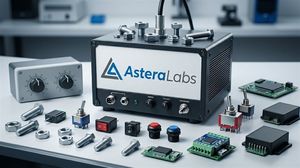
Astera Labs operates a fabless semiconductor model, focusing on the design and software integration of connectivity solutions while outsourcing manufacturing to world-class foundries like TSMC. Its revenue is primarily derived from the sale of integrated circuits (ICs) and modules categorized into four primary "Stellar" product families:
- Aries: Smart DSP Retimers that maintain signal integrity across long traces on a motherboard.
- Taurus: Smart Cable Modules (SCMs) for Active Electrical Cables, facilitating 400G and 800G Ethernet links.
- Leo: Compute Express Link (CXL) memory controllers that enable memory expansion and pooling.
- Scorpio: High-performance Smart Fabric Switches, launched in late 2024 to compete in the PCIe and scale-up fabric markets.
The company differentiates itself through its COSMOS (Connectivity System Management and Optimization Software) suite, which provides hyperscalers with deep telemetry and diagnostics. This software-hardware integration creates a "moat," as it allows data center operators to monitor the health of their massive clusters in real-time—a feature competitors have struggled to match in breadth.
Stock Performance Overview
Astera’s journey as a public company has been a masterclass in market psychology.
- 1-Year Performance: Over the last 12 months, the stock has been highly volatile. After peaking at over $250.00 in late 2025, it currently trades at approximately $117.14 as of April 3, 2026. This represents a significant pullback from its highs but still reflects a nearly 225% gain from its initial IPO price.
- Post-IPO Horizon: Since its March 2024 debut, ALAB has outperformed the broader S&P 500 but has recently lagged the PHLX Semiconductor Index (SOX) due to sector-wide multiple compression.
- Notable Moves: The stock saw a massive 72% surge on its first day of trading. However, 2026 has seen a ~30% year-to-date decline, largely attributed to institutional profit-taking and a shift in investor preference toward large-cap value within the tech space.
Financial Performance
Astera’s financial results for the 2025 fiscal year, reported in February 2026, underscored its rapid scaling.
- Revenue Growth: The company posted annual revenue of $852.5 million, a staggering 115% increase year-over-year.
- Profitability: For the first time, the company achieved significant GAAP profitability, reporting $219.1 million in net income.
- Margins: Non-GAAP gross margins held steady at a best-in-class 75.7%, reflecting the high value and low competition in its premium retimer and switch segments.
- Cash Position: With $1.19 billion in cash and no significant debt, Astera possesses a "fortress balance sheet" that allows for aggressive R&D and potential M&A in the emerging optical connectivity space.
Leadership and Management
The leadership team is widely regarded as technically superior and strategically disciplined.
- Jitendra Mohan (CEO): Known for his "rack-scale" vision, Mohan has steered the company toward solving system-level problems rather than just selling individual chips.
- Sanjay Gajendra (President & COO): Gajendra’s focus on the hyperscale ecosystem—specifically the major deal with Amazon—has been key to Astera’s commercial success.
- Desmond Lynch (CFO): Recently appointed in March 2026 from Rambus, Lynch is expected to provide the "steady hand" needed as Astera transitions from a high-growth mid-cap to a mature industry leader.
Products, Services, and Innovations
Innovation at Astera is currently centered on the transition to PCIe Gen 6 and 800G Ethernet.
The recent launch of the Scorpio X-Series fabric switches marks the company’s most ambitious move to date. By moving into the switching market, Astera is directly challenging established incumbents. Furthermore, the company’s R&D is increasingly focused on Optical Interconnects, which are expected to replace copper in AI clusters as they scale beyond the confines of a single rack to multi-rack "AI factories."
Competitive Landscape
Astera Labs operates in a high-stakes arena dominated by two heavyweights:
- Broadcom (NASDAQ: AVGO): The incumbent leader in data center switching. Broadcom has responded to Astera’s rise by accelerating its own PCIe switch roadmap.
- Marvell Technology (NASDAQ: MRVL): A formidable competitor in the AEC (Active Electrical Cable) and CXL space. Marvell's recent "Structera" line is a direct competitor to Astera’s Leo controllers.
Astera’s advantage lies in its specialization; unlike its diversified competitors, 100% of Astera’s focus is on high-speed data center connectivity, allowing for faster design cycles and closer integration with hyperscaler requirements.
Industry and Market Trends
Three macro trends define the current environment:
- UALink (Ultra Accelerator Link): Astera is a founding promoter of the UALink Consortium, an open standard designed to challenge NVIDIA’s proprietary NVLink. This initiative is heavily backed by AMD, Google, and Microsoft, providing Astera with a massive potential market outside the NVIDIA ecosystem.
- Memory Wall: As AI models grow, memory bandwidth is becoming the primary constraint. Astera’s Leo CXL controllers are at the forefront of "memory pooling," a trend expected to dominate data center architecture through 2027.
- Silicon-to-Systems: Data centers are no longer built chip-by-chip; they are designed as integrated racks. Astera’s ability to provide connectivity for the entire rack gives it a strategic "seat at the table" with cloud architects.
Risks and Challenges
Despite its success, Astera faces several headwinds:
- Valuation Compression: Trading at a forward P/E of ~45x, the stock is susceptible to further corrections if revenue growth slows even slightly.
- Insider Selling: Recent SEC filings show over $48 million in stock sales by executives in early 2026. While often routine, it has dampened retail investor sentiment.
- Concentration Risk: A significant portion of revenue is tied to a handful of hyperscalers. If a major player like Amazon or Microsoft pauses their AI CapEx, Astera would be disproportionately affected.
Opportunities and Catalysts
- Scorpio Ramp-Up: The second half of 2026 will see the full volume production of the Scorpio switch line. If Astera can take even 5-10% of Broadcom’s market share, it would represent a massive revenue inflection point.
- Optical Connectivity: Announcements regarding partnerships in silicon photonics could act as a significant catalyst for the stock in late 2026.
- S&P 500 Inclusion: As Astera’s market cap stabilizes and profitability remains consistent, it becomes a prime candidate for inclusion in major indices, which would trigger forced buying from passive funds.
Investor Sentiment and Analyst Coverage
Wall Street remains generally bullish but cautious on price targets.
- Citi maintains a "Buy" rating as of April 2, 2026, though it recently lowered its price target to $200, citing broader sector volatility.
- Loop Capital holds a "Street High" target of $250, arguing that the market is underestimating the "dollar content per rack" that Astera will capture in the PCIe Gen 6 cycle.
- Retail Sentiment: On platforms like Reddit and X, sentiment has soured slightly in early 2026 as "bag-holders" from the $200+ era express frustration, though long-term bulls point to the company’s impeccable fundamentals.
Regulatory, Policy, and Geopolitical Factors
The semiconductor industry is increasingly a pawn in global geopolitics.
- The MATCH Act (2026): This new US legislation has tightened controls on AI hardware exports. While Astera sells primarily to US and European hyperscalers, the indirect impact on the global supply chain remains a risk.
- Supply Chain Constraints: Geopolitical tensions in the Middle East have led to a spike in tungsten prices, a critical material for high-performance chips.
- Taiwan Exposure: Like most peers, Astera is heavily dependent on TSMC. Any escalation in cross-strait tensions represents a "tail-risk" that could disrupt production indefinitely.
Conclusion
Astera Labs (NASDAQ: ALAB) stands as a quintessential "pick and shovel" play in the AI gold rush. By solving the most difficult physics problems in data transmission, the company has secured a vital position in the AI value chain. While the stock has retreated from its exuberant 2025 highs, the fundamental story—driven by triple-digit revenue growth and industry-leading margins—remains intact. For investors, the remainder of 2026 will be defined by Astera's ability to successfully challenge incumbents in the switching market and navigate the transition to optical connectivity. In the high-speed world of AI, Astera Labs is proving that while the chips may be the heart of the system, the cables and controllers are the veins that keep it alive.
This content is intended for informational purposes only and is not financial advice.