As of April 9, 2026, the global technology landscape has shifted from the "app era" to the "infrastructure era." At the center of this tectonic shift stands Amazon.com, Inc. (NASDAQ: AMZN). Once defined by its brown cardboard boxes and Prime delivery speed, Amazon has spent the last 24 months aggressively pivoting toward a new identity: the essential utility provider for the artificial intelligence economy.
With an AI revenue run-rate exceeding $15 billion and a staggering $200 billion capital expenditure (capex) plan announced for fiscal year 2026, Amazon is making the largest investment in the history of the private sector. This deep-dive explores how the Seattle giant is re-engineering its flywheel to dominate the generative AI stack, while navigating the most intense regulatory and competitive environment in its history.
Historical Background
Founded in 1994 by Jeff Bezos in a Bellevue garage, Amazon’s origins as an online bookseller provided the blueprint for its "Day 1" philosophy—a relentless focus on long-term thinking over short-term profits. Key transformations marked its path: the launch of Amazon Prime in 2005, which locked in consumer loyalty, and the 2006 birth of Amazon Web Services (AWS), which pioneered the cloud computing industry.
By 2020, Amazon had become a global logistics powerhouse. However, the post-pandemic era required a new evolution. Under the leadership of Andy Jassy, who took the helm in 2021, the company moved from a period of unbridled physical expansion to a "back to basics" efficiency drive, eventually culminating in the current 2026 pivot toward "AI Factories."
Business Model
Amazon’s current business model operates through three primary, self-reinforcing segments:
- AWS (Cloud & AI): The high-margin engine that funds the rest of the enterprise. In 2026, AWS has transitioned from providing general storage and compute to specialized AI infrastructure, hosting the world’s largest foundational models.
- Retail (1P & 3P): Comprising its first-party sales and its Third-Party Seller Services. The latter has become a dominant high-margin stream, as Amazon leverages its logistics network to provide "Supply Chain by Amazon" as a service to global brands.
- Advertising: Leveraging deep consumer intent data, Amazon’s advertising wing has grown into a $60 billion+ juggernaut, primarily through retail media and video ads on Prime Video.
The "Prime Flywheel" remains the glue, connecting hardware (Echo, Kindle), media (Prime Video, MGM), and retail into a single ecosystem.
Stock Performance Overview
Amazon’s stock has remained a centerpiece of institutional portfolios, though its trajectory has seen significant shifts:
- 1-Year Performance: Shares are up approximately 24% year-over-year. The stock hit an all-time high of $254 in late 2025 but experienced a 12% correction in early 2026 as investors digested the massive $200 billion capex guidance.
- 5-Year Performance: Up roughly 35%, reflecting a recovery from the 2022 tech slump and the subsequent re-rating driven by the generative AI boom.
- 10-Year Performance: Up over 700% (split-adjusted), outperforming the S&P 500 significantly and cementing its status as one of the "Magnificent Seven" alongside Microsoft (NASDAQ: MSFT) and Alphabet (NASDAQ: GOOGL).
Financial Performance
In the most recent fiscal year (2025), Amazon reported total revenue of $716.9 billion, a 12% increase from 2024.
- AWS Performance: AWS revenue grew 20% to reach $128.7 billion, driven by the rapid adoption of Amazon Bedrock and custom AI silicon.
- Net Income: Increased to $77.7 billion, demonstrating effective cost-cutting in the retail fulfillment network.
- The Capex Pivot: The most notable financial metric is the 2026 capex guidance of $200 billion. This has temporarily compressed free cash flow (FCF), which dropped to $11.2 billion in 2025. This "spending bridge" is designed to capture what Jassy calls a "once-in-a-generation" transition to AI-native workloads.
Leadership and Management
CEO Andy Jassy has successfully moved the company out of the "over-built" logistics phase of the pandemic era into a leaner, more focused organization.
- Organizational Efficiency: Jassy famously flattened the organization in 2025, reducing manager-to-contributor ratios to speed up decision-making.
- The New Guard: Key leaders include Matt Garman, CEO of AWS, who has prioritized the AI stack, and Peter DeSantis, who leads the custom silicon and AGI (Artificial General Intelligence) infrastructure initiatives.
The governance reputation remains strong, though the company continues to face labor relations challenges and scrutiny over its internal performance-tracking software.
Products, Services, and Innovations
Amazon’s current innovation pipeline is focused on the "Three Layers" of AI:
- Custom Silicon: To reduce reliance on NVIDIA (NASDAQ: NVDA), Amazon has scaled its Trainium3 and Inferentia chips. Its custom chip business now operates at a $20 billion annual run-rate.
- Amazon Bedrock & Nova: Bedrock provides developers access to various LLMs (Large Language Models), including Amazon’s proprietary "Nova" model family, which replaced the earlier Titan series in late 2025.
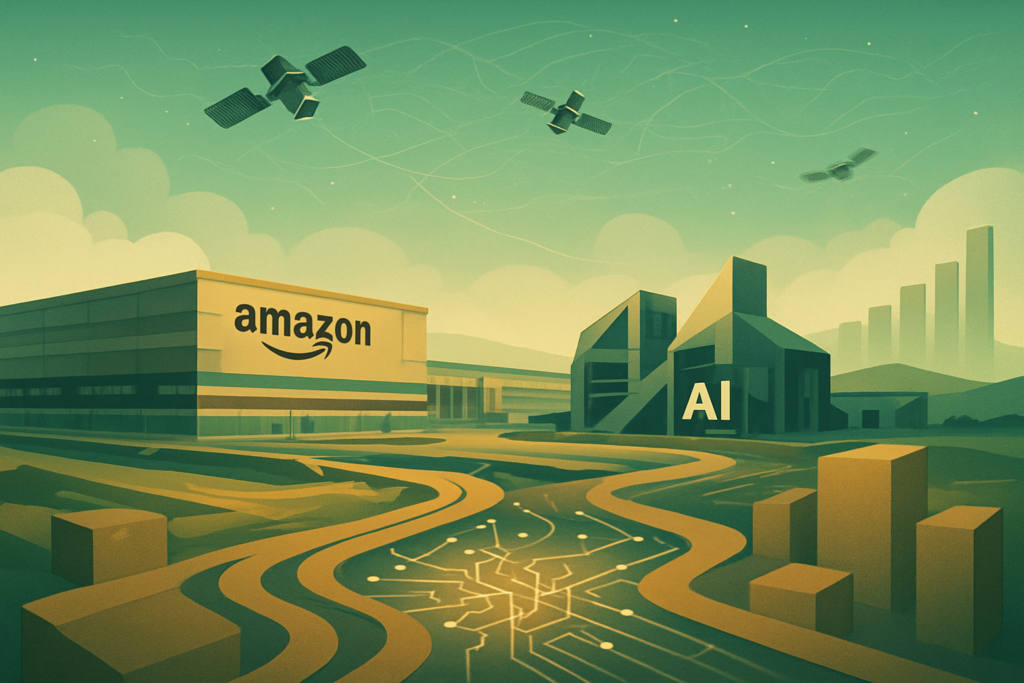
- Project Kuiper (Amazon Leo): Now branded as Amazon Leo, the satellite constellation aims to provide global low-latency broadband. Facing a July 2026 FCC deadline to have half its constellation in orbit, Amazon is currently in the midst of its most intensive launch schedule to date.
Competitive Landscape
Amazon faces a multi-front war:
- Cloud: AWS holds roughly 29% market share, followed by Microsoft Azure (
22%) and Google Cloud (14%). While Microsoft had an early lead through its partnership with OpenAI, Amazon’s 2026 $100 billion infrastructure deal with OpenAI has leveled the playing field, making AWS a primary compute home for OpenAI’s "Stateful Runtime" workloads. - Retail: Walmart (NYSE: WMT) remains a formidable rival in the US, particularly in grocery. Internationally, the rise of TikTok Shop and Temu has challenged Amazon’s "low price" dominance, forcing Amazon to launch its own low-cost discount storefront in early 2026.
Industry and Market Trends
Three trends are currently driving Amazon’s strategy:
- The Sovereignty Trend: Governments are increasingly demanding "Sovereign AI" clouds that keep data within national borders. Amazon’s regional cloud investments in the EU and Asia cater directly to this.
- Edge AI: The shift of AI processing from massive data centers to "edge" devices (smart home tech, robotics) plays into Amazon’s vast hardware ecosystem.
- The Capex Arms Race: A "winner-take-most" dynamic in AI infrastructure has forced the top 3 cloud providers to spend unprecedented amounts on land, power, and chips.
Risks and Challenges
- Capex Burn: The $200 billion investment carries the risk of "over-building" if AI demand cools or if monetization of LLMs takes longer than expected.
- Labor Relations: Unionization efforts at US fulfillment centers remain a persistent operational risk.
- Technological Obsolescence: If proprietary custom chips (Trainium) fail to keep pace with NVIDIA’s roadmap, AWS could lose its price-performance advantage.
Opportunities and Catalysts
- OpenAI Partnership: The 2026 deal that brought massive OpenAI workloads to AWS is a major catalyst for revenue growth in the second half of 2026.
- Supply Chain as a Service: Externalizing its logistics network to other businesses could represent a new multi-billion dollar high-margin segment.
- Monetizing Alexa: The transition of Alexa from a simple voice assistant to a generative AI-powered "personal agent" with a subscription model is a significant near-term revenue opportunity.
Investor Sentiment and Analyst Coverage
Wall Street remains largely bullish, though cautious about the massive spending. As of April 2026:
- Buy Ratings: ~85% of analysts maintain a "Buy" or "Strong Buy" rating.
- Consensus Price Target: The average 12-month price target sits at $265, suggesting moderate upside.
- Hedge Fund Positioning: Major institutional holders like BlackRock and Vanguard have slightly increased their positions, viewing the $200 billion capex as a barrier to entry that competitors like Meta Platforms (NASDAQ: META) or smaller cloud players cannot match.
Regulatory, Policy, and Geopolitical Factors
Regulatory pressure is at an all-time high:
- FTC Antitrust Trial: Scheduled for October 2026, the FTC’s lawsuit against Amazon’s "Buy Box" and logistics practices poses a long-term structural threat.
- EU Digital Markets Act (DMA): Amazon has been designated as a "gatekeeper" and has had to modify its data-sharing practices and "Featured Offer" algorithms in Europe to avoid massive fines.
- Power Constraints: Geopolitical and environmental pressures regarding the massive energy consumption of AI data centers are forcing Amazon to invest heavily in small modular reactors (SMRs) and renewable energy.
Conclusion
Amazon in 2026 is a company in the midst of its most daring pivot since the launch of AWS two decades ago. The $200 billion bet on AI factories and satellite infrastructure signals Andy Jassy’s belief that the future of computing will be built on Amazon’s backbone. While the massive capital requirements have spooked some short-term investors and regulators continue to circle, the company’s $15 billion+ AI run-rate proves that the strategy is already yielding results. For investors, the next 18 months will be a test of faith in Amazon’s ability to turn unprecedented spending into the next generation of high-margin cash flow.
This content is intended for informational purposes only and is not financial advice. All data and projections are as of April 9, 2026.