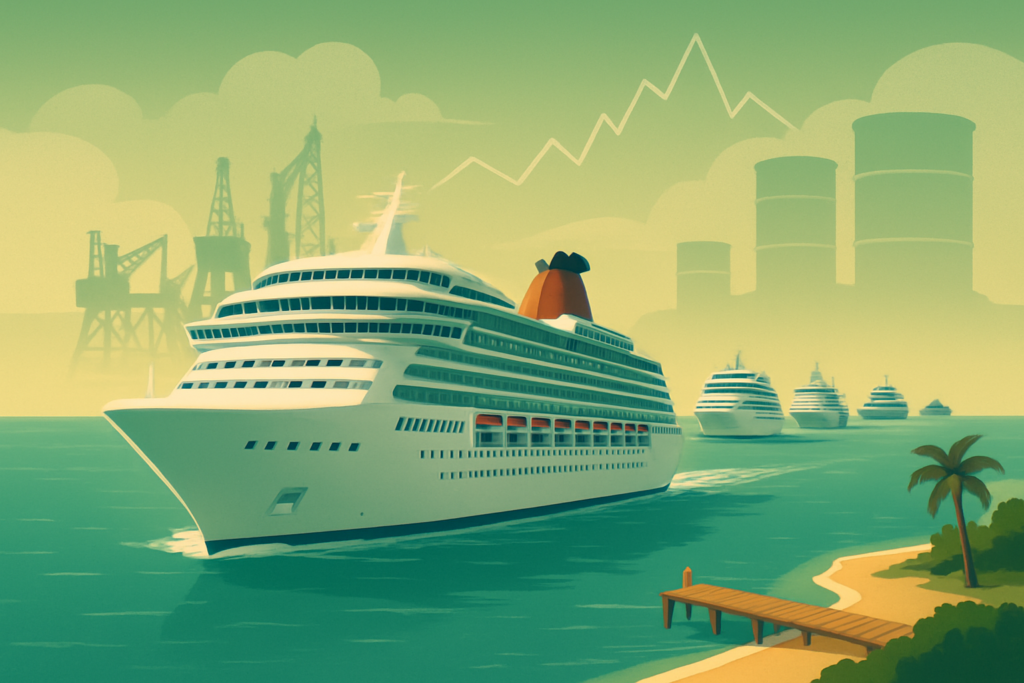
As of today, April 9, 2026, the global travel industry finds itself at a crossroads that few analysts predicted eighteen months ago. For Carnival Corp (NYSE: CCL), the world’s largest cruise operator, the last quarter has been a masterclass in volatility. After a blistering 2025 that saw the industry finally shed the last of its "pandemic-era" labels, a sudden surge in global energy prices has threatened to derail the most significant travel rally in a decade.
This deep dive explores how Carnival is navigating a landscape defined by record-breaking demand on one side and a crushing $126-per-barrel oil reality on the other.
Introduction
Carnival Corp (NYSE: CCL) is currently the focal point of a heated debate on Wall Street: Can operational efficiency and record demand overcome the structural vulnerability of unhedged fuel costs? In early 2026, the "revenge travel" trend transitioned into a sustainable "lifestyle travel" era, bolstered by the One Big Beautiful Bill Act (OBBBA) tax incentives that kept American wallets open. However, the geopolitical shock in the Middle East in March 2026 sent bunker fuel prices soaring, causing a sharp reversal in cruise stocks that had previously been the darlings of the discretionary sector. For Carnival, the challenge is existential yet filled with opportunity, as the company seeks to prove that its massive scale is a shield, not an anchor.
Historical Background
Founded in 1972 by Ted Arison with a single refurbished ship, the Mardi Gras, Carnival Cruise Line began as a "fun ship" alternative to the more formal cruising traditions of the time. The company’s trajectory was defined by aggressive acquisition and consolidation. Throughout the 1980s and 90s, Carnival transformed into a global powerhouse by acquiring iconic brands like Holland America Line, Princess Cruises, and Seabourn.
By the early 2000s, the merger with P&O Princess Cruises established Carnival Corporation & plc as the undisputed titan of the seas. However, the company faced its greatest trial during the 2020-2022 period, when the COVID-19 pandemic forced a total cessation of operations, leading to a debt-fueled survival strategy that fundamentally altered its balance sheet. The story of Carnival since 2023 has been one of "The Great Deleverage," as the company works to pay down the billions in high-interest debt taken on during the shutdown.
Business Model
Carnival operates as a "house of brands," managing nine distinct cruise lines including Carnival Cruise Line, Princess Cruises, Holland America Line, P&O Cruises, and the ultra-luxury Seabourn. This multi-brand strategy allows the company to capture every segment of the market, from budget-conscious families in the Caribbean to affluent retirees exploring Antarctica.
Revenue is split between two primary streams:
- Ticket Sales: The base fare for the cruise.
- Onboard Spending: High-margin revenue from casinos, specialty dining, beverages, and shore excursions. In Q1 2026, onboard spending reached a record 8.3% increase year-over-year, proving that once passengers are on the ship, their propensity to spend remains high despite broader inflationary pressures.
The company’s massive scale (over 90 ships) provides significant purchasing power and operational synergies, though it also creates a massive logistical footprint sensitive to port regulations and environmental mandates.
Stock Performance Overview
The last five years for CCL have been a rollercoaster. After bottoming out during the pandemic, the stock saw a slow recovery until 2024-2025, when a surge in bookings sent shares back toward the $30 range.
- 1-Year Performance: Up approximately 12%, though this figure masks a 25% rally followed by a sharp 15% pullback in March 2026 due to the oil shock.
- 5-Year Performance: The stock is still recovering from the massive dilution and debt issuance of 2020, remaining well below its pre-pandemic highs of $50+.
- Recent Moves: As of April 8, 2026, CCL saw a "buzzer-beater" rally of 10% in a single session, climbing back to $27.00 on news of a potential de-escalation in the Middle East that could lower fuel costs.
Financial Performance
In its Q1 2026 earnings report, Carnival shocked the market with a record $6.2 billion in revenue. For the first time since the pandemic, the company’s net income has stabilized, reporting $258 million in profit for the quarter.
- Margins: Adjusted EBITDA margins have improved as the company optimizes its fleet, though the projected spike in bunker fuel to $795 per metric ton in Q2 2026 is expected to compress margins temporarily.
- Debt: Total debt has been reduced to $25.3 billion, a significant improvement from the $30 billion peak.
- Valuation: Trading at an forward P/E that remains attractive compared to the broader S&P 500, provided that the energy crisis is transitory.
Leadership and Management
Under CEO Josh Weinstein, Carnival has shifted away from the "newbuild arms race" that defined the industry for decades. Weinstein’s strategy, titled the PROPEL framework, focuses on ROIC (Return on Invested Capital) rather than just capacity growth. Management has been praised for its "operational agility," including the decision to prioritize ship revitalization over expensive new orders. This capital discipline is a sharp departure from the previous leadership's focus on aggressive expansion and is seen as the primary reason for the company's stabilizing credit rating.
Products, Services, and Innovations
Carnival’s recent innovation focus is on "destination control." The development of Celebration Key, a massive private destination in the Bahamas, allows Carnival to capture 100% of the port spending that would otherwise go to third-party vendors.
Technologically, the company continues to roll out its "OceanMedallion" wearable across more brands, using AI to personalize guest experiences and streamline onboard logistics. In terms of sustainability, Carnival is a leader in LNG (Liquefied Natural Gas) powered vessels, though these still represent a minority of the total fleet.
Competitive Landscape
The "Big Three" cruise operators remain in a fierce battle for market share:
- Royal Caribbean (NYSE: RCL): Currently the "safe haven" for investors. RCL’s aggressive fuel hedging strategy (60% hedged for 2026) has protected its stock price during the recent oil surge, with shares trading near $280.
- Norwegian Cruise Line Holdings (NYSE: NCLH): Struggling with higher leverage and a smaller fleet, NCLH is often viewed as the higher-beta play in the sector.
- Market Share: Carnival still holds the largest share of total passengers globally, but Royal Caribbean has overtaken it in terms of total market capitalization due to higher margins and a premium brand perception.
Industry and Market Trends
The "reversal of the travel rally" is the dominant theme of April 2026. While demand remains "historically high"—with 85% of 2026 capacity already booked—the cost of delivery is rising. We are seeing a trend toward shorter, "close-to-home" cruises that require less fuel than trans-oceanic voyages. Additionally, the industry is seeing a demographic shift, as Millennials and Gen Z now represent the fastest-growing segments of the cruise market, attracted by the all-inclusive value proposition during inflationary periods.
Risks and Challenges
The most immediate risk is unhedged fuel exposure. Carnival’s policy of not hedging fuel means that for every 10% increase in oil prices, net income drops by approximately $145 million. This makes CCL a "geopolitical proxy" stock.
Other risks include:
- Debt Servicing: While reduced, $25 billion in debt remains sensitive to high interest rates.
- Environmental Regulation: New carbon taxes and "green port" mandates in Europe are increasing the cost of operations for older, less efficient ships.
Opportunities and Catalysts
The primary catalyst for 2026 is the $2.5 billion share buyback program and the resumption of dividends. If oil prices stabilize below $90, the massive cash flow generated by record bookings will flow straight to the bottom line, likely leading to a significant re-rating of the stock. Furthermore, the opening of Celebration Key in 2025/2026 is expected to be a major margin expander for the Carnival Cruise Line brand.
Investor Sentiment and Analyst Coverage
Wall Street remains "Moderately Bullish." Out of 27 analysts covering the stock, 21 maintain "Buy" ratings. While price targets were trimmed in March 2026 to reflect energy costs, the consensus target of $34.17 implies significant upside from current levels. Institutional ownership remains high at nearly 70%, with firms like BlackRock and Vanguard maintaining large core positions.
Regulatory, Policy, and Geopolitical Factors
Geopolitics are the "elephant in the room." The closure of certain shipping lanes in the Middle East has forced expensive reroutings for the world cruise segments. On the domestic front, the OBBBA policy has provided a floor for consumer demand, but any shift in U.S. fiscal policy following the 2026 mid-term elections could impact the discretionary spending power of Carnival’s core North American customer base.
Conclusion
As of April 9, 2026, Carnival Corp is a company caught between two worlds. Its operational performance has never been stronger, with record bookings and a revitalized fleet proving that the cruise product is more popular than ever. Yet, its vulnerability to external shocks—specifically energy prices—continues to create a "risk discount" on the stock.
For investors, the takeaway is clear: Carnival is no longer a "recovery play"; it is a "leverage play" on the global economy and energy stability. If the current oil spike proves to be a temporary geopolitical fever, Carnival is poised to lead the travel sector higher. If $120 oil is the new normal, the company’s path to pre-pandemic glory will be significantly longer and more arduous. Investors should watch the Q2 2026 fuel cost realizations and the progress of the PROPEL framework as the primary indicators of long-term health.
This content is intended for informational purposes only and is not financial advice.