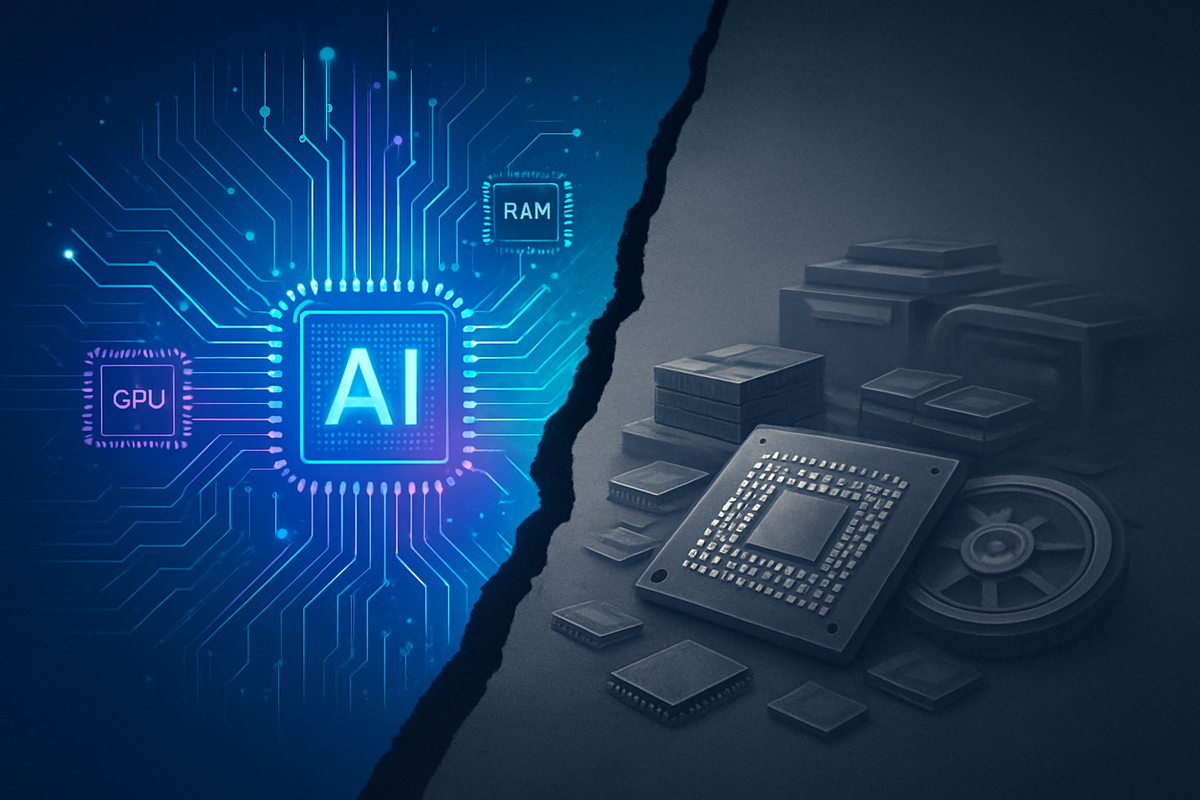
The global semiconductor industry, a bellwether for technological advancement, finds itself navigating a complex and bifurcated landscape as 2025 draws to a close. While the overarching narrative points towards a robust recovery and projected expansion, fueled almost entirely by an insatiable demand for Artificial Intelligence (AI) related hardware, a closer inspection reveals a challenging "slump" in specific sectors. This creates a divergent market reality where titans of AI innovation are soaring, while traditional segments like automotive and industrial electronics grapple with inventory corrections, softening demand, and the lingering specter of geopolitical tensions.
This intricate market dynamic signals a significant recalibration within the semiconductor ecosystem, forcing companies to strategically pivot and adapt. The immediate implication is a widening gap between those poised to capitalize on the AI revolution and those facing headwinds in more mature or cyclical markets, setting the stage for a period of intense competition and strategic re-evaluation across the industry.
A Tale of Two Markets: AI's Ascent Amidst Sectoral Headwinds
The semiconductor market's trajectory through 2024 and into 2025 has been anything but uniform, painting a picture of dramatic divergence rather than a monolithic slump. Following a notable decline in 2023, the industry staged a significant comeback in 2024, with sales surging by 19% year-over-year. This upward momentum is projected to continue into 2025, with market forecasts from World Semiconductor Trade Statistics (WSTS) anticipating an 11% increase, potentially pushing total revenue towards $697 billion. Some optimistic analyses even suggest surpassing $800 billion in 2025, representing nearly 20% growth. However, these impressive figures are predominantly powered by the unprecedented demand for Artificial Intelligence (AI) chips, particularly Graphics Processing Units (GPUs) and high-bandwidth memory (HBM), which alone accounted for over $125 billion in sales in 2024 and are expected to exceed $150 billion in 2025.
The timeline leading to this current state has been marked by several key developments. The initial post-pandemic surge in demand, followed by supply chain disruptions, led to a period of over-ordering and inventory build-up in many sectors. By late 2023 and early 2024, a correction began, particularly in consumer electronics and, subsequently, in the automotive and industrial segments. Simultaneously, the rapid advancements and widespread adoption of generative AI applications ignited an explosive demand for specialized processing power, creating a parallel, booming market. Geopolitical tensions, notably between the US and China, have further complicated the landscape, leading to export restrictions on advanced chip technology and a global push towards supply chain de-risking and domestic manufacturing, epitomized by initiatives like the US CHIPS Act.
Key players like Nvidia (NASDAQ: NVDA) have emerged as undisputed leaders in the AI chip space, solidifying their dominance with high-performance GPUs. Memory manufacturers such as SK Hynix (KRX: 000660), Micron Technology (NASDAQ: MU), and Samsung Semiconductor (KRX: 005930) have also seen a resurgence, strategically shifting production towards HBM to cater to AI servers. However, away from the AI spotlight, companies heavily reliant on the automotive and industrial sectors, including Infineon Technologies (FWB: IFX), Texas Instruments (NASDAQ: TXN), NXP Semiconductors (NASDAQ: NXPI), and Renesas Electronics (TYO: 6723), have reported anticipated revenue declines and are navigating a period of inventory adjustments and weaker end-market demand. Initial market reactions reflect this bifurcation, with AI-centric stocks enjoying robust valuations while others face investor skepticism and pressure to diversify or streamline operations.
Navigating the Crosscurrents: Winners and Losers in a Divided Market
The current semiconductor landscape presents a stark contrast, creating clear winners and a growing list of companies grappling with significant challenges. On the winning side, firms deeply entrenched in the Artificial Intelligence ecosystem are experiencing unprecedented growth. Nvidia (NASDAQ: NVDA), for instance, continues to be a primary beneficiary, with its AI GPUs becoming the backbone of data centers and cloud infrastructure powering generative AI. Its formidable market position, coupled with relatively limited competition in its high-end segment, has translated into soaring revenues and market capitalization. Similarly, companies like Broadcom (NASDAQ: AVGO), known for its networking chips and custom silicon solutions that support AI infrastructure, are seeing strong demand. Memory giants such as SK Hynix (KRX: 000660) and Micron Technology (NASDAQ: MU) are also firmly in the "winners" category, driven by the explosion in demand for High Bandwidth Memory (HBM) – a critical component for AI accelerators. These companies are strategically retooling their production lines to maximize HBM output, directly benefiting from the AI boom.
Conversely, a significant number of semiconductor companies, particularly those with a heavy reliance on traditional industrial, automotive, and broader consumer electronics markets, are facing considerable headwinds. Texas Instruments (NASDAQ: TXN), a broad-based analog and embedded processing chipmaker, has acknowledged a weaker demand environment in industrial and automotive sectors, leading to inventory adjustments and revenue pressures. Similarly, Infineon Technologies (FWB: IFX), a major supplier of power semiconductors and microcontrollers for automotive and industrial applications, has lowered its outlook, citing a slowdown in these key segments. NXP Semiconductors (NASDAQ: NXPI), another prominent player in automotive and industrial markets, is also navigating a period of reduced demand and inventory rebalancing among its customers. Renesas Electronics (TYO: 6723), a Japanese semiconductor manufacturer specializing in microcontrollers and automotive chips, is experiencing similar challenges, as the automotive sector, after a period of robust demand, now faces a correction.
These companies are directly impacted by the cyclical nature of their end markets, which are currently experiencing a downturn contrasting sharply with the AI surge. The automotive industry, in particular, has seen a slowdown in production and a need to deplete existing chip inventories, directly affecting the order books of these suppliers. For these "losers," the slump means tighter margins, potential revenue contractions, and increased pressure to innovate, diversify their customer base, or find new growth vectors outside their traditional strongholds. The disparity highlights the industry's uneven recovery, where the rising tide of AI is not lifting all boats equally, forcing a strategic re-evaluation for many established players.
Wider Significance: Reshaping the Global Semiconductor Landscape
The current bifurcated state of the semiconductor market extends far beyond individual company balance sheets, carrying profound implications for broader industry trends, geopolitical dynamics, and long-term technological trajectories. This event fits squarely into the ongoing narrative of technological transformation, where Artificial Intelligence is not merely an incremental improvement but a foundational shift demanding entirely new hardware architectures and manufacturing capabilities. The intense focus on AI chips is accelerating innovation in areas like advanced packaging, heterogeneous integration, and specialized processor design, pushing the boundaries of what's possible in computing. This trend also underscores the growing importance of software-hardware co-design, as chipmakers work more closely with AI developers to optimize performance.
The ripple effects on competitors and partners are significant. For companies not directly involved in AI chip manufacturing, the challenge is to either find niches that support the AI ecosystem (e.g., power management, cooling solutions, memory for AI) or to innovate in their traditional markets to withstand the downturn. Foundries like Taiwan Semiconductor Manufacturing Company (TSMC) (TPE: 2330) are critical beneficiaries of the AI boom, as they are the primary manufacturers of advanced AI chips, but they also face the immense capital expenditure requirements and technological hurdles associated with producing these cutting-edge components. Equipment suppliers, such as ASML Holding (AMS: ASML), continue to be vital, as their advanced lithography tools are indispensable for producing the most sophisticated chips, regardless of end-market application. However, their order books can be influenced by the capital expenditure plans of IDMs and foundries, which are subject to market demand fluctuations.
Regulatory and policy implications are also at the forefront. The "chip war" between the US and China continues to escalate, with both nations viewing semiconductor leadership as a matter of national security and economic dominance. The US CHIPS and Science Act, and similar initiatives in Europe and Japan, aim to onshore or "friendshore" semiconductor manufacturing, reducing reliance on potentially volatile supply chains. This leads to massive government subsidies and incentives, reshaping investment decisions and potentially creating regional manufacturing hubs. However, these policies also risk fragmenting the global supply chain, increasing costs, and potentially leading to overcapacity in certain segments while bottlenecks persist in others. Historically, semiconductor cycles have been characterized by boom and bust periods, often tied to macroeconomic conditions or major technological shifts (e.g., the PC era, the mobile era). This current period, however, is unique due to the unprecedented scale of AI demand and the intertwining of technological and geopolitical competition, suggesting a more structural, rather than purely cyclical, reshaping of the industry.
What Comes Next: Navigating the Future of Silicon
Looking ahead, the semiconductor industry stands at a pivotal juncture, with both short-term adjustments and long-term strategic realignments on the horizon. In the short term, the market will likely continue its bifurcated trajectory. The robust demand for AI-centric chips is expected to persist, driving further investment in advanced manufacturing capacities and research & development for next-generation AI accelerators. Companies like Nvidia (NASDAQ: NVDA), Broadcom (NASDAQ: AVGO), and memory providers like SK Hynix (KRX: 000660) and Micron Technology (NASDAQ: MU) will continue to capitalize on this wave. However, the traditional segments, particularly automotive and industrial, may face ongoing inventory corrections and slower recovery through early to mid-2026. This will necessitate strategic pivots for companies like Texas Instruments (NASDAQ: TXN), Infineon Technologies (FWB: IFX), and NXP Semiconductors (NASDAQ: NXPI), potentially involving a re-evaluation of product portfolios, cost-cutting measures, and a renewed focus on emerging opportunities within their respective markets.
Long-term possibilities include a continued push towards specialized silicon, moving beyond general-purpose computing to highly optimized chips for specific AI workloads (e.g., inference at the edge, large language model training). This could foster a new wave of innovation and market entrants. The geopolitical landscape will also remain a dominant factor, with ongoing efforts to build resilient, localized supply chains. This might lead to increased capital expenditures for new fabs in the US, Europe, and Japan, potentially reshaping the global manufacturing footprint. Market opportunities will emerge in areas adjacent to AI, such as advanced cooling solutions, power delivery, and secure edge AI devices. The increasing complexity of chip design will also create opportunities for Electronic Design Automation (EDA) software providers.
Potential scenarios range from a "soft landing" where traditional segments gradually recover while AI continues its ascent, to a more volatile "hard landing" if broader economic slowdowns or geopolitical tensions significantly disrupt global trade and investment. A key challenge will be managing the immense capital required for advanced chip manufacturing, which could lead to further consolidation or strategic partnerships within the industry. Companies may need to adapt by diversifying their customer base, investing in R&D for next-generation technologies, and building more flexible and resilient supply chains. The drive for sustainability and energy efficiency in AI hardware will also become increasingly critical, presenting both challenges and opportunities for innovation.
The Silicon Crossroads: A Market Transformed
In summary, the semiconductor market, as it approaches the end of 2025, is not experiencing a uniform slump but rather a profound transformation characterized by a "great divide." The key takeaway is the overwhelming dominance of Artificial Intelligence (AI) demand, which is single-handedly fueling a robust recovery and expansion for companies strategically positioned within this ecosystem. This includes chip design powerhouses like Nvidia (NASDAQ: NVDA) and Broadcom (NASDAQ: AVGO), as well as memory specialists such as SK Hynix (KRX: 000660) and Micron Technology (NASDAQ: MU), all of whom are benefiting from the insatiable need for high-performance computing and advanced memory. Conversely, companies heavily reliant on traditional sectors like automotive and industrial, including Texas Instruments (NASDAQ: TXN), Infineon Technologies (FWB: IFX), and NXP Semiconductors (NASDAQ: NXPI), are grappling with inventory corrections and softening demand, highlighting the uneven nature of the market's recovery.
Moving forward, the semiconductor market will continue to be shaped by the interplay of technological innovation, geopolitical dynamics, and macroeconomic conditions. The lasting impact of this period will likely be a more specialized and geographically diversified industry. The relentless pursuit of AI advancements will drive further investment in cutting-edge research, advanced manufacturing techniques, and specialized silicon architectures. Simultaneously, the push for supply chain resilience and national security will accelerate the development of regional manufacturing hubs, albeit potentially at a higher cost.
Investors should closely watch several key indicators in the coming months. These include the sustained growth rates of AI-related revenue for leading chipmakers, the pace of inventory depletion and recovery in the automotive and industrial sectors, and any new developments in international trade policies or government incentives for semiconductor manufacturing. Furthermore, monitoring capital expenditure plans of major foundries and IDMs will provide insights into future capacity and technological advancements. The ability of companies to adapt to these divergent market forces – either by doubling down on AI or by strategically navigating challenges in traditional segments – will ultimately determine their success in this rapidly evolving silicon landscape.
This content is intended for informational purposes only and is not financial advice