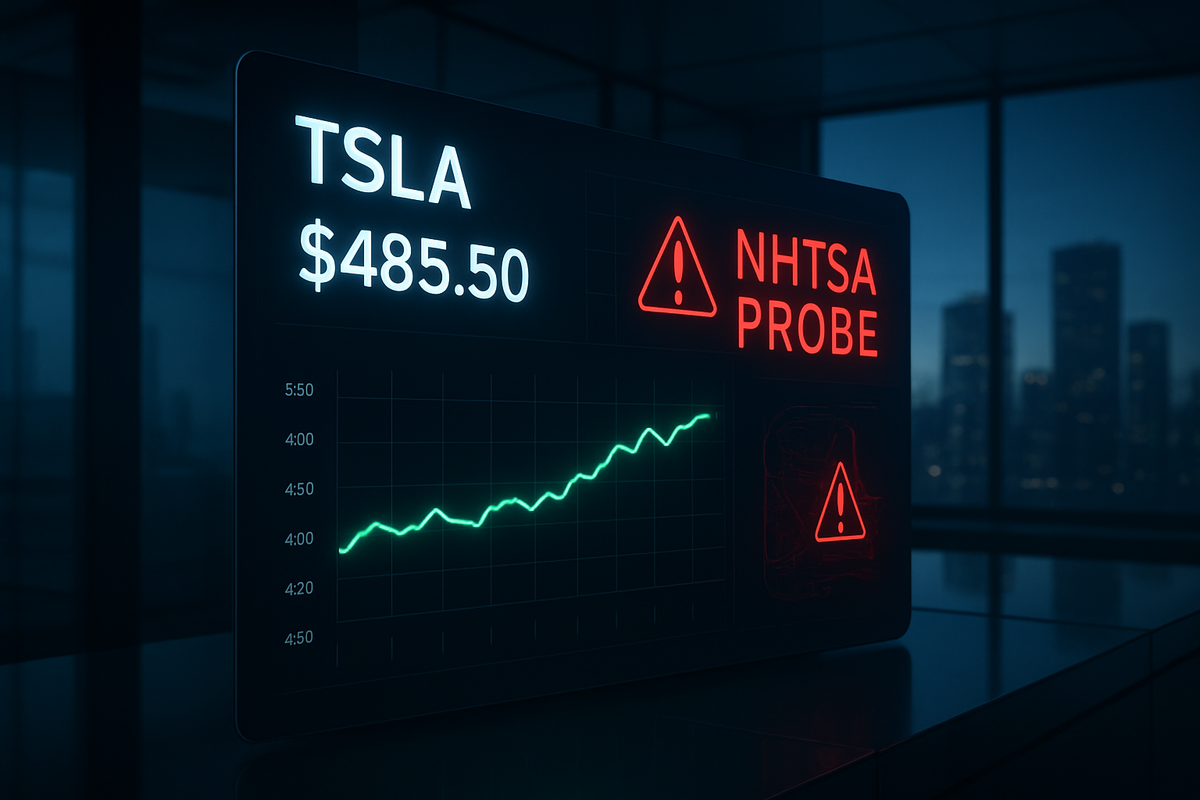
As the sun sets on 2025, Tesla (NASDAQ: TSLA) continues to baffle traditional market logic. On December 24, 2025, shares of the electric vehicle giant remained remarkably steady near the $485.50 level, despite the National Highway Traffic Safety Administration (NHTSA) opening two significant new investigations into the company’s safety protocols. The resilience of the stock highlights a growing "decoupling" between regulatory risk and investor valuation, as the market increasingly treats Tesla as an artificial intelligence powerhouse rather than a conventional automaker.
The latest regulatory friction comes at a time of peak optimism for the company, following a landmark legal victory in Delaware that reinstated CEO Elon Musk’s multibillion-dollar compensation package. While safety advocates sound the alarm over mechanical and software failures, institutional investors appear more focused on Tesla’s record-breaking Q3 deliveries and the successful launch of its "unsupervised" Robotaxi pilot in Austin, Texas.
The Dual Probe: Door Latches and Digital Deviations
The NHTSA’s Office of Defects Investigation (ODI) formally opened a probe on December 24, 2025, focusing on approximately 179,000 Model 3 sedans from the 2022 model year. The investigation centers on a harrowing concern: the mechanical emergency door releases. In the event of a total power loss or a vehicle fire—scenarios where electronic latches frequently fail—passengers have reported being unable to find or operate the manual overrides. The probe was triggered by a petition citing a crash where a driver was forced to break a window to escape a fire, resulting in severe physical injuries. Critics argue these releases are "hidden and non-intuitive," creating a potential death trap during high-stress emergencies.
Simultaneously, the agency is deepening its scrutiny of Tesla’s Full Self-Driving (FSD) software. Following an earlier October investigation into 2.88 million vehicles, the NHTSA is now reviewing 58 specific reports of "induced vehicle behavior" that violates traffic laws. These incidents include FSD-enabled cars allegedly running red lights, entering one-way streets in the wrong direction, and failing to yield at busy intersections. The agency’s objective is to determine whether the system’s programming fails to "forestall the driver’s supervision" when dangerous maneuvers occur unexpectedly, a move that could lead to a massive software-based recall.
The timeline of these events suggests a tightening net around Tesla’s autonomous ambitions. Throughout 2025, the company has pushed the boundaries of its FSD v13 software, aiming for a "1.5 million miles per critical intervention" milestone. However, the NHTSA’s aggressive stance reflects a federal government increasingly wary of the "move fast and break things" approach to public road safety. Despite these headwinds, the initial market reaction on Christmas Eve was one of calm, with trading volume remaining consistent as the $485 support level held firm.
Market Bifurcation: The Winners and Losers of the AI Shift
The late-2025 market landscape has created a stark divide between those who have embraced the "Software-Defined Vehicle" (SDV) era and those struggling to pivot. Rivian (NASDAQ: RIVN) has emerged as a primary beneficiary of Tesla’s high valuation, with its shares up 63% year-to-date. By hosting its own "Autonomy Day" and partnering with Volkswagen, Rivian has successfully positioned itself as the "leaner, more credible" alternative to Tesla, attracting investors who want exposure to EV growth without the regulatory baggage associated with the Musk brand.
Conversely, legacy giants like Ford (NYSE: F) and General Motors (NYSE: GM) find themselves in a challenging "hardware trap." While GM has maintained profitability through its internal combustion engine business, both companies have scaled back their pure-EV ambitions in late 2025. Ford’s decision to discontinue the electric F-150 Lightning in favor of hybrids was viewed by analysts as a concession of the high-tech EV crown to Tesla. Meanwhile, Lucid (NASDAQ: LCID) continues to struggle with cash burn, its stock plummeting nearly 29% in the final quarter of 2025 as it fails to achieve the scale necessary to compete with the industry leader.
The "autonomous arms race" has also minted winners in the semiconductor and insurance sectors. NVIDIA (NASDAQ: NVDA) remains the ultimate "arms dealer," providing the H-series clusters essential for Tesla’s neural network training. In the insurance world, Tesla’s vertical integration is disrupting traditional players. While Tesla Insurance expanded to 13 states by December 2025, legacy insurers like Allstate (NYSE: ALL) and GEICO are facing headwinds as they struggle to adapt their actuarial models to AI-driven risk. However, Tesla’s insurance division itself faces scrutiny, reporting a 92.5% loss ratio that some analysts call "unsustainable" despite its strategic importance.
A New Precedent: Decoupling Safety from Valuation
The current event fits into a broader industry trend dubbed the "Great Recalibration." For decades, a major NHTSA probe would have sent an automaker’s stock into a tailspin. In 2025, however, Tesla’s valuation is driven by its "AI and Physical Robotics" potential rather than its safety record. The successful deployment of the "Optimus" robot in Tesla factories and the Robotaxi launch have created a "valuation shield," where investors view safety recalls as minor software patches rather than existential threats.
This shift has significant regulatory implications. The California DMV recently issued a 30-day sales suspension order against Tesla for "misleading" FSD marketing—a move that would have been catastrophic for any other brand. Yet, the market’s shrug suggests that investors believe Tesla has reached a "too big to fail" status in the autonomous sector. This creates a historical precedent where a company’s technological lead provides enough leverage to navigate—or even ignore—traditional regulatory hurdles that would cripple a legacy manufacturer.
The ripple effects are being felt by partners and competitors alike. As Tesla moves toward a per-mile insurance model based on real-time Safety Score data, the entire automotive ecosystem is being forced to rethink liability. If Tesla can prove that its AI is statistically safer than a human—despite the NHTSA probes—it could force a total overhaul of federal safety standards, moving away from hardware mandates toward software-performance benchmarks.
The Road Ahead: FSD v13 and the 2026 Outlook
Looking forward to 2026, Tesla faces a critical junction. In the short term, the company must resolve the NHTSA’s concerns regarding the Model 3 door releases, likely through a hardware retrofit that could impact margins. More significantly, the outcome of the FSD "traffic violation" probe will determine the pace at which Tesla can scale its Robotaxi service beyond Austin. If the NHTSA mandates restrictive "geofencing" or hardware redundancies, Tesla’s path to a multi-trillion-dollar valuation could face significant delays.
Strategically, Tesla may be forced to pivot its marketing. To appease regulators, the company might move away from the "Full Self-Driving" branding in favor of more technical, less emotive terminology, similar to the "Autonomy+" branding used by Rivian. The emergence of FSD v13 will be the ultimate litmus test; if the software can achieve the promised intervention-free milestones, the regulatory pressure may eventually give way to a new era of federally sanctioned autonomous transport.
Final Assessment: What Investors Should Watch
The takeaway for the market on December 24, 2025, is clear: Tesla is no longer just a car company. Its ability to hold the $485 level in the face of federal investigations is a testament to the market's belief in its AI-driven future. However, the "recall overhang" remains a persistent risk. A mandated hardware redesign for millions of vehicles or a significant restriction on FSD would test the limits of investor patience and the company’s high Price-to-Earnings ratio.
Moving into the new year, investors should keep a close eye on the NHTSA’s final report on the Model 3 door latches and the progress of the Robotaxi expansion. While the stock’s resilience is impressive, the "Great Recalibration" is not without its dangers. The divide between Tesla’s technological promise and its regulatory reality has never been wider, and how that gap is bridged in 2026 will define the next decade of the automotive industry.
This content is intended for informational purposes only and is not financial advice.