As the final trading days of 2025 approach, a surprising victor has emerged in the global equities market. While the previous two years were dominated by the breakneck growth of artificial intelligence, 2025 has belonged to the "boring" titans of finance. Leading this charge is Citigroup Inc. (NYSE: C), a bank that spent much of the last decade as a pariah of the "Big Four." Today, December 24, 2025, Citigroup stands as the sector’s top performer, boasting a staggering 68% year-to-date gain and finally shedding its reputation as a perpetual turnaround story.
The immediate implications are profound: the banking sector’s resurgence signals a massive rotation of capital away from speculative tech and toward tangible, cash-flow-positive institutions. With the Federal Reserve recently lowering the federal funds rate to a target range of 3.50%–3.75% in its December meeting, and a new wave of deregulation sweeping through Washington D.C., the financial industry is entering 2026 with a level of momentum not seen since the pre-2008 era.
The Resurrection of Citi: From 'Bora Bora' to Book Value
The story of Citigroup’s outperformance is inseparable from the completion of "Project Bora Bora," the ambitious restructuring plan launched by CEO Jane Fraser in late 2023. For years, investors viewed Citi as a sprawling, inefficient bureaucracy. However, by the end of 2025, the bank successfully flattened its management structure from 13 layers to just eight, eliminated over 60 redundant committees, and completed the lion’s share of its 20,000-job headcount reduction.
The timeline of this transformation reached a fever pitch in the second half of 2025. In June, Wells Fargo & Company (NYSE: WFC) saw its long-standing $1.95 trillion asset cap finally removed, which many expected would steal the spotlight. Instead, Citigroup stole the headlines in August by hitting its aggressive $53.4 billion expense target. This was followed by the December sale of a 25% equity stake in Banamex to Mexican billionaire Fernando Chico Pardo for $2.3 billion, a move that de-risked the bank’s balance sheet and signaled the end of its messy international consumer exits.
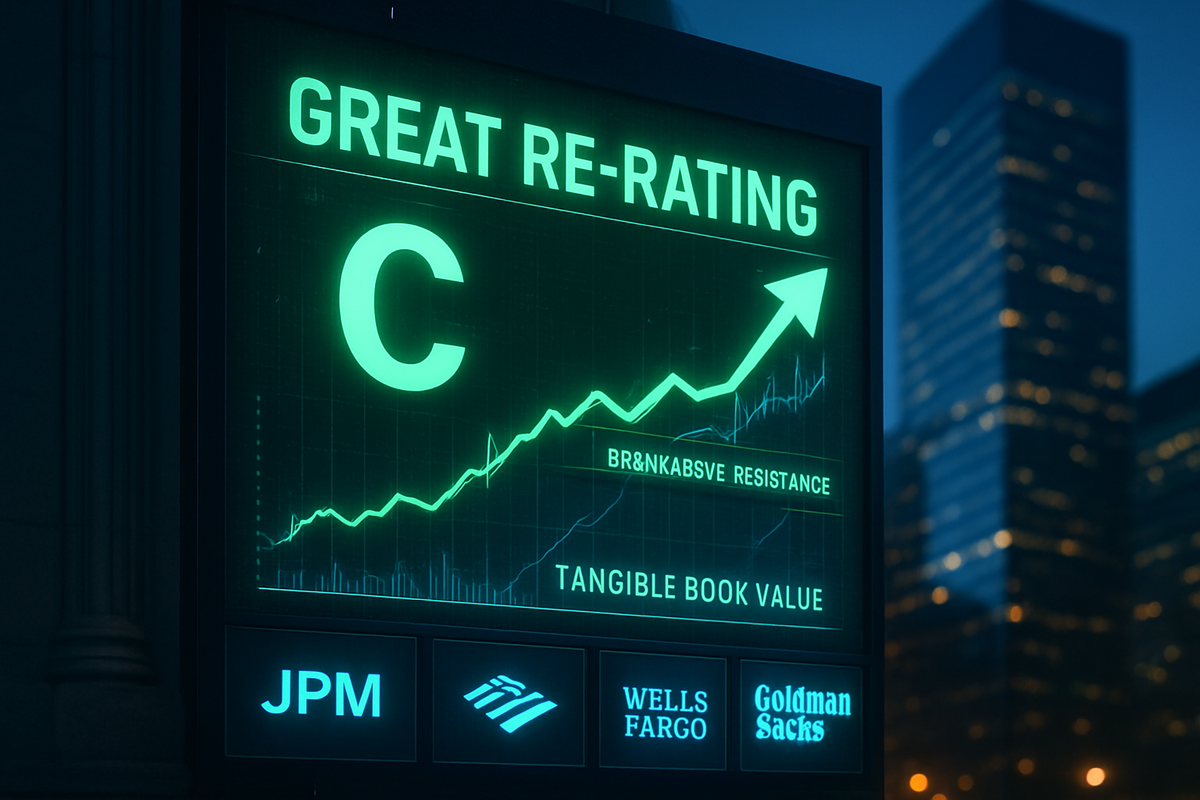
Initial market reactions to Citi’s Q3 2025 earnings—which featured a 34% surge in investment banking fees—were explosive. For the first time in seven years, Citigroup’s stock price, currently hovering around $119, has surpassed its tangible book value. This "re-rating" is a psychological milestone for the market, proving that investors no longer demand a discount for the complexity of Citi’s operations.
Winners and Losers in the New Financial Order
The primary winners of the 2025 banking boom are the "Big Four" and large regional players. JPMorgan Chase & Co. (NYSE: JPM) has continued its dominance, with net income hitting $14.4 billion in Q3, up 12% year-over-year. Meanwhile, Bank of America Corp. (NYSE: BAC) has leveraged a 43% jump in investment banking fees to post an impressive 23% rise in net income. These institutions have benefited from a "Goldilocks" environment: interest rates high enough to maintain decent net interest margins, but low enough to spark a resurgence in M&A activity.
Regional banks have also found a second wind. Institutions like PNC Financial Services Group, Inc. (NYSE: PNC) and U.S. Bancorp (NYSE: USB) were the beneficiaries of a significant softening of the "Basel III Endgame" regulatory proposal. Originally expected to face a 16% hike in capital requirements, the final 2025 rules slashed that increase to just 9%, while exempting most banks with under $250 billion in assets from the most stringent liquidity rules.
On the losing side are the smaller community banks and certain fintech disruptors. While the large caps are enjoying a "lighter touch" from regulators like the OCC and the CFPB, smaller banks are still struggling with the cost of legacy technology. Furthermore, the 2025 administration's focus on traditional banking has stripped some of the "regulatory arbitrage" advantages previously enjoyed by non-bank lenders and "Buy Now, Pay Later" firms, many of which have seen their valuations stagnate as capital returns to the regulated giants.
A Paradigm Shift in Regulation and Industry Trends
The wider significance of this event lies in the dramatic shift in the regulatory and political landscape. The year 2025 marked the rise of the Department of Government Efficiency (DOGE), which has targeted the bureaucratic overhead of federal financial regulators. This shift has led to a more lenient merger review process, sparking a wave of consolidation that analysts believe will continue well into 2026.
Historically, this period draws comparisons to the post-2016 deregulation rally, but with a key difference: the banks are now much better capitalized. The softening of Basel III is not a return to the "Wild West" of 2007, but rather a recognition that the "higher for longer" rate environment of 2023-2024 proved the resilience of the current system. The trend toward "de-banking" or using reputation risk to target specific industries has also been curtailed by executive order, providing banks with more freedom to lend across the energy and defense sectors.
Furthermore, the industry is seeing a shift in focus from pure retail banking to "Services" and "Wealth Management." Citigroup’s Services division, which handles global cash management for corporations, saw its best quarter ever in late 2025. This move toward fee-based, capital-light revenue streams is the new blueprint for the entire sector, as banks seek to insulate themselves from future interest rate volatility.
The Road Ahead: 2026 and Beyond
Looking forward, the short-term outlook remains bullish, but not without risks. The Federal Reserve’s "hawkishly neutral" stance suggests that while rates are coming down, they won't return to the zero-bound levels of the 2010s. This is a double-edged sword: it supports net interest income but keeps borrowing costs high for consumers. Analysts are closely watching for potential strategic pivots in the wealth management space, as Morgan Stanley (NYSE: MS) and The Goldman Sachs Group, Inc. (NYSE: GS) ramp up competition for high-net-worth clients.
A major challenge emerging for 2026 is the potential for tariff-related economic friction. If global trade tensions escalate, the very international networks that have made Citigroup a winner in 2025 could become liabilities. Additionally, while the Banamex IPO is slated for 2026, any significant market volatility could force further delays, testing the patience of investors who have grown accustomed to Citi’s recent streak of "promises kept."
Closing Thoughts for the Modern Investor
The banking sector’s performance in 2025 has been a masterclass in operational discipline and regulatory navigation. Citigroup, once the industry’s laggard, has successfully rebranded itself as a lean, focused institution. The market has rewarded this clarity with a historic valuation re-rating that has lifted the entire sector.
As we move into 2026, investors should keep a close eye on three key metrics: the pace of credit cost increases as the labor market cools, the total volume of M&A activity in a deregulated environment, and the final execution of the Banamex IPO. While the "easy money" from the 2025 rally may have been made, the fundamental health of the banking sector has not been this robust in nearly two decades. The "Great Re-Rating" may just be the beginning of a new era for American finance.
This content is intended for informational purposes only and is not financial advice.