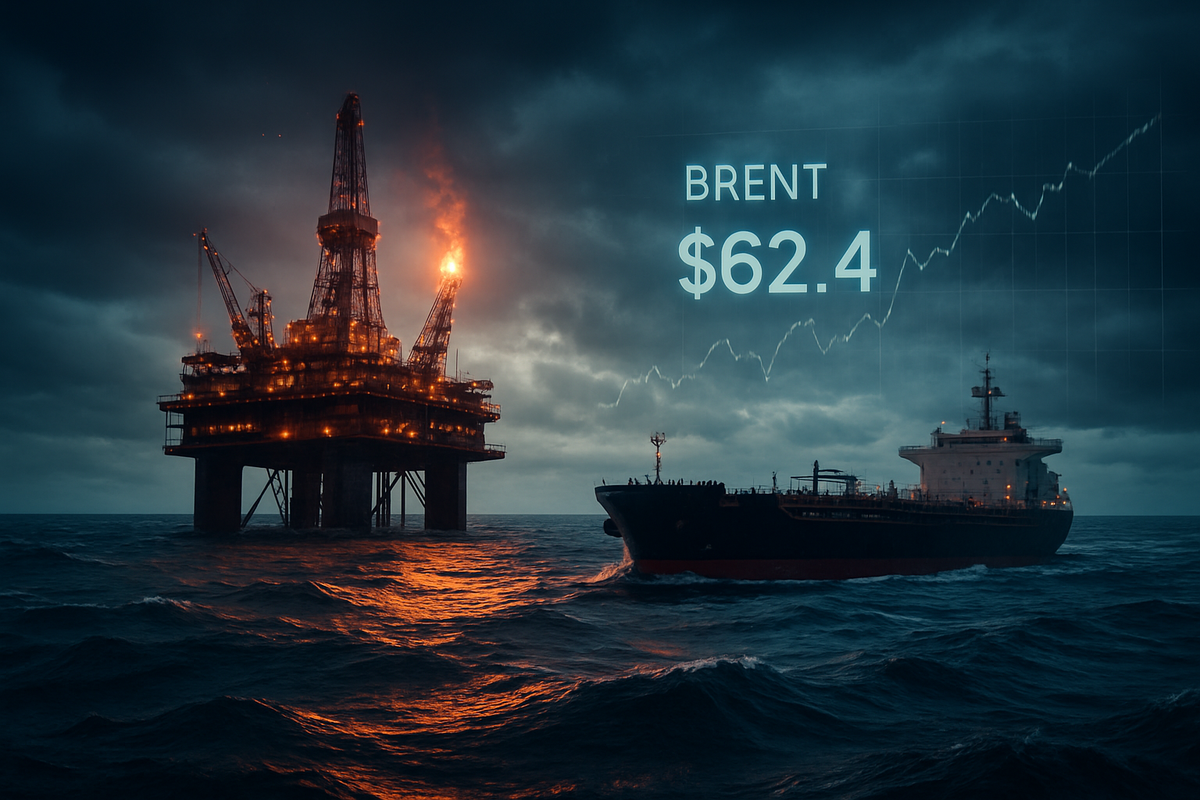
Brent crude oil futures climbed to $62.4 per barrel on Friday, December 26, 2025, marking a sharp reversal from mid-month lows and securing a significant weekly gain. This rally comes as a series of geopolitical flashpoints—ranging from a U.S. naval blockade in the Caribbean to drone strikes on critical Eurasian energy infrastructure—have re-injected a substantial risk premium into a market that was previously bracing for a supply glut.
The price recovery, which saw Brent bounce from a five-year low of $59 per barrel reached just ten days ago, reflects a sudden shift in trader sentiment. While long-term concerns regarding global demand remain, the immediate threat of supply disruptions and a strategic pivot by the OPEC+ alliance have provided a firm floor for prices heading into the new year.
A Perfect Storm of Supply Disruptions and Strategic Pauses
The primary driver behind the late-December surge is an escalating "oil quarantine" enforced by the United States against Venezuela. In a series of aggressive maritime maneuvers, the U.S. Coast Guard and naval assets have moved to intercept and seize tankers suspected of participating in the "shadow fleet" that sustains the Maduro administration. Notable incidents involving the tankers Skipper, Centuries, and Bella 1 have signaled a zero-tolerance policy for sanctioned shipments, effectively tightening the Atlantic basin market.
Simultaneously, the conflict in Eastern Europe has taken a direct toll on physical supply. Ukrainian drone campaigns have expanded their reach, successfully targeting the Caspian Pipeline Consortium (CPC) terminal on the Black Sea coast. This strike is estimated to have removed nearly 500,000 barrels per day (bpd) from the global market for the remainder of December. Furthermore, continued uncertainty surrounding a Gaza ceasefire and U.S. military activity against ISIS cells in Nigeria have contributed to a heightened sense of fragility in global energy corridors.
On the policy front, the OPEC+ alliance, led by Saudi Arabia and Russia, has moved to stabilize the market. While the group followed through on a scheduled production increase of 137,000 bpd for December, they surprised analysts during their recent ministerial meetings by agreeing to pause all planned production hikes for the first quarter of 2026. This "layered unwinding" strategy is designed to prevent a projected surplus from overwhelming the market in the coming months.
Energy Majors Rise While Airlines Brace for Impact
The rally in crude prices has provided a timely boost to the world’s largest integrated energy companies. Exxon Mobil Corp. (NYSE: XOM) saw its shares climb to approximately $119.22, nearing its 52-week high, as investors reacted to the improved pricing environment and the company’s robust production profile. Similarly, Chevron Corp. (NYSE: CVX) maintained resilience, trading at $150.50, partially insulated by its unique licensing positions that allow it to operate in volatile regions where others are restricted.
In Europe, Shell PLC (NYSE: SHEL) and BP PLC (NYSE: BP) also captured gains, with Shell’s stock supported by its massive $3.5 billion quarterly share buyback program. BP, meanwhile, benefited from higher integrated margins as European energy security once again became a top-tier concern following the CPC terminal disruption.
Conversely, the transportation sector is navigating the price spike with cautious optimism. Despite the rise in jet fuel costs, Delta Air Lines Inc. (NYSE: DAL) and United Airlines Holdings Inc. (NASDAQ: UAL) have seen their stock prices remain stable, trading at $71.00 and $113.00 respectively. This resilience is attributed to record-breaking holiday travel demand and the fact that oil prices, while rising, remain significantly below the $80-plus levels seen in previous years. Analysts suggest that these carriers' ability to pass through costs via airfare during peak seasons has mitigated the immediate sting of the $62.4 Brent price.
Shifting From Demand Fears to Supply Security
This late-December rally represents a pivot in the broader energy narrative of 2025. For much of the year, the market was dominated by fears of a "structural surplus" driven by slowing economic growth in Asia and the rapid adoption of electric vehicles. However, the events of the past two weeks have reminded the market that geopolitical instability remains the ultimate wild card for energy security.
The crackdown on the "shadow fleet" is a particularly significant trend. By targeting the logistics of sanctioned oil, Western regulators are making it increasingly expensive and risky for non-aligned nations to source cheap, illicit crude. This forces a return to transparent, regulated markets, which naturally exerts upward pressure on benchmark prices like Brent.
Historically, this period mirrors the volatility spikes seen in the early 2020s, yet it occurs within a more disciplined regulatory environment. Governments are increasingly balancing the "energy trilemma"—security, affordability, and sustainability. While the push for green energy continues, the immediate necessity of maintaining stable oil flows to prevent economic shocks has forced a pragmatic re-evaluation of fossil fuel infrastructure protection.
Navigating the 2026 Outlook
Looking ahead to the first quarter of 2026, the market faces a tug-of-war between short-term supply shocks and long-term oversupply projections. The OPEC+ decision to pause production increases until April 2026 suggests that the cartel is prepared to act as a "swing producer" to defend the $60 price floor. If geopolitical tensions in the Black Sea or the Caribbean escalate further, a breach of the $65 or $70 levels cannot be ruled out.
However, the long-term challenge remains the anticipated surge in non-OPEC production from the U.S., Brazil, and Guyana. Companies will likely focus on "value over volume," prioritizing high-margin projects and returning capital to shareholders rather than chasing aggressive production targets. For the airline and logistics sectors, the focus will shift toward fuel hedging strategies and the accelerated adoption of Sustainable Aviation Fuel (SAF) to insulate themselves from future fossil fuel volatility.
A Critical Juncture for Global Markets
The rise of Brent crude to $62.4 per barrel serves as a stark reminder of the fragile balance governing the global economy. While the rally has provided a windfall for energy majors and a reprieve for oil-exporting nations, it introduces new inflationary pressures that central banks will monitor closely as they enter 2026.
Key takeaways for the market include the renewed importance of geopolitical risk premiums and the strategic discipline shown by OPEC+. Moving forward, the market will be defined by how effectively these supply-side shocks are absorbed by a global economy that is still in the midst of a complex energy transition.
Investors and policymakers should keep a close watch on the status of the CPC terminal repairs and any further escalations in the U.S. naval blockade of Venezuela. These factors, combined with the next round of OPEC+ meetings in early 2026, will determine whether this rally is a temporary spike or the beginning of a sustained upward trend in energy costs.
This content is intended for informational purposes only and is not financial advice.