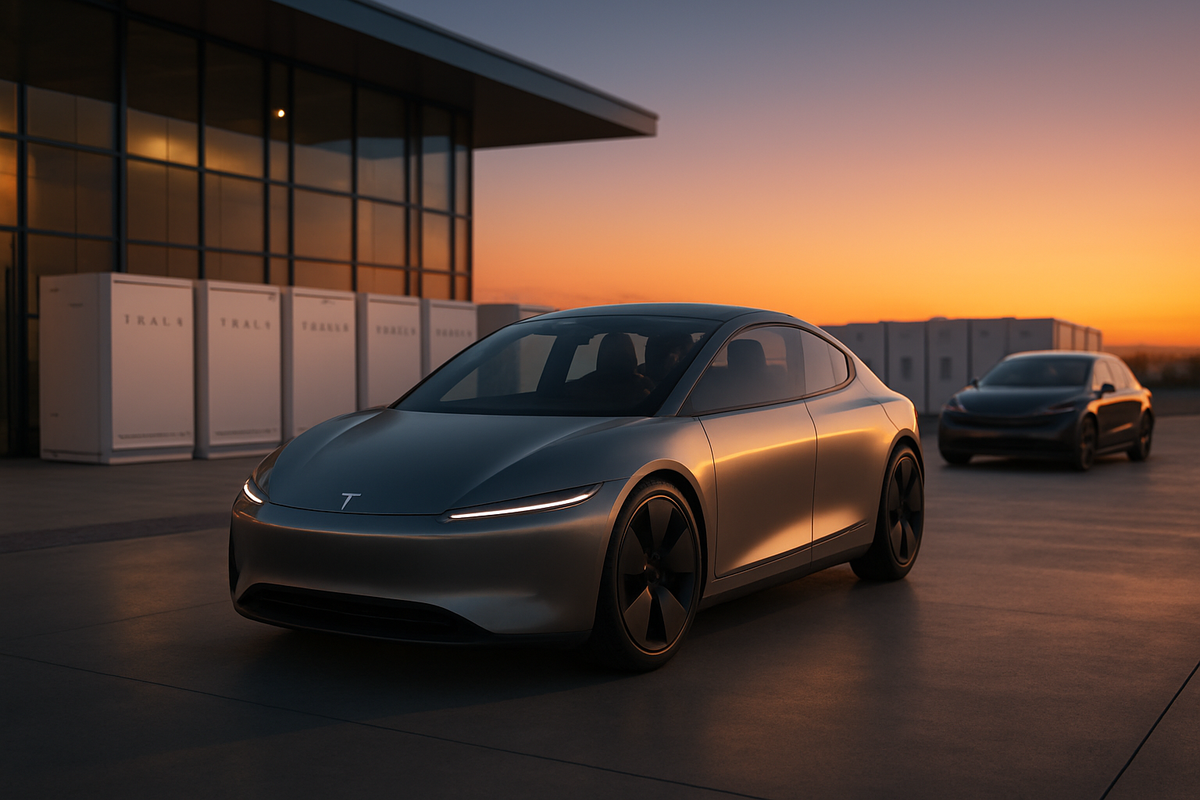
As the curtains close on 2025, Tesla, Inc. (NASDAQ: TSLA) has once again defied the skeptics, orchestrating a massive year-end rally that propelled its market capitalization to a staggering $1.6 trillion. Despite fierce global competition and a shifting regulatory landscape for electric vehicles, the Texas-based titan saw its stock reach a record intraday high of $498.83 on December 22, before settling near the $485 mark this week. The surge represents a pivotal shift in investor sentiment, as the market begins to value the company less as a traditional automaker and more as a dominant force in artificial intelligence and distributed energy.
The immediate implications of this performance are profound for both retail and institutional investors. Tesla’s ability to maintain high delivery volumes while pivoting its product strategy toward "unsupervised" Full Self-Driving (FSD) and autonomous "Cybercabs" has restored its status as a growth darling. However, this valuation comes at a time when the company has officially ceded its crown as the world’s largest battery-electric vehicle (BEV) seller to Chinese rival BYD Company Limited (SZSE: 002594), signaling a new era of global competition where software and ecosystem lock-in may matter more than raw unit sales.
The Road to $500: A Year of Pivots and Breakthroughs
The narrative of 2025 was defined by Tesla’s strategic agility. The year began with the launch of the Model Y "Juniper" refresh in January, which breathed new life into the world’s best-selling vehicle with a 447-mile range and a modernized interior. This was followed by the mid-year introduction of the Model Y L, a six-seater variant that became an overnight sensation in the Chinese market. These hardware updates provided the necessary cash flow to fund Tesla’s more ambitious AI projects, even as automotive gross margins faced pressure, hovering between 17% and 18% throughout the year.
The real catalyst for the year-end surge, however, was the breakthrough in autonomous driving. In June 2025, Tesla began unsupervised FSD testing in Austin, Texas, achieving a milestone of 1.5 million miles per intervention—a metric that finally surpassed the average human driver benchmark. This technological leap was punctuated by the November Shareholder Meeting at Giga Texas, where Elon Musk showcased "production-intent" Cybercabs. These steering-wheel-less vehicles are now appearing in showrooms across the U.S., with full-scale production scheduled for the second quarter of 2026.
Financially, the third quarter of 2025 served as a turning point. Tesla reported record revenue of $28.1 billion, bolstered by a "pull-forward" of demand in the United States before federal tax credits expired in late September. Perhaps most surprisingly, the Energy segment emerged as a primary profit engine. With gross margins exceeding 30% on the back of record Megapack and Powerwall deployments—totaling 12.5 GWh in Q3 alone—Tesla proved that its utility-scale battery business is no longer a "side project" but a core pillar of its valuation.
Market Winners and Losers in the Wake of Tesla’s Surge
Tesla’s dominant year-end performance has created a ripple effect across the industry, with clear winners and losers emerging. Among the winners is Nvidia Corporation (NASDAQ: NVDA), which continues to supply the massive compute power required for Tesla’s FSD training clusters. As Tesla scales its AI infrastructure, Nvidia remains an indispensable partner. Additionally, lithium miners like Albemarle Corporation (NYSE: ALB) have seen a stabilization in prices as Tesla’s record delivery of 497,099 units in Q3 signaled that the "EV winter" of 2024 has thawed, driven by lower interest rates and renewed consumer interest.
Conversely, legacy automakers such as Ford Motor Company (NYSE: F) and General Motors (NYSE: GM) find themselves in a challenging position. While both companies have successfully pivoted back toward hybrid models to sustain profitability, they continue to lag behind Tesla in software-defined vehicle architecture. The "unsupervised" FSD milestone achieved by Tesla in 2025 has widened the technological moat, making it increasingly difficult for legacy OEMs to compete on autonomy. Similarly, pure-play EV startups like Lucid Group, Inc. (NASDAQ: LCID) and Rivian Automotive, Inc. (NASDAQ: RIVN) have struggled to match Tesla's scale, facing a "valuation squeeze" as investors gravitate toward the relative safety and diversified revenue streams of the industry leader.
The most formidable challenger remains BYD Company Limited (SZSE: 002594). By delivering 1.6 million BEVs through Q3 2025 compared to Tesla’s 1.2 million, BYD has solidified its lead in the mass-market segment. Tesla’s decision to delay the dedicated $25,000 "Model 2" platform until 2026, opting instead for "stripped-down" versions of the Model 3 and Model Y, has allowed BYD to dominate the affordable EV space in Europe and Southeast Asia. This rivalry is expected to intensify in 2026 as both companies race to localize production in new markets to bypass trade barriers.
AI, Autonomy, and the Changing Regulatory Landscape
Tesla’s 2025 performance fits into a broader industry trend where "AI-first" companies are capturing a disproportionate share of market value. The transition from a car company to a robotics and AI firm is no longer just a CEO talking point; it is reflected in the 1.5 million miles-per-intervention safety data and the deployment of Optimus Gen 3 prototypes in Tesla’s own factories. This shift has forced regulators, particularly the National Highway Traffic Safety Administration (NHTSA), to accelerate the development of frameworks for Level 4 and Level 5 autonomy, as Tesla’s data-driven approach puts pressure on the existing legal definitions of "driver control."
The regulatory environment has also been shaped by the Federal Reserve’s pivot. Three consecutive interest rate cuts in late 2025, bringing the federal funds rate down to a range of 3.50%–3.75%, have significantly lowered the cost of auto loans. This macroeconomic tailwind was a major factor in Tesla’s Q4 rally, as it made the $36,990 "Standard" Model 3 accessible to a wider demographic just as federal subsidies were winding down. Historically, this mirrors the 2019-2020 period where a combination of product refreshes and easing monetary policy catalyzed Tesla’s first major breakout.
Furthermore, Tesla’s success in the energy sector is influencing national policy. As the U.S. and Europe struggle with aging power grids and the intermittent nature of renewable energy, Tesla’s Megapack has become a de facto standard for grid stabilization. This has positioned the company as a key player in national security and infrastructure discussions, providing a "defensive" quality to its stock that was absent in previous years. The ripple effect on competitors is clear: everyone from Siemens AG (OTC: SIEGY) to local utility providers is now racing to integrate large-scale storage solutions.
Looking Ahead: The 2026 Roadmap
As we look toward 2026, the primary focus for investors will be the transition from pilot production to volume manufacturing for the Cybercab. While the "unsupervised" FSD testing in Austin has been a success, scaling this to a nationwide, revenue-generating Robotaxi network remains the "holy grail." The first half of 2026 will likely see Tesla seeking expanded permits in California and Florida, where regulatory hurdles for autonomous ride-hailing are currently being negotiated. Any delay in the Q2 2026 production timeline for the Cybercab could lead to short-term volatility in the stock.
Another critical watchpoint is the official launch of the "Model 2" or "Model Q" on the new unboxed platform. While the stripped-down Model 3 and Model Y variants have served as an effective stopgap in 2025, Tesla needs a dedicated, low-cost platform to reclaim global market share from BYD. Strategic pivots may also involve the Optimus robot; if Tesla can prove that these bots can perform meaningful labor in Giga Texas by late 2026, it could unlock a multi-trillion-dollar valuation tier that the market is only just beginning to price in.
Conclusion: A New Paradigm for the EV Pioneer
Tesla’s journey through 2025 has been a masterclass in adaptation. By leveraging its lead in AI and energy storage, the company has successfully navigated a period of intense competition and high interest rates to emerge with a $1.6 trillion valuation. The key takeaways for the year are clear: software and energy are now the primary drivers of Tesla's profitability, and the company’s "AI moat" is growing wider as it approaches human-level safety in autonomous driving.
Moving forward, the market will be less focused on quarterly delivery beats and more on the execution of the autonomous roadmap. Investors should keep a close eye on FSD intervention data and the progress of Giga Mexico, which is expected to be the home of the next-generation affordable platform. While the competition from China is formidable, Tesla’s integrated ecosystem of hardware, software, and energy puts it in a unique position to lead the next industrial revolution. As 2026 begins, the question is no longer whether Tesla can build cars, but how quickly it can build the future of autonomy.
This content is intended for informational purposes only and is not financial advice.