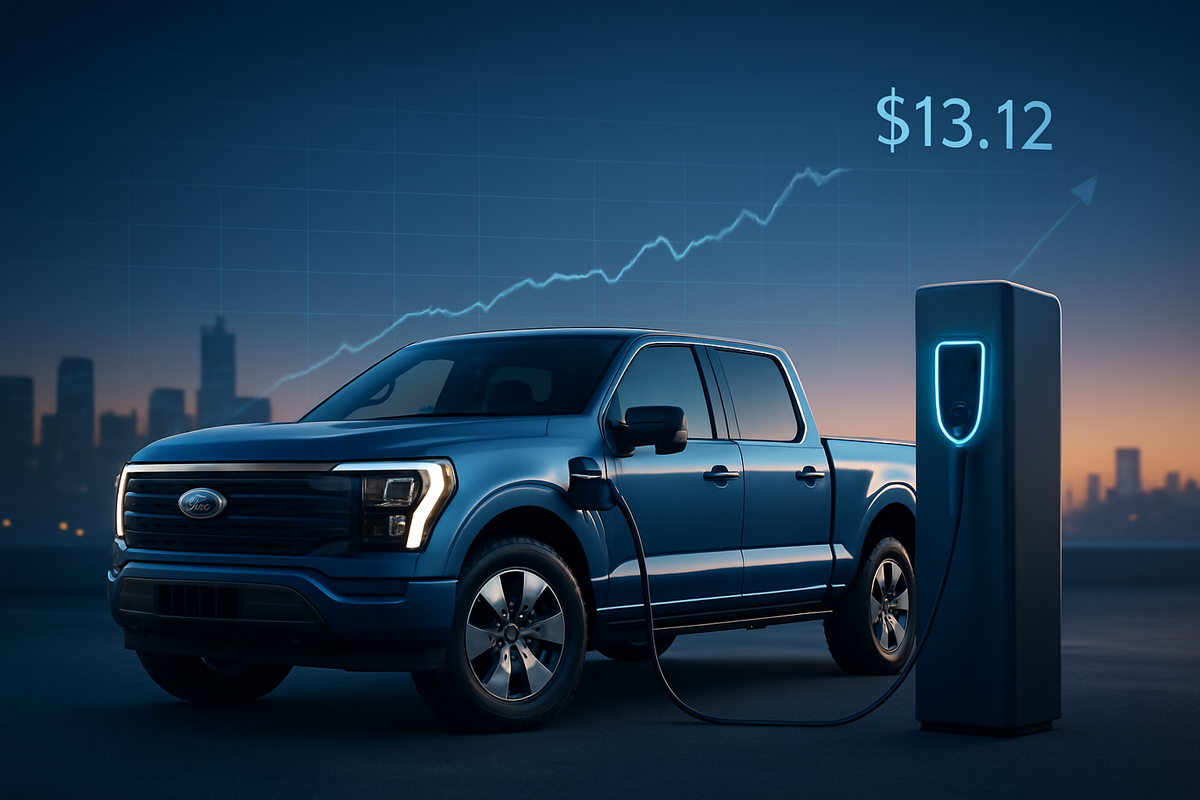
As the opening bell rings for 2026, Ford Motor Company (NYSE: F) finds itself at a pivotal crossroads, with its stock price hovering at $13.12. This valuation reflects a market that is cautiously weighing Ford’s record-breaking profits in its commercial and internal combustion segments against the staggering $5 billion annual losses generated by its "Model e" electric vehicle division. After a volatile 2025, Ford has emerged not as the pure-play EV leader it once aimed to be, but as a pragmatist, doubling down on hybrid technology to bridge the gap in a cooling electric market.
The immediate implications for Ford are stark: the company is currently weathering a "sales vacuum" following the expiration of federal EV tax credits in late 2025. While competitors like General Motors (NYSE: GM) have pushed for pure EV volume, Ford’s strategic retreat from large electric SUVs in favor of a "skunkworks" low-cost platform suggests a long-term play for profitability over market share. For investors, the $13.12 entry point represents a "show-me" story, where upcoming Q4 2025 earnings will reveal just how much a late-year supplier crisis hampered the company's bottom line.
The 2025 Pivot: A Year of Hard Truths and Supply Chain Shocks
The journey to Ford’s current $13.12 share price was marked by a dramatic shift in strategy throughout 2025. The year began with optimism as Ford provided North American Charging Standard (NACS) adapters to its customers, allowing access to the Tesla (NASDAQ: TSLA) Supercharger network. However, by mid-2025, the "EV fever" that had gripped the industry began to break. Ford’s pure EV sales, including the Mustang Mach-E and F-150 Lightning, saw year-over-year declines of nearly 40% in some months, as consumer interest shifted decisively toward hybrid alternatives.
In August 2025, Ford CEO Jim Farley made the difficult decision to cancel a planned three-row electric SUV and delay the highly anticipated "Project T3" electric truck until 2028. This move resulted in a massive $19.5 billion special restructuring charge. The end of the year brought further complications when a major fire at an aluminum supplier, Novelis, created a projected $1.5 billion to $2.0 billion EBIT headwind for the fourth quarter. These compounding factors forced Ford to lower its full-year 2025 adjusted EBIT guidance to between $6.0 billion and $6.5 billion, tempering the stock's year-end rally.
Winners and Losers in the New Automotive Hierarchy
As 2026 begins, the competitive landscape has been redrawn. General Motors (NYSE: GM) has emerged as a temporary "winner" in terms of EV volume, securing the #2 spot in the U.S. market and achieving variable profit positivity on its Ultium-based lineup. However, Ford (NYSE: F) is winning the "margin war" through its Ford Pro commercial division and its Ford Blue legacy segment. By focusing on hybrids, which saw a 50% sales surge in 2025, Ford has maintained a dividend-paying cushion that its more EV-exposed rivals lack.
Conversely, pure-play EV manufacturers are facing a harsh reality. Rivian (NASDAQ: RIVN) saw its sales collapse by 43% in October 2025 immediately following the expiration of federal tax credits, highlighting the industry's heavy reliance on subsidies. Tesla (NASDAQ: TSLA) also saw its U.S. market share dip below 40% for the first time, as "Musk fatigue" and aging product lines allowed legacy makers to chip away at its dominance. Meanwhile, suppliers of hybrid components and traditional internal combustion parts are seeing a second wind as the industry's transition to full electrification slows to a crawl.
Regulatory Rollbacks and the 'Year of the Hybrid'
The broader industry significance of Ford’s current position cannot be overstated. The start of 2026 marks a radical shift in the regulatory environment. The "One Big Beautiful Bill" (OBBB), which took effect on January 1, officially replaced the $7,500 point-of-sale EV tax credit with a $10,000 tax deduction for car loan interest. This change favors higher-income buyers and traditional financing, potentially cooling the entry-level EV market further. Additionally, the EPA’s decision to eliminate penalties for failing to meet Corporate Average Fuel Economy (CAFE) standards has effectively removed the "regulatory gun" from the heads of legacy automakers.
This new policy landscape validates Ford’s 2025 pivot. By revoking California’s Clean Air Act waiver, federal regulators have neutralized the most aggressive state-level EV mandates, allowing Ford to focus on its most profitable products: gas-powered and hybrid F-Series trucks. This historical precedent—reminiscent of the mid-2000s shift back to SUVs—suggests that the transition to EVs will be a decades-long evolution rather than a decade-long revolution. Ford’s decision to prioritize "Extended Range Electric Vehicles" (EREVs) over pure battery-electrics aligns perfectly with this new era of "cautious realism."
The 2026 Roadmap: Earnings, Skunkworks, and T3
Looking ahead, the next six months will be critical for Ford. The Q4 2025 earnings call, expected in February 2026, will be the first major test. Investors will be looking for clarity on how quickly Ford can recover from the Novelis aluminum supply disruption and whether the $5 billion-plus losses in the Model e division have finally peaked. The company's ability to normalize production of high-margin F-Series trucks will be the primary driver of stock performance in the short term.
Longer-term, the market is focused on Ford’s "skunkworks" platform—a dedicated team in California working on a low-cost EV architecture designed to compete with affordable Chinese imports from companies like BYD (OTC: BYDDY). If Ford can successfully launch a profitable $25,000 to $30,000 EV by 2027, it could reclaim its status as an innovation leader. Until then, the "Project T3" truck remains a distant 2028 goal, leaving the F-150 Lightning to carry the torch in a segment that is increasingly price-sensitive and infrastructure-wary.
Investor Takeaway: Watching the Margins and the Mandates
In summary, Ford enters 2026 as a leaner, more realistic version of itself. The $13.12 stock price reflects a company that has successfully insulated its bottom line from the "EV winter" by leaning into its heritage strengths in trucks and commercial vans. While it has surrendered the lead in EV volume to GM and Tesla, its hybrid-first strategy is providing the cash flow necessary to fund the next generation of automotive technology without risking insolvency.
For investors, the key metrics to watch in the coming months are hybrid sales growth and the EBIT margins of the Ford Pro division. As interest rates remain a concern for car buyers, Ford’s ability to offer competitive financing on its popular hybrid models will be its greatest competitive advantage. While the road to full electrification has proven longer and windier than anticipated, Ford’s current valuation suggests it is well-positioned to navigate the curves ahead, provided it can execute on its low-cost EV promises.
This content is intended for informational purposes only and is not financial advice.