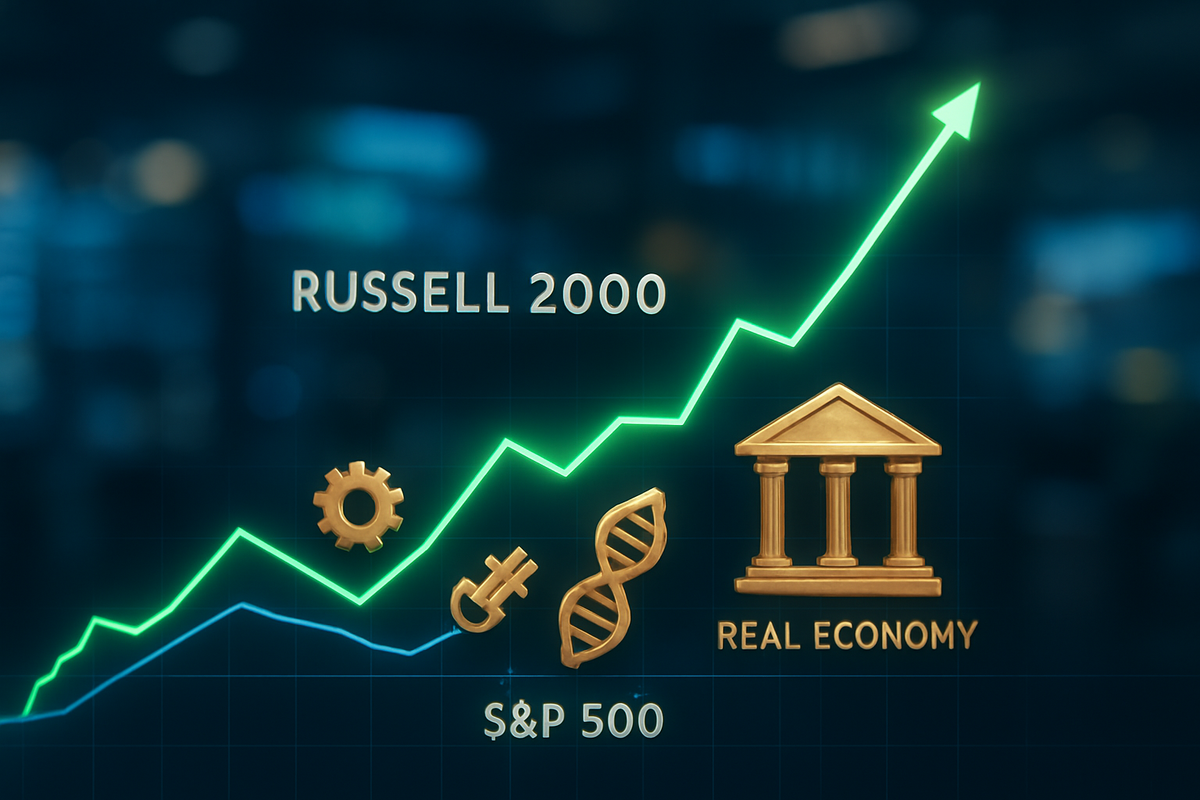
As of mid-January 2026, the U.S. equity markets are witnessing a historic recalibration that few analysts predicted eighteen months ago. The Russell 2000 index, the benchmark for American small-cap companies, has officially secured its longest streak of relative outperformance against the S&P 500 (NYSEArca: SPY) since 2019. This "Great Rotation" has seen investors flee the high-valuation heights of mega-cap technology and pour capital into the broader, domestically focused sectors of the economy, signaling a profound shift in market leadership.
The implications of this shift are immediate and far-reaching. For years, the "Magnificent Seven" dominated the investment landscape, but as of January 12, 2026, the narrative has flipped. Small-caps are no longer the laggards of the high-interest-rate era; instead, they have become the primary beneficiaries of a cooling inflationary environment and a more accommodative Federal Reserve. This transition suggests that the bull market is finally broadening, reducing the concentration risk that has plagued major indices for the better part of a decade.
A Record-Breaking Run for Small-Caps
The current winning streak is not merely a flash in the pan but the result of a sustained 11-month trend. Since February 2025, the Russell 2000 (NYSEArca: IWM) has consistently outperformed the S&P 500 on a monthly basis, a feat of resilience not seen in nearly seven years. The momentum reached a fever pitch in December 2025, when the small-cap index surged by 12%, crossing the psychological 2,600 mark and hitting fresh all-time highs. This rally continued into the first week of 2026, with the index adding an additional 5% in just five trading sessions.
The timeline leading to this moment was paved by a series of pivotal Federal Reserve decisions. Throughout late 2025, the Fed delivered three consecutive 0.25% interest rate cuts in September, October, and December, bringing the federal funds rate down to a range of 3.50%–3.75%. For the thousands of companies in the Russell 2000 that rely on floating-rate debt or regional bank credit, these cuts acted as a massive liquidity injection. Market participants, who had spent most of 2024 fearing a "higher-for-longer" scenario, reacted with a wave of buying that overwhelmed the selling pressure in the tech sector.
Key stakeholders, including institutional asset managers and pension funds, have been the primary drivers of this rotation. Many had been underweight small-caps for years, waiting for a clear signal that the valuation gap between the Russell 2000 and the S&P 500 had reached an unsustainable extreme. By the end of 2025, the Russell 2000 was trading at a forward price-to-earnings (P/E) ratio of 18x, while the S&P 500 sat at a lofty 27x. This 25-year extreme in valuation disparity proved to be the breaking point, triggering a massive reallocation of capital.
Winners and Losers in the New Market Regime
The "Small-Cap Renaissance" has created clear winners across several key sectors, most notably in biotechnology and industrial technology. Viking Therapeutics (NASDAQ: VKTX) has emerged as a poster child for this era, with its obesity drug VK2735 entering Phase 3 trials amidst a revitalized funding environment. Similarly, GeneDx Holdings (NASDAQ: WGS) has seen a meteoric rise as investor interest in healthcare genomics returned with a vengeance, fueled by lower capital costs and a surge in domestic healthcare spending.
In the technology space, the focus has shifted from the "builders" of Artificial Intelligence to the "appliers." SoundHound AI (NASDAQ: SOUN) has capitalized on this trend, seeing its shares soar as enterprise demand for voice-AI solutions moved from experimental phases to full-scale deployment. Meanwhile, the domestic infrastructure boom has benefited companies like AAON, Inc. (NASDAQ: AAON) and Willdan Group (NASDAQ: WLDN), the latter of which has transformed into an AI infrastructure powerhouse by catering to the massive cooling and power needs of new data centers being built across the American heartland.
Conversely, the losers in this rotation are the previous market darlings. Mega-cap tech giants like NVIDIA (NASDAQ: NVDA) and Microsoft (NASDAQ: MSFT), while still fundamentally strong, have struggled to keep pace with the nimble growth of their smaller counterparts. These companies have faced "AI fatigue" as investors demand more immediate returns on massive capital expenditures. Regional banking has also seen a resurgence, as the steepening yield curve has improved net interest margins for local lenders, further drawing capital away from the safe-haven "Big Six" banks.
Analyzing the Wider Significance
This event fits into a broader industry trend of "reshoring" and the localization of supply chains. Small-cap companies are often more tethered to the domestic U.S. economy than their multi-national counterparts. As the U.S. continues to incentivize domestic manufacturing and energy independence, the Russell 2000 has become a direct proxy for the health of the "Real Economy." This shift away from globalized tech dominance marks a return to a more traditional market structure where industrial and cyclical stocks play a leading role.
The ripple effects are already being felt by competitors and partners. Larger firms are finding it more expensive to acquire their smaller rivals as valuations in the Russell 2000 rise, potentially slowing the pace of M&A in some sectors while accelerating it in others where "buying growth" is the only option. Furthermore, the regulatory environment is beginning to favor this broadening; policy implications for 2026 suggest a continued focus on antitrust measures against mega-caps, which provides a natural tailwind for smaller competitors to gain market share.
Historical precedents for this rotation can be found in the early 2000s following the dot-com bubble burst. Much like today, that era saw a decade of large-cap tech dominance followed by a multi-year period where small-cap value stocks significantly outperformed. The 2025-2026 rotation mirrors this "mean reversion," suggesting that the current trend may not just be a short-term anomaly but the beginning of a multi-year cycle of small-cap leadership.
What Comes Next for the Markets
Looking ahead to the remainder of 2026, the short-term outlook remains bullish for small-caps, though the pace of the rally may moderate. Analysts are watching for any signs of "re-inflation" that could force the Federal Reserve to pause its rate-cutting cycle. If inflation remains stable near the 2.7% mark, the Russell 2000 is projected to see earnings growth of 17% to 22% throughout the year, a figure that continues to dwarf the mid-single-digit growth expected from the broader S&P 500.
Strategic pivots will be required for investors who have spent years in a "passive tech" mindset. The market is moving toward a "stock picker’s" environment where individual company fundamentals—particularly debt levels and cash flow—matter more than they did during the era of zero-percent interest rates. Potential challenges include a potential cooling of the labor market, which could hit the consumer-discretionary heavy small-cap sector. However, the emergence of companies like Kratos Defense (NASDAQ: KTOS) and Rocket Lab (NASDAQ: RKLB) as leaders in the aerospace sector suggests that government spending and defense contracts will provide a solid floor for the index.
Summary and Final Thoughts
The Russell 2000's record-breaking winning streak against the S&P 500 marks a definitive end to the era of extreme market concentration. Driven by a dovish Federal Reserve, a massive valuation gap, and accelerating domestic earnings, small-cap stocks have reclaimed their place at the forefront of the American economy. The "Great Rotation" of 2025-2026 has not only rewarded patient investors but has also provided a much-needed diversification to the broader financial system.
Moving forward, the market appears more balanced and healthy than it has been in years. The broadening of the bull market suggests that the economic recovery is deep-rooted and less dependent on a handful of tech titans. For investors, the coming months will require a focus on quality within the small-cap space, as the "easy money" from the initial rotation has likely been made. Watching the Fed's next moves and the quarterly earnings reports of domestic industrials will be critical for navigating this new market regime.
This content is intended for informational purposes only and is not financial advice.