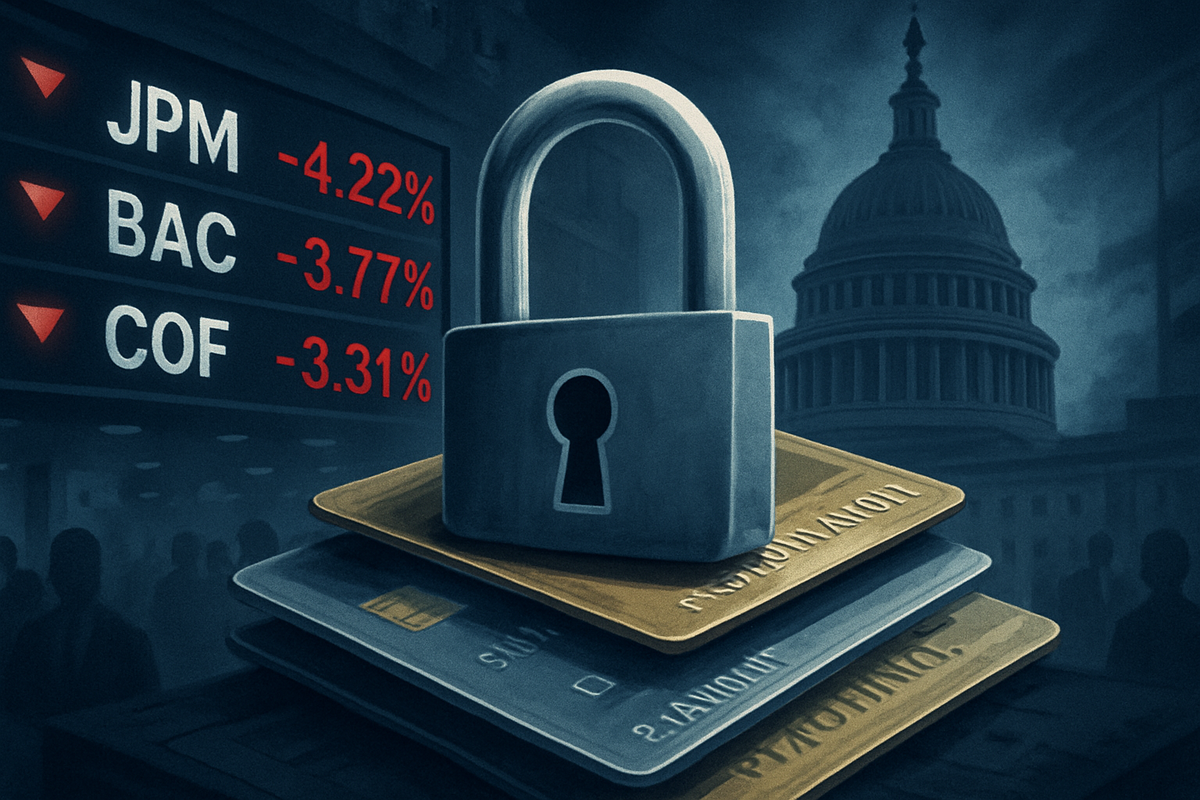
The U.S. banking sector is facing its most significant regulatory upheaval in decades as a bipartisan push to cap credit card interest rates at 10% gains sudden, aggressive momentum in Washington. This week, the stock market responded with a sharp sell-off, as investors priced in a future where the highly lucrative credit card business model—driven by record-high Annual Percentage Rates (APRs)—could be dismantled overnight. The proposal has sent shockwaves through the financial industry, threatening to compress net interest margins and force a total reimagining of consumer lending.
The immediate implications of this proposal, known as the 10 Percent Credit Card Interest Rate Cap Act, go far beyond a simple reduction in monthly bills for consumers. Major lenders have already begun signaling that a mandatory 10% ceiling would necessitate the immediate termination of most credit card rewards programs and a drastic tightening of credit availability. For the millions of Americans who rely on credit for daily expenses, the "10% shock" could mean the end of cash-back perks and, for many in the subprime category, the loss of access to revolving credit entirely.
A Rare Bipartisan Alliance Targets "Exploitative" Lending
The current legislative firestorm reached a boiling point on January 10, 2026, when President Donald Trump formally endorsed a one-year emergency 10% cap on credit card interest rates. This endorsement breathed new life into the 10 Percent Credit Card Interest Rate Cap Act (S. 381), a bill that has unified an unlikely "horseshoe coalition" of populist conservatives and progressive liberals. Led by Senator Josh Hawley (R-MO) and Senator Bernie Sanders (I-VT), proponents argue that the current average credit card APR of 28.6% is predatory, especially given that the Federal Reserve's discount rate remains significantly lower.
The timeline leading to this moment has been marked by increasing public frustration over "sticky" inflation and the widening gap between bank borrowing costs and consumer charges. Throughout 2025, several congressional hearings highlighted the record-breaking profits of credit card issuers even as household debt hit new peaks. By the time the House version of the bill (H.R. 1944) was introduced by Alexandria Ocasio-Cortez (D-NY) and Anna Paulina Luna (R-FL) in late 2025, the industry was already on high alert. The President’s January 10th announcement on social media, threatening to implement the cap via executive order if Congress does not act by January 20, 2026, turned a simmering policy debate into a full-blown market crisis.
Industry reactions were instantaneous. The Bank Policy Institute and other trade groups have warned of a constitutional challenge, arguing that the Consumer Financial Protection Act does not grant the executive branch the authority to set interest rate caps without a direct act of Congress. Despite these legal hurdles, the political momentum has shifted the narrative from "if" a cap is possible to "how" the industry will survive it.
The Fallout: Heavy Hits for Consumer-Facing Lenders
The market reaction between January 12 and January 14 has been "swift and unforgiving," according to several Wall Street analysts. Capital One Financial (NYSE: COF) has emerged as the most vulnerable among the major players, with its stock price plummeting by over 10% in just two trading sessions. As an institution that relies heavily on interest income from subprime and near-prime borrowers, Capital One’s business model is uniquely exposed to a 10% ceiling, which many analysts believe is below the "break-even" point for unsecured lending to higher-risk individuals.
The "Big Two" of American banking, JPMorgan Chase (NYSE: JPM) and Bank of America (NYSE: BAC), have also seen their shares slide, falling 3.2% and 2.9% respectively. While these giants are more diversified than monoline lenders, they remain the largest credit card issuers by volume in the United States. Analysts at Morgan Stanley estimate that a 10% cap would strip between $20 billion and $30 billion in annual interest revenue from the banking industry. Other specialized lenders like Synchrony Financial (NYSE: SYF) and Bread Financial (NYSE: BFH) fared even worse, with Synchrony dropping nearly 9.7% and Bread Financial cratering 12.5%, as their entire profit structures are built on high-margin, private-label credit products.
For these companies, the loss of interest income isn't just a bottom-line issue; it is a direct threat to their Net Interest Margin (NIM). For a company like Capital One, the NIM compression could be as severe as 300 to 500 basis points. To protect profitability, these banks have already begun discussing the "nuclear option": the introduction of substantial annual fees for all cardholders and the elimination of popular rewards points and airline miles that have become a staple of the American middle-class lifestyle.
A Tectonic Shift in the Financial Landscape
This legislative push represents a radical departure from the deregulation trends of the late 20th century and fits into a broader global movement toward "pro-consumer" financial protection. If passed, the 10% cap would be the most restrictive federal intervention in consumer lending since the Credit Card Accountability Responsibility and Disclosure (CARD) Act of 2009. However, unlike the 2009 Act, which focused on transparency and fee structures, a hard rate cap directly dictates the price of risk.
The ripple effects could be devastating for the credit ecosystem. The Electronic Payments Coalition (EPC) released a report on January 13, 2026, suggesting that up to 88% of current credit card accounts could be closed or severely restricted under the new law. Banks would no longer be able to justify the risk of lending to anyone with a credit score below 740, effectively locking out nearly 180 million Americans from the revolving credit market. This could force a migration of consumers toward unregulated and far more dangerous alternatives, such as predatory payday lenders or illegal "loan sharking" operations, creating a "credit desert" for the very people the bill aims to help.
Furthermore, the loss of interchange and interest revenue would likely lead to a contraction in the fintech and payment processing sectors. Partners who rely on bank-issued cards for their ecosystems—such as retailers with co-branded cards—would see their secondary revenue streams vanish, leading to potential retail sector volatility.
Navigating the "Credit Desert": What Comes Next?
In the short term, the banking industry is preparing for a protracted legal battle. If the President attempts to enforce a 10% cap through executive action on January 20, a flurry of injunctions is expected within hours. However, the legislative threat remains the primary concern for long-term investors. Banks are currently in "emergency lobbying mode," attempting to negotiate a higher cap—perhaps 15% or 18%—or a "carve-out" for certain types of secured credit.
Strategically, banks are already pivoting. We are likely to see a surge in "Buy Now, Pay Later" (BNPL) offerings and other installment loan products that might fall outside the traditional definition of a revolving credit card. This shift would allow lenders to charge fixed fees rather than interest, effectively bypassing the 10% cap. Additionally, the industry may move toward a "subscription model" for credit, where users pay a flat monthly fee for the privilege of access, regardless of their balance.
The long-term scenario remains a "survival of the fittest" for the banking sector. Diversified giants like JPMorgan Chase are better positioned to weather the storm by shifting focus to investment banking and wealth management, while smaller, card-dependent banks may be forced into defensive mergers or significant downsizing.
Conclusion: A New Era for the American Wallet
The proposed 10% credit card interest rate cap marks a potential end to the "Golden Age" of credit card rewards and the beginning of a much tighter, more exclusive lending environment. While the bill’s proponents view it as a necessary correction to corporate greed, the market's violent reaction underscores the risk of a massive credit contraction. The "10% shock" is not just about cheaper debt; it is about who gets to access debt at all.
Moving forward, the market will remain on edge as the Senate Banking Committee begins its deliberations. Investors should keep a close watch on two key indicators: any movement on a compromised "middle ground" rate cap and the potential for an executive order on January 20. For now, the era of the high-limit, high-reward credit card is on life support, and the future of American consumer finance hangs in the balance of a rare, high-stakes political gamble.
This content is intended for informational purposes only and is not financial advice.