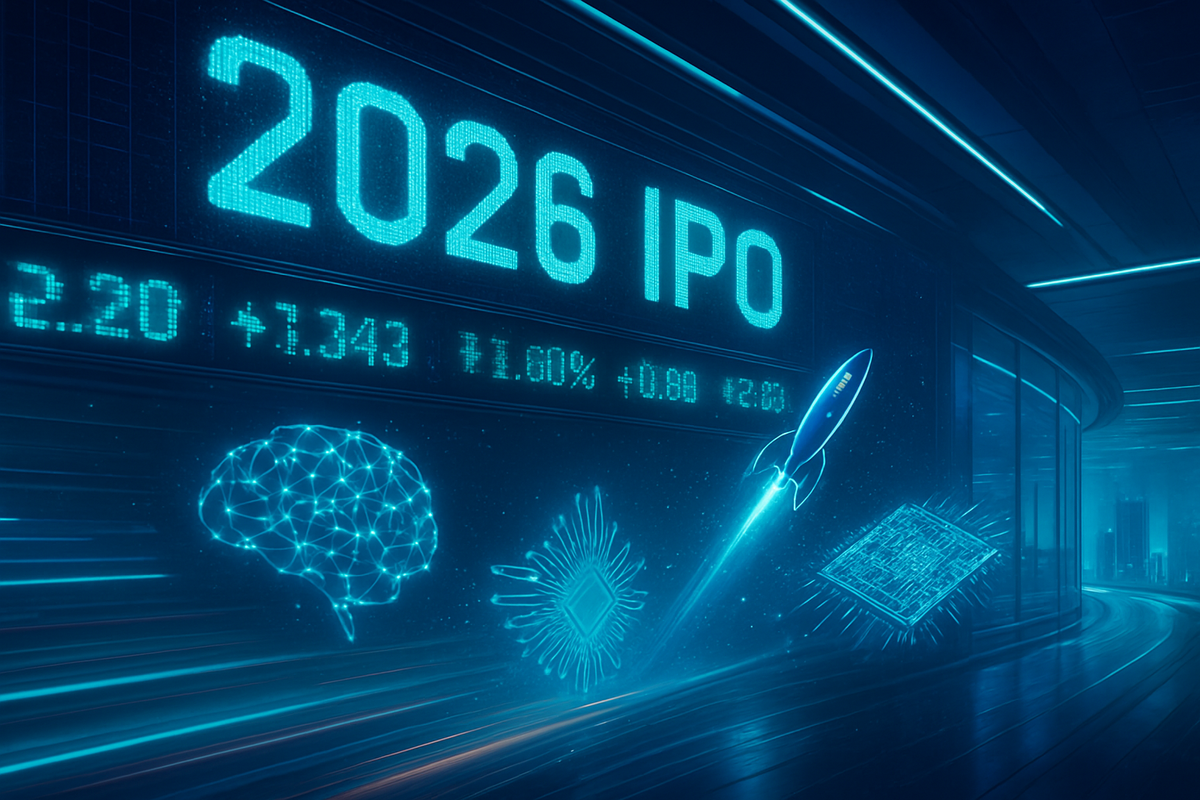
As of mid-January 2026, the global financial markets are standing on the precipice of what many analysts are calling a "mega-wave" of public listings. After years of stagnation and high interest rates that kept the world’s most valuable private companies on the sidelines, the floodgates have finally opened. Investment banking giants including Goldman Sachs (NYSE: GS) and Morgan Stanley (NYSE: MS) are forecasting that 2026 will be a "historic year" for issuance, driven by a stabilizing macro environment and a multi-year backlog of "unicorns" that are finally ready to test the public markets.
The immediate implications of this resurgence are profound. With the Federal Reserve navigating a measured rate-cutting cycle and a more permissive antitrust climate in Washington, the risk appetite for high-growth, large-scale technology companies has returned to levels not seen since the 2021 boom. This "coiled spring" of late-stage startups is led by three generational giants—OpenAI, SpaceX, and Cerebras Systems—whose combined valuations could exceed $3 trillion, fundamentally reshaping the benchmarks of the modern stock exchange.
The road to this moment has been paved with strategic restructuring and a shift in investor priorities. Throughout 2025, the narrative moved away from speculative growth toward "operational discipline." In October 2025, OpenAI took the monumental step of transitioning into a Public Benefit Corporation (PBC), a move that simplified its complex corporate structure and paved the way for a public debut now rumored for late 2026. This transition was a crucial prerequisite to satisfy institutional investors who were wary of the previous nonprofit-controlled "capped-profit" model.
Meanwhile, Elon Musk’s SpaceX has shifted its strategy from a long-speculated spinoff of its Starlink satellite business to a "Unified IPO" targeted for the second half of 2026. By folding the cash-generating Starlink—which hit 10 million subscribers last month—into the broader Starship and launch business, the company aims for a record-breaking $1.5 trillion valuation. Simultaneously, the AI chipmaker Cerebras Systems has successfully navigated the regulatory hurdles that stalled its 2024 filing. After restructuring its investor base to satisfy federal reviews regarding foreign ties, Cerebras is now slated for a Q2 2026 debut, bolstered by a fresh $10 billion chip supply deal with OpenAI signed just weeks ago.
The key players in this drama include the major investment banks who are seeing a massive windfall. JPMorgan Chase & Co. (NYSE: JPM) reported a nearly 50% surge in investment banking revenue in the final quarter of 2025, a clear signal that the dealmaking machinery is back in high gear. Initial market reactions have been overwhelmingly positive, with the Renaissance IPO Index outperforming the broader S&P 500 by 15% since the start of the new year.
The primary beneficiary of this IPO wave is undoubtedly Microsoft Corp. (NASDAQ: MSFT). With a roughly 27% stake in OpenAI, Microsoft stands to see its investment—originally valued at $13 billion—swell to over $200 billion upon a successful public listing. Furthermore, as the primary cloud provider for OpenAI, any capital raised by the AI giant will likely flow back into Microsoft’s Azure ecosystem, reinforcing its dominance in the cloud infrastructure space.
On the other hand, the impending arrival of Cerebras Systems represents a tactical challenge for Nvidia Corp. (NASDAQ: NVDA). While Nvidia remains the undisputed king of AI training, Cerebras is positioning itself as the leader in the "inference" market—the process of running models rather than training them. If Cerebras’s "wafer-scale" technology can deliver on its promise of being 20 times faster than current Nvidia hardware for specific inference tasks, it could erode the premium valuation Nvidia has enjoyed. Similarly, Alphabet Inc. (NASDAQ: GOOGL) faces increased pressure; the sheer scale of the capital being raised by SpaceX and OpenAI will likely force Google to accelerate its own capital expenditures to keep its Gemini and TPU programs competitive.
A surprise winner in this environment has been EchoStar Corp. (NASDAQ: SATS), which saw its stock surge in late 2025 as the SpaceX IPO news broke. Investors are betting that a public SpaceX will seek spectrum licensing deals and more aggressive satellite partnerships, creating a rising tide that lifts the entire space and telecommunications sector.
This IPO surge is not occurring in a vacuum; it is the culmination of the "Inference Flip." For the first time, in early 2026, global spending on running AI models has surpassed the spending on training them. This shift is a critical industry trend that explains why companies like Cerebras and OpenAI are choosing now to list. They are moving from the research-and-development phase into the high-volume, commercial delivery phase of the AI revolution.
Furthermore, the 2026 pipeline reflects a significant change in regulatory sentiment. The "pro-business" stance of the current administration has drastically reduced the threat of antitrust interventions that previously blocked mega-mergers and large-scale IPOs. This mirrors the late 1990s tech boom but with a crucial difference: these companies are entering the market with billions in revenue and positive cash flow, unlike the unprofitable dot-coms of the past. SpaceX, for instance, reported its first full year of positive free cash flow in 2025, providing a fundamental floor to its astronomical valuation.
However, historical precedents suggest that such a concentrated wave of liquidity can also be a double-edged sword. The massive "sucking sound" of capital moving into these three giants could temporarily drain liquidity from mid-cap tech stocks, creating a "winner-take-all" dynamic that may leave smaller innovators struggling for attention.
Looking ahead, the short-term focus will be on the legal arena. OpenAI still faces a significant hurdle with Elon Musk’s lawsuit regarding its for-profit transition, which is scheduled for a jury trial in March 2026. The outcome of this trial could either solidify OpenAI’s path to the NASDAQ or throw its valuation into a tailspin. Long-term, the success of these IPOs will depend on the "cost-per-token" metric. In 2026, investors are no longer satisfied with "AI potential"; they are demanding proof that AI deployments can be delivered at a margin that justifies their $1 trillion valuations.
Strategically, we may see a pivot where public companies increasingly seek "foundational" investments in these new entities to maintain their technological edge. We could also see a scenario where the sheer size of the SpaceX and OpenAI offerings necessitates a multi-stage listing process or the creation of new types of tracking stocks to manage the various divisions of these sprawling empires.
In summary, the 2026 IPO pipeline is more than just a series of company debuts; it is a referendum on the future of the American economy. The move toward public status for OpenAI and SpaceX marks the institutionalization of the AI and Space races. For investors, the takeaway is clear: the era of "wait and see" in the private markets is over. The "coiled spring" has been released, and the resulting influx of high-quality, high-growth equity is set to redefine portfolio strategies for the next decade.
As we move through the first quarter of 2026, the market will be watching the Cerebras roadshow and the Musk-OpenAI trial with intense scrutiny. These events will serve as the bellwethers for whether the "Year of the Trillion-Dollar Unicorn" fulfills its promise or if the weight of these massive valuations proves too heavy for the current recovery to bear.
This content is intended for informational purposes only and is not financial advice.