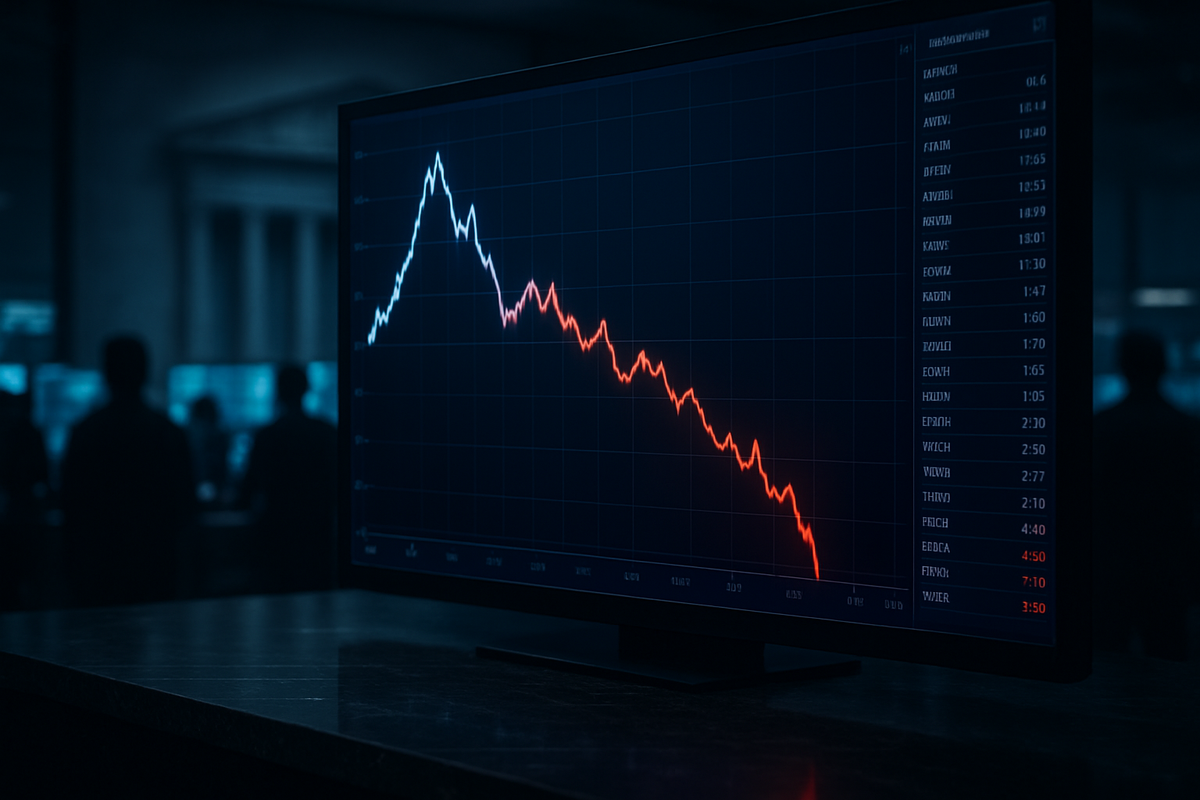
In a week that has left many investors scratching their heads, Bank of America (NYSE: BAC) delivered a fourth-quarter earnings report that, on paper, should have sent shares soaring. On January 14, 2026, the banking giant reported earnings per share of $0.98 and total revenue of $28.4 billion, comfortably outperforming analyst expectations. Despite this "double beat," the market's response was swift and unforgiving: shares of the nation's second-largest bank plummeted 3.7%, dragging down much of the financial sector with it.
This disconnect highlights a growing "market malaise" that has taken hold in the early days of 2026. While the bank’s operational machinery is humming at near-peak efficiency—buoyed by a massive rebound in investment banking and disciplined lending—investors are looking past the current successes. A combination of conservative forward guidance, looming regulatory threats, and a general exhaustion after a six-month rally has created a scenario where even a stellar performance isn't enough to satisfy a jittery Wall Street.
A Tale of Two Realities: The Results vs. The Reaction
The events leading up to the January 14th release were marked by high expectations. Bank of America (NYSE: BAC) had seen its stock price climb roughly 17% in the preceding six months, as analysts bet on a "Goldilocks" environment of moderate interest rates and steady consumer spending. When CEO Brian Moynihan took the stage to announce a 12% year-over-year increase in net income, reaching $7.6 billion, the initial numbers looked like a victory lap. Net Interest Income (NII) had risen 10% to $15.9 billion, and the bank’s digital adoption had reached a record 41.4 million mobile users.
However, the narrative shifted during the subsequent earnings call. Management’s projection for 2026 NII growth was pegged at a modest 5% to 7%. While technically growth, this was viewed as "soft" compared to the aggressive expansion investors had baked into the stock price. The situation was further exacerbated by a sudden "regulatory shockwave" from Washington. Just days before the report, a populist political proposal emerged calling for a one-year, 10% cap on credit card interest rates. Given Bank of America’s massive consumer lending footprint, the potential for a margin squeeze turned the "beat" into a "sell the news" event.
Initial market reactions were sharply negative, as institutional algorithms and retail investors alike reacted to the cautious 2026 outlook. The 3.7% drop was not just a rejection of BAC’s specific performance, but a reflection of the anxiety surrounding the entire banking landscape. Key stakeholders, including major hedge funds that had been long on the sector, began trimming positions, fearing that the "golden era" of high-interest-rate profitability might be coming to an abrupt end as the Federal Reserve signaled a potential pause or pivot in late 2026.
Winners and Losers in the Sector Shake-Up
Bank of America (NYSE: BAC) was not the only casualty of this sentiment shift. Wells Fargo (NYSE: WFC) saw its shares drop 4.6% following a report that missed revenue targets, while Citigroup (NYSE: C) slid 3.3% as it continued to deal with the expensive fallout of its international restructuring. These "losers" share a common vulnerability: high sensitivity to interest rate fluctuations and heavy exposure to the consumer credit market. If the proposed credit card rate caps gain legislative traction, these institutions face a direct threat to their highest-margin products.
On the other side of the ledger, certain niche players and "fortress" institutions may emerge as relative winners. JPMorgan Chase (NYSE: JPM), while also seeing a slight dip in sympathy with the sector, remains the benchmark for stability. Its diversified revenue streams—spanning global payments, asset management, and specialized corporate lending—provide a cushion that more consumer-heavy banks like BAC lack. Analysts also point to fintech disruptors and digital-first banks that operate with lower overhead; if traditional banks are forced to cap rates, these leaner competitors might find more room to capture market share in a low-margin environment.
The real "winners" in the eyes of some analysts, however, are the long-term investors. Many institutional desks, including those at KBW and various Seeking Alpha contributors, have labeled the BAC price drop as a significant buying opportunity. With a fair value estimate remaining in the mid-$60s, the current dip allows entry into a company with a 14% Return on Tangible Common Equity (ROTCE) and a track record of returning over $30 billion to shareholders annually. For those who believe the "market malaise" is a temporary overreaction, the current fundamentals offer a compelling value proposition.
Broader Significance and Historical Precedents
The reaction to BAC’s earnings fits into a broader trend of "expectation exhaustion" that often occurs at the tail end of a bull run. Historically, the banking sector is the "canary in the coal mine" for economic shifts. The current situation mirrors the late-2018 market jitters, where strong corporate earnings were ignored in favor of fears about peak interest rates and slowing global growth. In 2026, the fear is not just about the economy, but about a shifting regulatory regime that is increasingly targeting the profitability of big finance to court a frustrated electorate.
Ripple effects are already being felt by competitors and partners. The conservative guidance from Moynihan has forced other regional and national banks to re-evaluate their own 2026 projections. If the largest banks are signaling a slowdown in NII growth, it sets a ceiling for the entire industry. Furthermore, the 4% projected rise in expenses for Q1 2026—driven by payroll taxes and benefit resets—highlights a persistent challenge for all public companies: the "sticky" nature of inflation in the service and labor sectors, which continues to erode the gains made from higher revenues.
Regulatory implications cannot be understated. The proposed interest rate cap on credit cards represents a significant pivot toward populist economic policy. If enacted, it would be the most substantial intervention in bank pricing since the post-2008 Dodd-Frank era. This threat has introduced a "political risk premium" back into bank stocks, something that had largely faded during the relatively stable mid-2020s. Investors are now forced to weigh a bank's fundamental strength against the unpredictable nature of legislative mandates.
The Path Forward: Strategic Pivots and Scenarios
In the short term, Bank of America (NYSE: BAC) must focus on cost containment to offset the projected expense increase in the coming quarter. We are likely to see an acceleration of the bank’s "efficiency ratio" initiatives, which could involve further investment in AI-driven customer service and back-office automation to reduce reliance on expensive human capital. Strategically, the bank may also shift its focus toward its high-performing investment banking and sales and trading divisions, which contributed $4.5 billion this quarter and are less susceptible to consumer interest rate caps.
Longer term, the bank faces a fork in the road. If the Federal Reserve moves toward aggressive rate cuts later in 2026, BAC will need to pivot its asset-sensitive balance sheet to protect its margins. Conversely, if the regulatory environment becomes truly hostile, we may see the bank diversify even further into wealth management—where it already leads via Merrill Lynch—to generate more fee-based, non-interest income. The challenge will be maintaining its dividend and share buyback programs, which have been a primary draw for investors, in the face of these headwinds.
Potential scenarios range from a "soft landing" recovery, where the market realizes it overreacted to conservative guidance, to a deeper "sector reset." If the credit card cap proposal gains momentum in Congress, BAC and its peers may face a multi-year period of compressed earnings. However, the bank’s massive $3.3 trillion balance sheet and its "fortress" capital position provide it with the tools to weather almost any storm, provided it can navigate the shifting political and economic winds with its usual discipline.
Wrap-Up and Investor Outlook
The recent saga of Bank of America (NYSE: BAC) serves as a stark reminder that in the world of high finance, the past is rarely as important as the future. The bank delivered everything a traditional analyst could ask for: higher profits, improved revenue, and disciplined growth. Yet, the 3.7% drop proves that the market is currently more concerned with what might happen in the next twelve months than what happened in the last three. Between soft NII guidance and a looming regulatory battle over credit card rates, the "malaise" currently infecting the financial sector is born of uncertainty.
Moving forward, the key takeaway for investors is that fundamentals remain strong, but the "easy money" phase of the bank rally is likely over. The disconnect between a profit beat and a price drop suggests that the market is recalibrating its valuation models for a more complex, politically sensitive environment. Those who believe in the bank's underlying digital leadership and capital management should see this as a consolidation phase, while more cautious investors will want to see how the regulatory threats materialize before diving back in.
In the coming months, all eyes should be on the Federal Reserve’s commentary and the progress of the interest rate cap bill in Washington. These external factors will likely dictate the direction of Bank of America’s stock more than any internal metric. While the "beat" was real, the "malaise" is equally potent, leaving BAC in a period of transition as it seeks to prove that its fundamentals can survive a changing of the economic guard.
This content is intended for informational purposes only and is not financial advice.