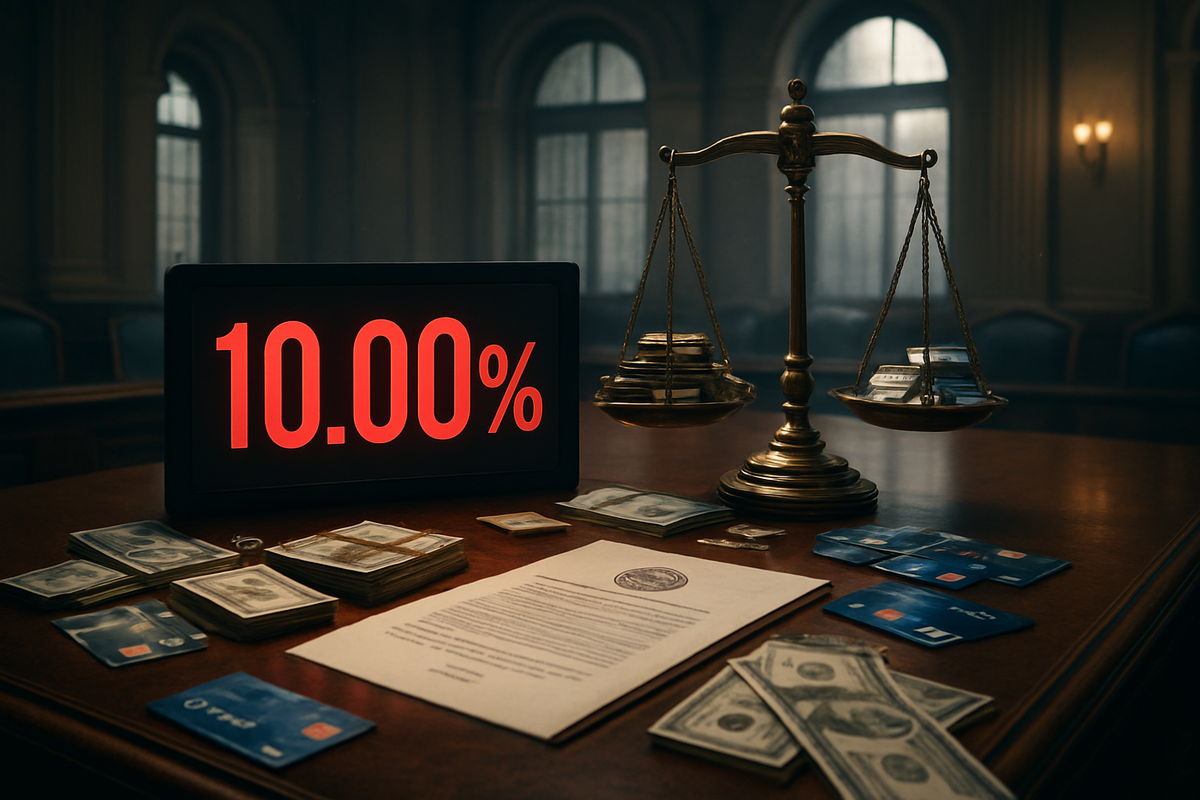
The American financial landscape is currently bracing for what many analysts are calling "Interest Rate Armageddon." As of mid-January 2026, a bipartisan legislative push to cap credit card interest rates at a hard 10% has moved from a progressive pipe dream to a central pillar of the national political agenda. Following a series of public endorsements from President Donald Trump in early January, the proposal has sent shockwaves through Wall Street, pitting a populist "horseshoe" coalition of far-left and far-right lawmakers against the nation’s largest financial institutions.
The immediate implications are stark: bank stocks have seen their most volatile start to a year in over a decade, and the credit markets are beginning to tighten in anticipation of a legislative sea change. Proponents argue the cap is a necessary corrective for a nation drowning in $1.23 trillion of credit card debt, while the banking lobby warns of a looming "credit crunch" that could disenfranchise millions of subprime borrowers and effectively end the era of generous credit card rewards programs.
The Populist Surge: From the Fringe to the Forefront
The momentum behind the 10% cap reached a boiling point on January 9, 2026, when President Trump issued a series of public demands for a one-year "emergency cap" on credit card APRs to combat persistent inflationary pressures on middle-class families. This endorsement breathed new life into the 10 Percent Credit Card Interest Rate Cap Act (S. 381), a bill originally introduced in early 2025 by the unlikely duo of Senator Bernie Sanders (I-VT) and Senator Josh Hawley (R-MO). What was once viewed as a fringe populist effort has now become a central battleground for the 2026 midterm elections.
The timeline leading to this moment has been defined by a rapid escalation in consumer debt levels and a series of aggressive interest rate hikes by the Federal Reserve in previous years, which pushed the average credit card APR to nearly 23% by late 2025. In response, Senator Roger Marshall (R-KS) announced on January 15, 2026, that he would introduce the Consumer Affordability Protection Act, a refined version of the cap that specifically targets large financial institutions with over $100 billion in assets. This "Big Bank" focus is designed to protect smaller community lenders while forcing the industry's titans to absorb the costs of the rate ceiling.
Market reactions have been swift and severe. Since the start of the year, the KBW Bank Index has plummeted by nearly 12%, as investors weigh the possibility of a permanent structural shift in bank profitability. The "Horseshoe" coalition—comprising populist Republicans and progressive Democrats—has dared establishment leadership in both parties to choose a side, creating a rare moment of political unity that has left traditional pro-business factions in Congress scrambling for a counter-narrative.
Titans Under Siege: The Winners and Losers of the 10% Cap
The proposed cap represents an existential threat to the high-margin credit card units of several major US lenders. JPMorgan Chase & Co. (NYSE: JPM) holds roughly $239 billion in card balances, and CFO Jeremy Barnum has signaled that the firm is prepared for a protracted legal battle, stating that "everything is on the table" to protect its margins. Analysts estimate a 1% to 4% hit to 2026 earnings for the banking giant if the cap is enacted.
Citigroup Inc. (NYSE: C) is widely considered the most vulnerable among the "Big Four" banks. Due to its massive portfolio of retail-services and store-branded credit cards—which often carry the highest APRs in the industry—analysts at Keefe, Bruyette & Woods (KBW) project a potential 10% cut to the bank's 2026 earnings. Citigroup’s stock has already reflected this anxiety, underperforming its peers since the January 9 announcement.
Capital One Financial Corp. (NYSE: COF) is also in the crosshairs. Internal analysis of Capital One’s master trusts suggests that a 10% cap would slash its "excess spread"—the crucial safety cushion for bondholders—by approximately 90%, from $1.7 billion to $175 million. Shares of Capital One fell over 11% in the second week of January. Meanwhile, American Express Company (NYSE: AXP) saw its shares drop 7% in early January; although its customer base is generally more affluent, the bank still relies on net interest income for roughly a quarter of its revenue, and a 10% ceiling would force a radical restructuring of its premium rewards ecosystem.
A Structural Shift in the Credit Economy
This event fits into a broader global trend of "financial populism," where governments are increasingly intervening in private markets to alleviate the cost-of-living crises. Historically, credit card interest rates in the U.S. have been largely unregulated at the federal level since the Supreme Court's 1978 Marquette decision, which allowed banks to "export" the interest rates of their home states across the country. A federal 10% cap would represent the most significant reversal of financial deregulation in nearly half a century, drawing comparisons to the usury laws of the early 20th century.
The ripple effects extend far beyond the banks themselves. Payment processors like Visa Inc. (NYSE: V) and Mastercard Incorporated (NYSE: MA) are facing a secondary assault via the Credit Card Competition Act of 2026, reintroduced on January 13. By targeting both the interest rates and the "swipe fees" that fund the modern credit ecosystem, lawmakers are attempting to dismantle the current "spend-and-reward" model. Critics argue that this will lead to a significant "credit scarcity" event, where banks will be forced to close the accounts of approximately 14 million subprime households who are deemed too risky to lend to at a 10% rate.
The regulatory implications are profound. If the cap is passed, it could set a precedent for federal intervention in other consumer lending products, such as auto loans and "Buy Now, Pay Later" (BNPL) services. This move signals a pivot away from the disclosure-based regulation of the past (like the Truth in Lending Act) toward more direct, price-control-based oversight of the financial sector.
The Road Ahead: Legislative Hurdles and Strategic Pivots
Looking forward, the path to a 10% cap remains fraught with obstacles. Despite the populist momentum, Senate leadership—including Majority Leader John Thune and Banking Committee Chair Tim Scott—remains skeptical. While Senator Scott has agreed to hold a hearing in early 2026, he has warned of the "unintended consequences" of market interference. Furthermore, constitutional scholars have noted that the President lacks the executive authority to set interest rates by decree, meaning the battle must be won in the halls of Congress.
In the short term, banks are likely to begin a preemptive "cleansing" of their balance sheets, reducing credit limits for high-risk borrowers and phasing out low-tier rewards programs to preserve capital. If the legislation gains further traction, expect a surge in "fee-based" credit products as banks look for alternative revenue streams to replace lost interest income. Strategic pivots toward more secure, asset-backed lending may also become a priority for firms currently over-leveraged in the unsecured credit space.
The ultimate scenario could be a compromise: a temporary, two-year cap or a slightly higher ceiling (such as 15% or 18%) that allows banks time to adjust their models. However, with the midterm elections looming, the political incentive to remain "tough on banks" may outweigh the technical concerns of economists, making a hard cap a distinct, if volatile, possibility for the second half of 2026.
Summary and Investor Outlook
The proposal to cap credit card interest rates at 10% has ignited a firestorm that is reshaping the relationship between Washington and Wall Street. For consumers, the promise of $100 billion in annual interest savings is a powerful draw; for the financial sector, it is a direct threat to the profitability of the $1.2 trillion credit card market. The emergence of a "Horseshoe" coalition has broken traditional party lines, making this one of the most unpredictable legislative cycles in recent memory.
Moving forward, the market will likely remain in a "wait-and-see" defensive posture. Investors should keep a close watch on the upcoming Senate Banking Committee hearings and any formal language introduced in Senator Marshall’s new bill. The key metrics to monitor will be the "excess spread" in bank credit card trusts and any shifts in subprime delinquency rates, which could serve as the "canary in the coal mine" for a broader credit contraction. Whether this 10% cap becomes law or remains a potent political tool, the era of unchecked credit card interest rates appears to be drawing to a close.
This content is intended for informational purposes only and is not financial advice.