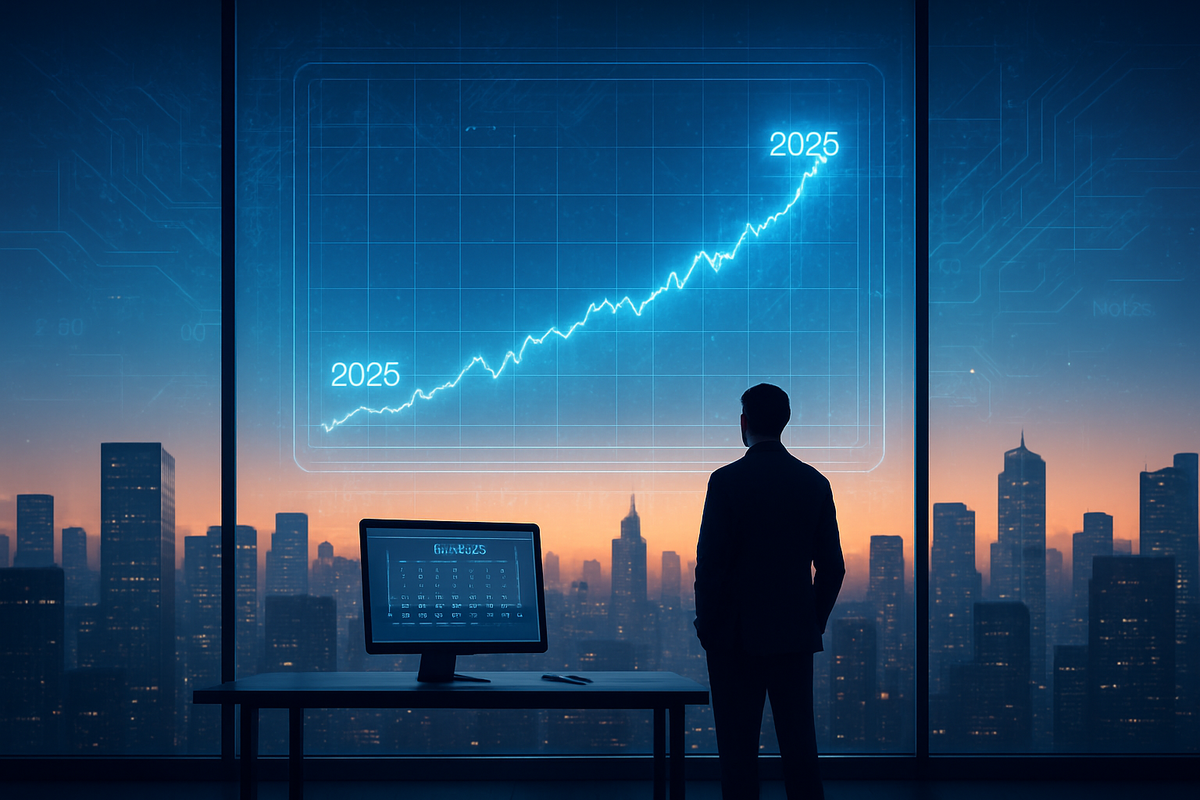
As the opening bell rang on the morning of January 2, 2026, the atmosphere on the floor of the New York Stock Exchange was thick with both optimism and a familiar, calculated anxiety. Following a resilient 2025 that saw the S&P 500 (NYSE: SPY) surge by more than 16%, investors are now turning their eyes to a decades-old market adage: the "January Barometer." With the global economy balancing between a "soft landing" and the potential volatility of a U.S. midterm election year, the performance of the market this month is being treated as a critical signal for the remaining eleven months of 2026.
The immediate implications are significant. While the Federal Reserve has successfully guided the federal funds rate down to the 3.50%–3.75% range, the market is looking for confirmation that corporate earnings can sustain their upward trajectory without the "sugar high" of ultra-low interest rates. If the January Barometer holds true to its historical 83% accuracy rate, a positive close for the S&P 500 on January 31 could pave the way for a year-end target of 8,000, a milestone that seemed unreachable just two years ago.
The History and Mechanics of a Market Legend
The January Barometer was first popularized in 1972 by Yale Hirsch, creator of the Stock Trader’s Almanac. The theory is simple: "As goes January, so goes the year." Hirsch’s research suggested that the S&P 500’s performance in the first month of the year is a reliable predictor of the full calendar year's direction. This isn't merely a superstition; the barometer is rooted in the fact that January is when the U.S. Congress convenes, new corporate budgets are implemented, and pension fund allocations are typically rebalanced.
Historically, the indicator has been remarkably consistent. Since 1950, when January has ended in the green, the market has followed suit for the full year approximately 86% of the time, delivering an average gain of over 16%. However, the signal is less reliable when January is negative—a phenomenon often described as "slightly better than a coin toss." This is largely due to the equity market's inherent upward bias over the long term. In 2026, the stakes are higher as the market seeks to transition from the "AI Hype" era of 2024-2025 into a period of "AI Efficiency," where companies must prove they can turn massive infrastructure investments into bottom-line profits.
The timeline leading up to this moment has been defined by a cooling of inflation and a stabilization of the labor market. Throughout 2025, the "Magnificent Seven" stocks continued to lead, but the rally began to broaden into mid-cap and value sectors. Key stakeholders, including institutional asset managers at firms like BlackRock (NYSE: BLK) and Vanguard, are now watching the "First Five Days" of January—a secondary indicator that often serves as an early warning system for the full-month barometer.
Winners and Losers in the 2026 Pivot
As the January Barometer unfolds, certain companies are positioned to either capitalize on the momentum or face increased scrutiny. Alphabet Inc. (NASDAQ: GOOGL) has emerged as a consensus favorite for 2026. After spending much of 2025 refining its AI-integrated search capabilities, the company is viewed as having an attractive valuation compared to its peers. If January starts strong, Alphabet’s dominance in high-margin AI advertising could make it a primary beneficiary of renewed investor confidence.
Conversely, Nvidia Corporation (NASDAQ: NVDA) faces a "prove it" year. While the company was the undisputed champion of the 2024-2025 bull run, analysts are watching to see if the projected $440 billion in global AI infrastructure spending for 2026 will translate into a new wave of chip orders. A sluggish January could signal that the market is beginning to tire of the "infrastructure play" and is looking for more diversified growth. Amazon.com, Inc. (NASDAQ: AMZN) is also under the microscope; after a relatively stagnant 2025, a strong January performance for the retail and cloud giant would be seen as a signal that its AWS acceleration is back on track.
In the automotive and energy sectors, Tesla, Inc. (NASDAQ: TSLA) remains a wild card. With sentiment currently split between "Buy" and "Hold," Tesla’s performance this month will likely be tied to consumer demand data and progress in its Full Self-Driving (FSD) software. On the losing side, defensive sectors like Consumer Staples and Real Estate, represented by the likes of Procter & Gamble (NYSE: PG) and American Tower (NYSE: AMT), may continue to struggle if a positive January encourages investors to chase high-growth tech and financial stocks instead of "safe haven" dividends.
Macro Trends and the Midterm Shadow
The significance of the January Barometer in 2026 is amplified by the broader macroeconomic and political landscape. This is a U.S. midterm election year, a period historically characterized by increased market volatility. On average, the 12 months leading up to a midterm election see the S&P 500 return only about 0.3% as political uncertainty weighs on investor sentiment. A positive January would defy this "midterm curse" and suggest that economic fundamentals—such as the Fed’s projected rate cuts—are currently more powerful than political headwinds.
Regulatory policy also looms large. The market is still digesting the long-term impacts of the "One Big Beautiful Bill Act," a series of permanent tariffs that have introduced new inflationary pressures. If January shows signs of consumer resilience despite these costs, it will provide a much-needed green light for the Federal Reserve to continue its path toward a 3.25% terminal rate. Furthermore, the "Agentic AI" trend—where autonomous AI agents handle complex business processes—is moving from the pilot phase to full-scale deployment, a shift that could redefine productivity metrics across the S&P 500.
Comparing this to the post-pandemic recovery of 2021 or the inflation-shock of 2022, 2026 feels like a year of normalization. The "Magnificent Seven" are no longer carrying the entire market on their backs; the "S&P 493" (the remaining companies in the index) are expected to accelerate their earnings growth to roughly 9% this year. This broadening of participation is a healthy sign, but it makes the January Barometer even more important as a gauge of overall market health rather than just a reflection of a few tech giants.
The Road Ahead: Scenarios for 2026
Looking forward, the market faces two primary scenarios. In the "Bullish Barometer" scenario, a positive January leads to a steady climb toward the 8,000 mark for the S&P 500. This would likely be driven by a successful "soft landing" where inflation stays near 2.5% and the Fed delivers two 25-basis-point cuts in the first half of the year. In this environment, companies like Microsoft Corporation (NASDAQ: MSFT) would likely see massive expansion as their enterprise AI tools become standard corporate overhead.
In the "Bearish Barometer" scenario, a negative January—perhaps triggered by a spike in geopolitical tensions or a disappointing start to the Q4 2025 earnings season—could lead to a year of sideways trading or a moderate correction. Investors would likely pivot toward "quality" and "value," favoring cash-rich companies with strong balance sheets, such as JPMorgan Chase & Co. (NYSE: JPM). The strategic adaptation required for 2026 will involve moving away from speculative growth and toward companies that can demonstrate tangible margin expansion through AI efficiency.
Summary and Investor Outlook
The January Barometer remains one of the most watched, if debated, indicators in the financial world. As of early January 2026, the market is standing on a foundation of solid 2025 gains, cooling interest rates, and a maturing AI sector. The key takeaway for investors is that while the barometer is not a crystal ball, it serves as a powerful psychological and fundamental anchor. A positive month would signal that the market has the strength to weather the inevitable volatility of a midterm election year.
Moving forward, investors should closely monitor the "First Five Days" of trading and the final close on January 31. Beyond the barometer, the focus will remain on the Federal Reserve’s commentary and the upcoming earnings reports from the mega-cap tech leaders. While the road to S&P 8,000 is paved with potential obstacles, a strong start in January would provide the momentum needed to turn 2026 into another landmark year for the American economy.
This content is intended for informational purposes only and is not financial advice.