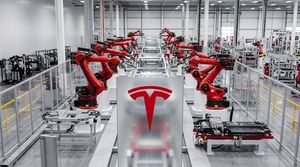
As the opening bells of 2026 ring across Wall Street, a profound shift in market leadership is unfolding. The long-standing dominance of "Big Tech" and the "Magnificent 7" has hit a significant wall, giving way to a robust resurgence in the so-called "Old Economy." In the first trading sessions of the new year, capital is flowing aggressively into value-oriented sectors—specifically Industrials, Basic Materials, and Energy—marking what many analysts are calling the "Great Rotation of 2026."
This transition is not merely a short-term correction but a fundamental reassessment of value. While the technology sector grapples with "valuation fatigue" and a growing skepticism over the immediate return on investment for massive Artificial Intelligence (AI) expenditures, the physical world is demanding attention. Driven by record federal infrastructure spending and a structural deficit in critical commodities, the companies that build, power, and provide the raw materials for the modern world are now the market's primary engines of growth.
The Infrastructure Peak and the AI Monetization Gap
The momentum behind this rotation has been building throughout 2025, reaching a fever pitch as 2026 begins. A primary catalyst is the "One Big Beautiful Bill Act" (OBBBA), passed in July 2025, which permanently extended 100% bonus depreciation and immediate R&D expensing for domestic manufacturers. This policy, combined with the "peak impact" phase of the Infrastructure Investment and Jobs Act (IIJA), has funneled an estimated $209 billion into "shovels-in-the-ground" projects. From bridge reconstructions to the massive expansion of the national power grid, the demand for heavy machinery and electrical infrastructure has reached levels not seen in decades.
In contrast, the technology sector is facing a "monetization gap" that has soured investor sentiment. Throughout 2024 and 2025, hyperscalers like Microsoft Corp. (NASDAQ: MSFT) and Alphabet Inc. (NASDAQ: GOOGL) poured hundreds of billions into AI data centers. However, as 2026 begins, the market is demanding to see the bottom-line revenue from these investments. With the Federal Reserve maintaining a "shallow easing" cycle and keeping the neutral interest rate in the 3.25% to 3.75% range, the high-multiple valuations of growth stocks are being punished by a higher cost of capital, while value stocks with strong free cash flow are being rewarded.
The Winners of the Physicalization Trend
The primary beneficiaries of this shift are the industrial giants that provide the backbone for both the "Old Economy" and the AI revolution itself. Caterpillar Inc. (NYSE: CAT) has emerged as a clear leader, reporting a record $40 billion backlog as it supplies the heavy equipment needed for both infrastructure projects and data center construction. Similarly, Eaton Corporation plc (NYSE: ETN) is seeing unprecedented demand for electrical switchgear and cooling systems required to keep massive AI server farms operational.
In the Basic Materials sector, the narrative is dominated by the "structural deficit" of copper. Freeport-McMoRan Inc. (NYSE: FCX) is riding a wave of high prices as copper is increasingly viewed as the "new oil," essential for the electrification of the global economy. Meanwhile, the Energy sector is seeing a sharp divergence. While crude oil faces an oversupply that has pressured companies like Occidental Petroleum Corp. (NYSE: OXY), natural gas producers like Devon Energy Corp. (NYSE: DVN) are thriving. The "insatiable" demand for electricity to power AI and the domestic manufacturing boom has turned natural gas into a critical strategic asset for 2026.
A Structural Shift Toward Reshoring and Tangible Assets
The wider significance of this rotation lies in the "physicalization" of the global economy. After decades of prioritizing software and digital services, the market is recognizing that the digital world cannot expand without a massive physical footprint. This trend is further bolstered by the continued "reshoring" or "friendshoring" of manufacturing. By early 2026, over 45% of U.S. manufacturers have relocated significant portions of their international operations back to North America to mitigate geopolitical risks and tariff pressures.
This movement represents a move away from the "K-shaped" recovery of the early 2020s, where only tech thrived, toward a broader "U-shaped" recovery that favors domestic value. Historically, this mirrors the post-dot-com era of the early 2000s, where the collapse of high-flying tech stocks led to a multi-year bull market in commodities and industrials. The regulatory environment has also shifted; policy is now focused on "Fortress America" manufacturing, providing a tailwind for domestic producers of steel, chemicals, and energy that their predecessors a decade ago did not enjoy.
The Road Ahead: Earnings as the Ultimate Arbiter
As we look toward the remainder of 2026, the short-term focus will be on the upcoming Q1 earnings season. Investors will be scrutinizing the reports of Big Tech firms for any signs that AI spending is finally translating into software-as-a-service (SaaS) revenue growth. If these numbers disappoint, the rotation into value could accelerate further. For Industrials and Materials, the challenge will be managing the inflationary pressures on raw materials and labor that often accompany such a robust growth phase.
In the long term, the market may be entering a secular period where "tangible assets" outperform "intangible assets." Strategic pivots are already underway; many tech-focused hedge funds are reportedly diversifying into "hard asset" plays, and private equity is increasingly targeting mid-cap industrial firms. The primary risk to this outlook would be a sudden global recession that dampens commodity demand, but for now, the momentum remains firmly with the builders and the producers.
Market Outlook and Investor Takeaways
The start of 2026 has provided a clear signal: the era of "growth at any price" has ended, replaced by a focus on valuation, dividends, and industrial utility. The key takeaways for the current market are the strength of the U.S. manufacturing base and the critical role of the energy transition in driving demand for basic materials. While Big Tech is far from obsolete, it is no longer the only game in town, and its path to growth is now fraught with higher hurdles and stricter investor oversight.
Moving forward, investors should watch the "copper-to-gold" ratio as a barometer for industrial health and keep a close eye on the Federal Reserve’s rhetoric regarding "sticky" inflation. If interest rates remain at these elevated levels, the premium on value stocks will likely persist. The Great Rotation of 2026 is a reminder that while the future may be digital, it is built on a foundation of steel, copper, and reliable energy.
This content is intended for informational purposes only and is not financial advice.