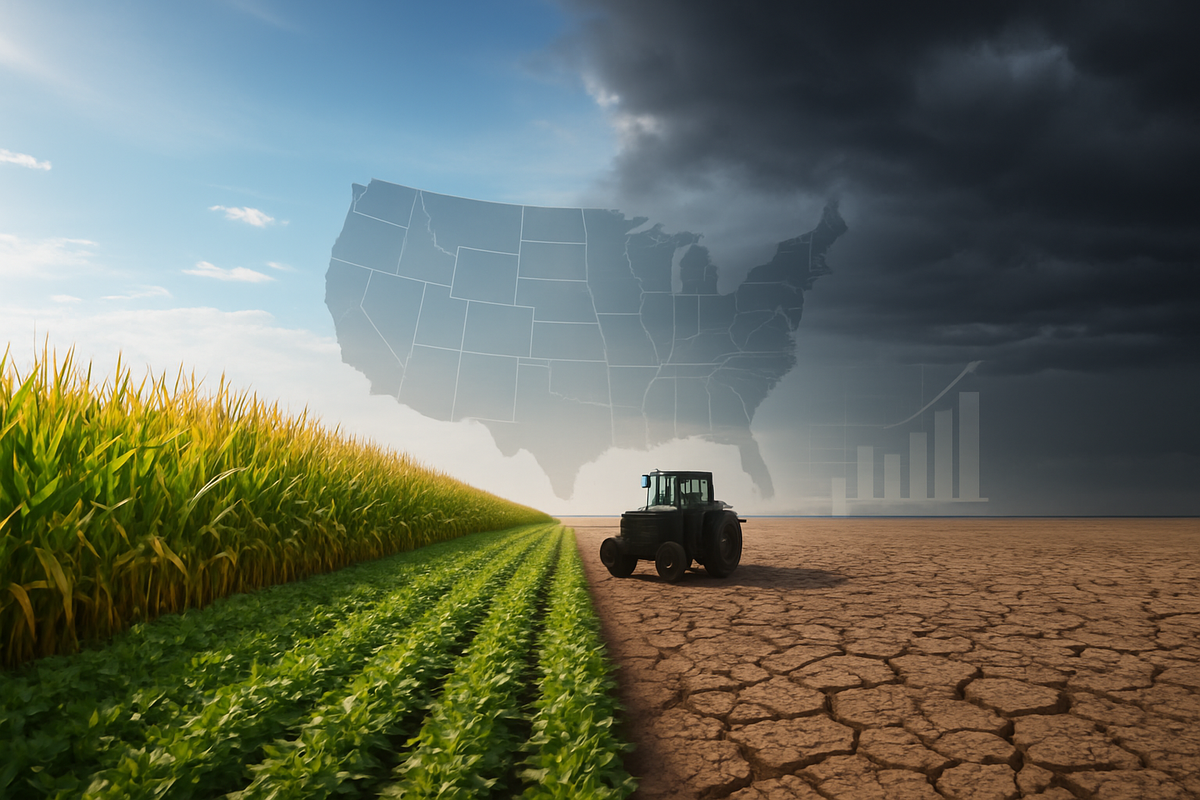
As the calendar turns to 2026, the United States Department of Agriculture (USDA) has released its comprehensive review of the 2025 agricultural year, a period defined by what outgoing Chief Economist Seth Meyer describes as a "year of extremes." While American farmers achieved resilient production levels in major commodities like corn and soybeans, the year was marred by a brutal economic squeeze, biological threats to livestock, and erratic weather patterns that tested the limits of the domestic supply chain.
The review arrives at a pivotal moment for the agency and the industry. Seth Meyer, a central figure in agricultural policy and market analysis since 2021, has confirmed he will conclude his tenure as Chief Economist at the end of January 2026. Meyer is slated to return to the University of Missouri to lead the Food and Agricultural Policy Research Institute (FAPRI), leaving behind a legacy of navigating the sector through one of its most volatile post-pandemic stretches.
A Turbulent Timeline: Weather, Disease, and the Margin Squeeze
The 2025 agricultural year was characterized by a series of overlapping crises that began with severe drought conditions in the Southern Plains, which significantly hindered winter wheat planting. This was followed by a freak mid-May cold snap that damaged emerging crops in the Midwest, and later, torrential summer rains that led to localized flooding and crop failures. Despite these regional disasters, national yields for corn reached a staggering 16.8 billion bushels, while soybeans hit a record 4.3 billion bushels. However, these high volumes did not translate into prosperity for many producers; commodity prices retreated from their 2022–2023 peaks while input costs for fertilizer, fuel, and labor remained stubbornly high.
Beyond weather, biological threats emerged as a primary concern for the USDA in 2025. The persistent spread of Highly Pathogenic Avian Influenza (HPAI) continued to disrupt the poultry and egg markets, keeping retail prices volatile. More alarming was the northward migration of the New World Screwworm through Mexico, which posed a direct threat to the U.S. cattle industry and required emergency federal intervention. These biological disruptions, combined with trade uncertainties, created a "perfect storm" of operational risks that defined Meyer’s final full year in office.
The economic pressure on farmers prompted a major policy shift in mid-2025. On July 4, the "One Big Beautiful Bill Act" (OBBBA) was signed into law, significantly raising reference prices for major commodities to provide a stronger safety net. Recognizing that OBBBA payments would not reach bank accounts until late 2026, the USDA also deployed $12 billion in "Farmer Bridge Assistance" in late 2025, providing roughly $30 to $44 per targeted acre to keep operations solvent during the transition.
Market Winners and Losers: Machinery Slumps While Bio-Tech Soars
The "year of extremes" created a sharp divide among public companies in the agricultural sector. Companies tied to large-scale equipment and traditional grain merchandising faced significant headwinds, while those focused on proprietary seeds and biological crop protection found a path to growth.
Deere & Co (NYSE: DE) emerged as a primary indicator of the industry's cooling sentiment. Despite beating Q4 earnings, the company issued a cautious 2026 forecast, predicting that the market for large agricultural equipment would drop by 15-20%. With net income falling to $5.03 billion in 2025—down from previous record highs—Deere executives described the current environment as the "bottom of the ag cycle," as high interest rates and diminished farm income stifled capital expenditures. Similarly, CNH Industrial (NYSE: CNHI) was forced to slash profit forecasts due to the combined impact of muted machinery demand and rising costs associated with steel and aluminum tariffs.
In the grain processing and trading space, Archer-Daniels-Midland (NYSE: ADM) and Bunge Global (NYSE: BG) both reported significant earnings pressure. ADM saw its profits hit five-year lows in the second quarter of 2025, as abundant grain supplies thinned processing margins and biofuel policy uncertainty clouded the outlook. Bunge Global reported its lowest Q2 earnings since 2018, with its grain merchandising segment slumping 78%. Bunge is now betting heavily on the integration of its $7.3 billion Viterra acquisition to find efficiencies in what remains a low-margin environment.
Conversely, Corteva (NYSE: CTVA) stood out as a notable winner. The company raised its guidance in late 2025, with net sales reaching approximately $17.8 billion. Corteva’s success was driven by strong demand for its proprietary seed brands and biological products, which farmers increasingly used to combat the unpredictable weather and pest pressures highlighted in Meyer’s review. The company expects a 6% growth in operating EBITDA for 2026, buoyed by market share gains across North and Latin America.
Policy Shifts and the Global Ripple Effect
The events of 2025 represent a fundamental shift in U.S. agricultural policy. The passage of the OBBBA marks a return to a more robust federal interventionism, aimed at protecting domestic food security against global market volatility. This shift is a direct response to the "economic squeeze" that saw producer margins hit multi-year lows despite record-setting production. The $12 billion bridge assistance program is a historical precedent in scale, reflecting the government's urgency in preventing a widespread farm debt crisis.
Globally, the 2025 review underscores a period of trade realignment. For soybeans, the record production in the U.S. met with "unfair market disruptions" and trade tensions that led to a significant build-up in ending stocks. As we enter 2026, the industry is closely watching newly negotiated trade flows with China, which will be critical in determining whether the current surplus can be cleared without further depressing prices.
Furthermore, the USDA's struggle with biological threats like the New World Screwworm highlights the increasing need for cross-border regulatory cooperation. The northward movement of such pests suggests that climate-driven biological risks are becoming a permanent fixture of the agricultural landscape, necessitating long-term investments in biosecurity and monitoring that go beyond traditional crop insurance models.
The 2026 Outlook: Searching for the Bottom
Looking ahead, the agricultural sector is bracing for a period of stabilization. With the 2026 outlook for corn and soybeans dependent on trade negotiations and the successful implementation of the OBBBA, the market is searching for a price floor. For wheat, the upside production surprise of 2025 has ironically led to stagnant planting forecasts for 2026, as low prices disincentivize farmers from expanding acreage.
Strategic pivots are already underway. Machinery manufacturers like Deere and CNH Industrial are shifting focus toward "global sourcing optimization" and precision technology to mitigate the impact of tariffs and lower unit sales. Meanwhile, the grain majors (ADM and Bunge) are pivoting toward renewable diesel feedstocks and value-added processing to offset the volatility of traditional grain merchandising.
The transition of Seth Meyer to FAPRI also marks a shift in the intellectual leadership of the sector. Meyer’s departure leaves a void at the USDA at a time when the "One Big Beautiful Bill Act" requires expert calibration. His move to lead one of the nation’s premier agricultural policy research institutes suggests that the debate over the future of the American farm safety net will increasingly be shaped by academic and data-driven analysis outside of Washington.
Summary and Investor Takeaways
The USDA’s 2025 review paints a picture of a resilient but financially strained agricultural sector. While production volumes remain high, the "year of extremes" has exposed vulnerabilities in farm income and biosecurity. The departure of Seth Meyer marks the end of an era of steady-handed analysis during a period of unprecedented global shocks.
Key takeaways for the market moving forward include:
- Watch the OBBBA Implementation: The timing and scale of payments in late 2026 will be the primary driver of farm liquidity and machinery demand.
- Monitor Trade Flows: Soybean prices remain highly sensitive to trade relations with China; any further disruptions could lead to a massive domestic surplus.
- Biotech Resilience: Companies like Corteva that provide proprietary solutions to weather and biological risks are currently outperforming traditional equipment and merchandising firms.
- Machinery Bottoming: Investors should look for signs of a "bottom" in the equipment cycle, as Deere and CNH Industrial navigate a high-interest-rate environment.
As the industry moves into 2026, the focus will shift from surviving the "extremes" of the past year to navigating the new policy and trade realities of a post-Meyer USDA.
This content is intended for informational purposes only and is not financial advice.