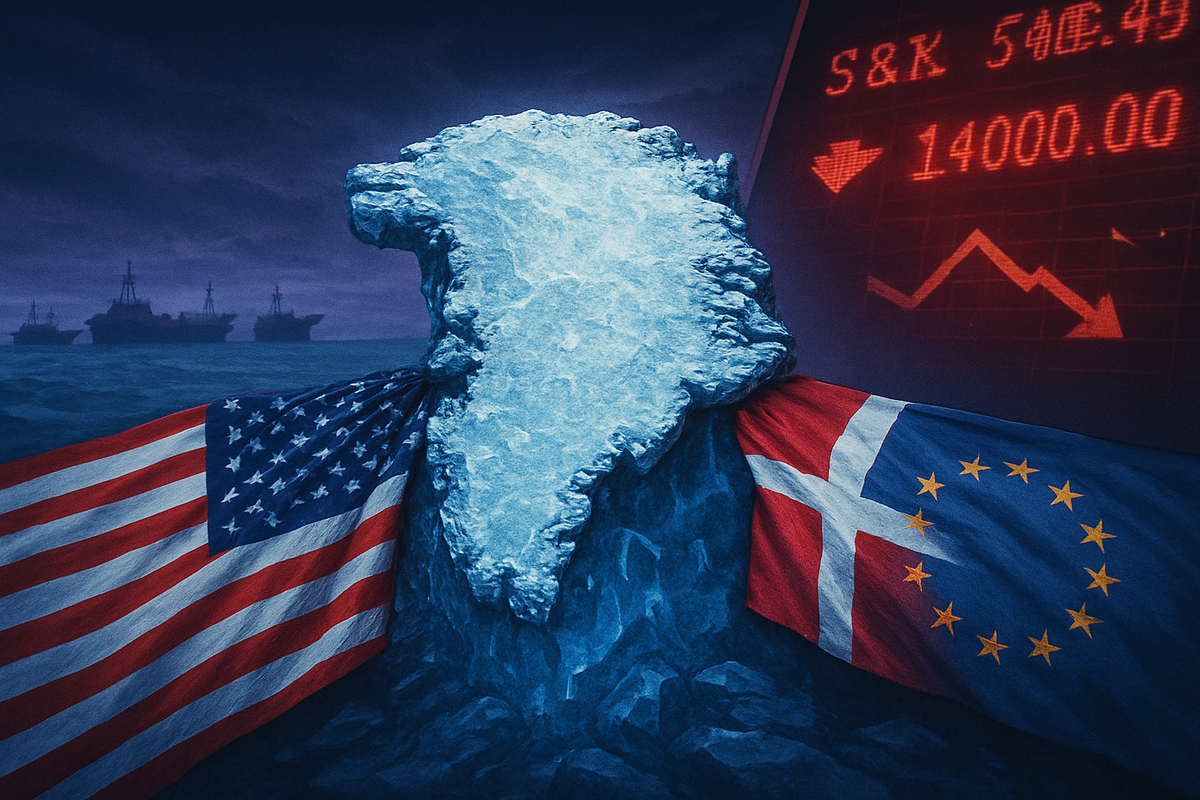
The global financial landscape was upended this weekend as the Trump administration unveiled a radical new trade offensive, dubbed the “Greenland Tax,” aimed at coercing the Kingdom of Denmark into negotiating the sale of the world's largest island. In a surprise announcement on Saturday, January 17, 2026, President Trump declared a tiered tariff regime targeting eight European nations—Denmark, Norway, Sweden, France, Germany, the United Kingdom, the Netherlands, and Finland—accusing them of obstructing American national security interests in the Arctic. The move signals a pivot from traditional trade protectionism toward a doctrine of "territorial mercantilism," using the economic might of the United States to redraw the geopolitical map.
The immediate implications for the market have been severe. On Monday, January 20, 2026, the S&P 500 (^GSPC) tumbled 2.1%, its sharpest one-day decline in months, as investors grappled with the prospect of a full-scale trade war with the European Union. Bond markets were equally volatile, with the 10-Year Treasury Yield jumping to 4.29% as traders priced in the inflationary pressure of new import duties. For the public, the immediate concern is a spike in the cost of high-end consumer goods, from German automobiles to French luxury items, as the first 10% wave of tariffs is set to take effect on February 1, 2026.
The Greenland Gambit: A Weekend That Shook the Markets
The current crisis began in the early hours of January 17, when the White House issued an executive order citing Section 232 of the Trade Expansion Act of 1962, claiming that the lack of U.S. control over Greenland’s strategic minerals and its vast Arctic territory constitutes a national security threat. The timeline for the "Greenland Tax" is aggressive: a 10% blanket tariff on all goods from the "Greenland Eight" nations starting in February, escalating to a punishing 25% on June 1, 2026, unless a "meaningful agreement" on the transfer of the territory is reached. This move effectively shatters the "Turnberry Truce" of August 2025, which had briefly brought stability to transatlantic trade following a year of tension.
Key players in this drama include Secretary of State Marco Rubio, who has spent the last 48 hours framing the acquisition as essential to countering Russian and Chinese influence in the North. Meanwhile, Danish Prime Minister Mette Frederiksen has remained steadfast, calling the proposal "absurd" and reaffirming that "Greenland is not for sale." This diplomatic stalemate has sent shockwaves through the industry. The initial market reaction was a flight to safety; while the Nasdaq Composite (^IXIC) fell 2.4% due to its heavy exposure to global supply chains, Gold surged over 3% to record highs of $4,750 per ounce as a hedge against the looming uncertainty.
The reaction from the European Union has been swift and defiant. European leaders, meeting in an emergency session in Brussels, have already threatened to activate the Anti-Coercion Instrument (ACI). This could lead to a "trade bazooka" of retaliatory measures, including the exclusion of U.S. firms from public procurement and the potential revocation of intellectual property protections for American tech giants. The escalation has turned what was once a fringe geopolitical curiosity into the primary driver of global market volatility in early 2026.
The Corporate Crossfire: Mining Titans and Luxury Giants
The announcement has created a stark divide between potential winners in the strategic resource sector and heavy losers in the consumer and industrial sectors. At the center of the "winner" circle is Critical Metals Corp (NASDAQ: CRML), which controls the Tanbreez project in Southern Greenland. As the U.S. government looks to secure domestic or "friendly" control of rare earth elements, CRML has seen a speculative surge in its stock price, with investors betting on federal subsidies or a primary role in an American-administered Greenland. Similarly, companies like Amaroq Minerals (TSXV: AMRQ) and Greenland Resources (TSX: MOLY), which are developing gold and molybdenum projects respectively, find themselves as the ultimate prizes in this geopolitical tug-of-war.
Conversely, the "Greenland Eight" tariffs represent a direct assault on European industrial giants and American retailers. LVMH Moët Hennessy Louis Vuitton (OTC: LVMUY), the world’s largest luxury goods company, saw its shares slide as the 25% tariff looms over its French-made leather goods and champagne. German automakers are also in the line of fire; Bayerische Motoren Werke AG (OTC: BMWYY), commonly known as BMW, and Volkswagen AG (OTC: VWAGY) face the prospect of passing on thousands of dollars in costs to U.S. consumers, potentially crippling their competitive edge in the North American market.
Retailers with high exposure to European supply chains are also under intense pressure. Hennes & Mauritz AB (STO: HM-B), or H&M, and Adidas AG (OTC: ADDYY) are bracing for margin compression as the cost of importing Swedish design and German engineering rises. Perhaps most vulnerable to retaliation is Boeing Co (NYSE: BA), which has historically been the first target for EU retaliatory duties on aircraft. Analysts at JPMorgan have warned that if the "Greenland Tax" reaches the 25% phase in June, it could shave as much as 0.5% off the total U.S. GDP growth for 2026 due to the resulting supply chain disruptions.
The Geopolitical Shift: Territorial Mercantilism and the New Arctic Order
This event marks a significant departure from the trade policies of the last several decades, signaling the rise of "territorial mercantilism." By tying trade access to land acquisition, the Trump administration is reviving 19th-century diplomatic tactics for a 21st-century economy. This shift fits into a broader industry trend where "resource nationalism" is becoming the primary driver of trade policy. The scramble for the Arctic—rich in an estimated $3 trillion worth of rare earths, nickel, and hydrocarbons—is no longer just about mining rights; it is about sovereign control of the routes and the soil itself.
The ripple effects extend far beyond Denmark. NATO allies like Norway and the UK now find themselves in the crosshairs of their primary security partner, creating a fracture in the Western alliance that competitors like Russia and China are likely to exploit. Historically, the closest precedent was the 1946 proposal by the Truman administration to buy Greenland for $100 million in gold, but that effort lacked the punitive trade mechanisms being deployed today. The current strategy reflects a belief that the U.S. market is an indispensable asset that can be used as leverage for non-trade objectives.
Furthermore, the regulatory implications are profound. If the administration successfully uses Section 232 to justify tariffs for territorial expansion, it sets a precedent that could be applied to other strategic areas, such as the South China Sea or Caribbean territories. This "policy by proclamation" approach bypasses traditional Congressional oversight, leading to a legal environment where market players must react to executive tweets and orders rather than settled law or long-term treaties.
The Path to the Arctic: Scenarios for the Summer Escalation
As we look toward the June 1 deadline for the 25% tariff escalation, several scenarios emerge. In the short term, we expect extreme volatility in the currency markets, particularly the Euro and the Danish Krone, as they react to the threat of a decoupled transatlantic economy. Strategic pivots are already underway; some European manufacturers are reportedly exploring "third-country assembly" in Mexico or Canada to bypass the "Greenland Eight" designation, though the administration has warned that "circumvention will be met with immediate sanctions."
A potential "Purchase 2.0" scenario remains the ultimate goal of the administration. This would likely involve a multi-billion dollar payout to Denmark, coupled with a sovereignty-sharing agreement that allows Greenlanders significant autonomy while the U.S. manages defense and resource extraction. However, if Denmark continues to refuse, the market must prepare for a "Frozen Trade War" where tariffs remain indefinitely. This would necessitate a massive restructuring of the luxury, automotive, and high-tech sectors, as companies like ASML Holding N.V. (NASDAQ: ASML) in the Netherlands find themselves caught in the crossfire of American demands and European resistance.
In the long run, this conflict may accelerate the development of domestic U.S. rare earth processing. If Greenland remains out of reach, the administration will likely double down on subsidizing projects in the American West and Alaska. For investors, the challenge is distinguishing between companies that can pass on these costs and those that will see their margins evaporate in a protectionist Arctic environment.
Investors’ Outlook: Navigating the Northern Storm
The "Greenland Tax" represents more than a trade dispute; it is a fundamental realignment of the relationship between the United States and its closest allies. For investors, the key takeaway is that geopolitical risk is no longer a peripheral concern but a central component of equity valuation. The era of predictable, rule-based trade is increasingly being replaced by a more transactional and unpredictable model. As the S&P 500 enters a period of heightened sensitivity to trade headlines, the market's resilience will be tested by the potential for a dual-front trade war with both the EU and China.
Moving forward, the market will likely see a continued rotation into "hard assets" like gold and strategic mineral stocks, while the consumer discretionary and aerospace sectors remain under a cloud of uncertainty. Investors should watch closely for the EU’s formal retaliatory list, expected in late February, and for any signs of a diplomatic "off-ramp" before the 25% tariffs trigger in June. The strength of the U.S. dollar will also be a critical indicator; while tariffs typically strengthen a currency, the unpredictability of this move has led to a rare decoupling where both stocks and the dollar have shown signs of weakness.
In the coming months, the focus will remain on the Arctic. Whether this gambit results in a historic land acquisition or a generational rift in the Western alliance, the "Greenland Tax" has permanently altered the trade landscape. Investors are advised to maintain diversified portfolios and keep a close eye on the T-bond market, as the inflationary impact of these tariffs may force the Federal Reserve to reconsider its interest rate path for the remainder of 2026.
This content is intended for informational purposes only and is not financial advice.