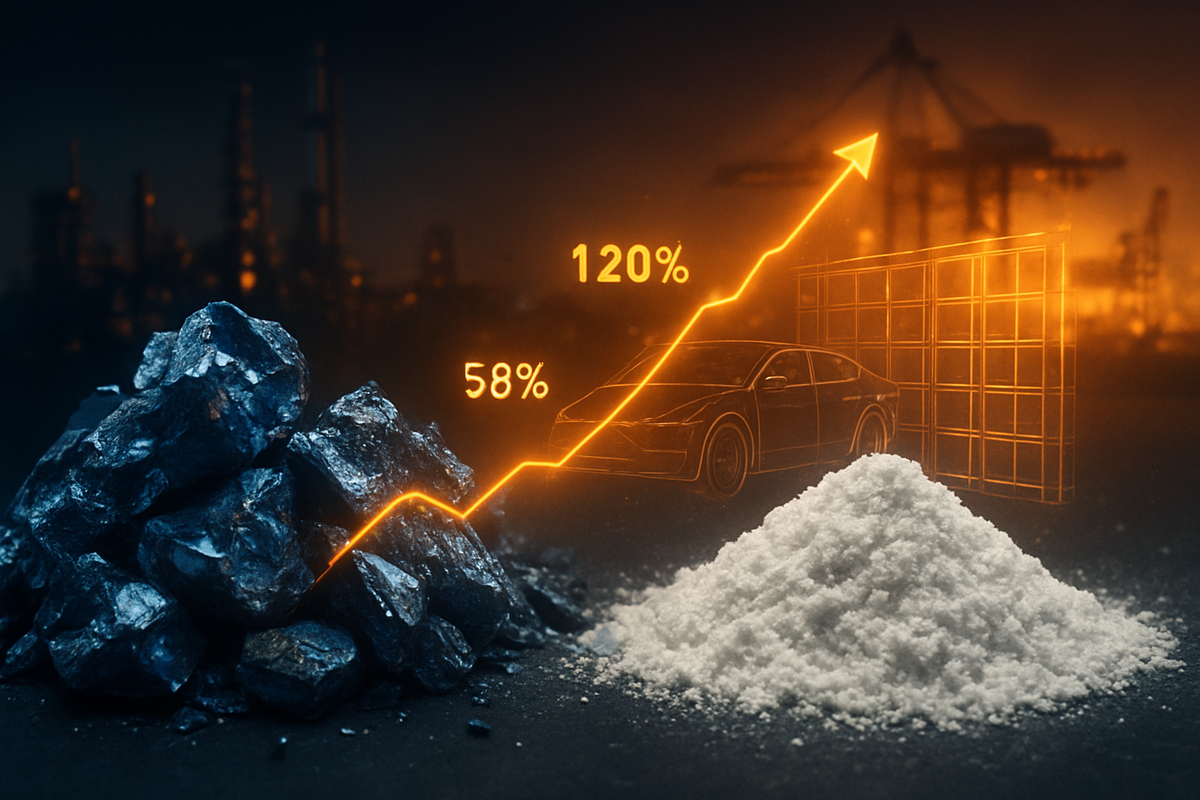
The global commodities market has entered 2026 with a startling reversal of fortune for the materials powering the green revolution. After nearly three years of price stagnation and oversupply, battery metals have come roaring back, with Cobalt prices surging by 120% and Lithium recovering 58% from their cyclical lows. This resurgence marks a definitive end to the "glut era" of 2023–2024, signaling a tightening market where supply-side interventions and a broadening of demand are finally catching up to the ambitious timelines of the global energy transition.
The implications for the broader market are profound. As of January 20, 2026, the cost of raw materials is once again a primary concern for electric vehicle (EV) manufacturers and grid-scale storage developers. While the previous years were defined by a "wait and see" approach, the current price action suggests that the window for securing low-cost long-term contracts has slammed shut. This shift is not merely a supply-demand rebalancing; it is the beginning of a new phase in the "Hotter Commodities" trend, where critical minerals are increasingly treated as strategic national assets rather than simple industrial inputs.
The Great Rebalancing: From Glut to Scarcity
The journey to the current price levels began in the final months of 2025. Following a period where the market was flooded with cheap material, particularly from high-cost lepidolite projects in China, a wave of production cuts finally rebased the floor. By mid-2025, several Chinese producers shuttered operations, unable to sustain losses as lithium prices hovered near $13,000 per metric ton. As these sources exited, the market found itself surprisingly lean just as seasonal demand for portable electronics and energy storage systems (ESS) spiked. Today, benchmark spodumene prices have reclaimed the $2,000 per tonne level, representing a 58% recovery that has caught many analysts off guard.
In the Cobalt market, the surge has been even more dramatic, with prices jumping 120% to reach approximately $56,414 per metric ton. The catalyst was a series of assertive moves by the Democratic Republic of Congo (DRC), the world's primary cobalt source. Seeking to stabilize their national revenue, the DRC government implemented strict export quotas and temporary bans on unprocessed ore throughout late 2025. This structural supply shock coincided with a renewed interest in cobalt-rich battery chemistries for high-performance defense applications and heavy-duty transport, creating a "perfect storm" for price appreciation.
The timeline of this recovery has been punctuated by the rapid growth of the Energy Storage Systems (ESS) sector. While the pace of passenger EV adoption in Western markets saw a cooling period in early 2025, the demand for grid-scale batteries to support renewable energy infrastructure grew at a staggering 45% year-over-year. This "ESS inflection point" has decoupled battery metal demand from the automotive cycle, providing a sturdier and more diversified floor for prices as we move into 2026.
Winners and Losers in a Volatile Landscape
The primary beneficiary of this market shift has been Rio Tinto Group (NYSE: RIO), which finalized its massive $6.7 billion acquisition of Arcadium Lithium (NYSE: ALTM) in late 2025. By absorbing Arcadium's diverse asset base just before the 58% price recovery, Rio Tinto has effectively leapfrogged many of its peers to become a top-tier lithium producer. The move is already being hailed as a masterclass in counter-cyclical investing, positioning the mining giant to benefit from higher margins throughout 2026.
Conversely, Albemarle Corporation (NYSE: ALB) has adopted a more cautious, "disciplined" stance. Despite the price rebound, the company has maintained a pause on construction at its major U.S. refinery projects. Citing high domestic labor costs and the current policy volatility in Washington, Albemarle has shifted its focus toward leaner operations and strategic partnerships, such as its recent production targets with Power Metals Corp (TSXV: PWM). For Albemarle, the challenge remains balancing the need for domestic capacity with the reality of global price competition, making them a "wait-and-see" winner if federal support solidifies.
Glencore plc (LSE: GLEN) has further cemented its status as the king of cobalt. As the leading trader of the metal, Glencore was the first to successfully navigate the DRC’s new quota system, utilizing its sophisticated logistics network to maintain supply flows while prices skyrocketed. Meanwhile, downstream players like Tesla, Inc. (NASDAQ: TSLA) find themselves in a more precarious position. After years of enjoying falling battery costs, the sudden reversal in metal prices is expected to squeeze margins on their more affordable "Model 2" and mass-market vehicle initiatives, potentially forcing a choice between price hikes or lower profitability.
Policy Uncertainty and the National Security Pivot
A significant driver of the current market volatility is the evolving policy landscape in the United States. On January 14, 2026, just days before this report, the U.S. government signed a proclamation launching Section 232 negotiations regarding the import of processed critical minerals. This move signals a shift toward direct market intervention, as Washington explores the possibility of setting "minimum price floors" for domestic lithium and cobalt. The intent is to insulate U.S. miners and processors from "price dumping" by foreign competitors, particularly China, which has historically dominated the refining space.
This policy shift is part of the broader "Hotter Commodities" trend, where minerals are viewed through the lens of national security. The focus has moved beyond the mine site to the "choke points" of the supply chain: refining and processing. The development of the Lobito Corridor—a strategic rail link designed to bypass traditional routes and facilitate ex-China mineral exports from Africa—has become a cornerstone of Western mineral diplomacy. For companies operating within this corridor, the geopolitical tailwinds are now just as important as the underlying commodity prices.
However, the "policy risk premium" remains high due to uncertainty surrounding the Inflation Reduction Act (IRA) and its $7,500 EV tax credits. With ongoing debates in Washington about "unraveling" or modifying these subsidies, many developers are hesitant to commit to long-term capital expenditures. This uncertainty has led to a bifurcated market: while "Blue States" like California and New York are implementing their own state-level incentive programs, the federal landscape remains a source of caution for the mineral extraction industry.
The Road Ahead: Strategic Pivots for 2026
Looking toward the remainder of 2026, the market is likely to see a significant strategic pivot toward diversification. With cobalt and lithium prices at multi-year highs, battery manufacturers are expected to accelerate research into "cobalt-free" and "lithium-sulfur" chemistries, though these remain years away from mass-market scale. In the short term, the focus will be on "urban mining" and recycling. High commodity prices have finally made the economics of battery recycling viable, potentially creating a new revenue stream for companies that can efficiently recover metals from end-of-life EV packs.
Furthermore, the electrification of the military and heavy industry will likely emerge as a secondary demand driver. From electrified exoskeletons to unmanned aerial vehicles, the defense sector’s "uninterruptible" demand for high-energy batteries provides a hedge against fluctuations in consumer EV sentiment. This "defense-critical" demand is less sensitive to price spikes than the consumer market, further insulating the battery metal rebound from potential economic headwinds.
In the long term, the outcome of the Section 232 negotiations will be the most critical factor to watch. If Washington successfully implements a price floor or higher tariffs, it could lead to a permanent "Green Premium" for minerals sourced and processed within the "Friendly-Shoring" network of U.S. allies. This would create a two-tiered global market: one governed by the lowest global cost, and another governed by supply chain security and environmental standards.
Market Outlook and Final Thoughts
The resurgence of cobalt and lithium in early 2026 serves as a stark reminder of the inherent volatility in the energy transition. The 120% jump in cobalt and 58% recovery in lithium are not just market corrections; they are signals of a structural shift toward a more complex, geopolitically charged commodities environment. The "glut years" were a temporary reprieve that may have lulled some manufacturers into a false sense of security regarding raw material availability.
For the market moving forward, the focus will shift from "securing supply" to "securing refined supply." Investors and industry stakeholders should keep a close eye on the progress of the Lobito Corridor and the final rulings on U.S. price floors. These regulatory developments will likely dictate which companies can thrive in an era where mineral trade is synonymous with national trade policy.
In the coming months, the ability of companies to manage their input costs while navigating a patchwork of regional subsidies will be the primary differentiator of success. While the price surge provides a tailwind for miners, it presents a formidable challenge for the downstream transition. The "Hotter Commodities" trend is here to stay, and the battle for the materials of the future has only just entered its most intense phase.
This content is intended for informational purposes only and is not financial advice.