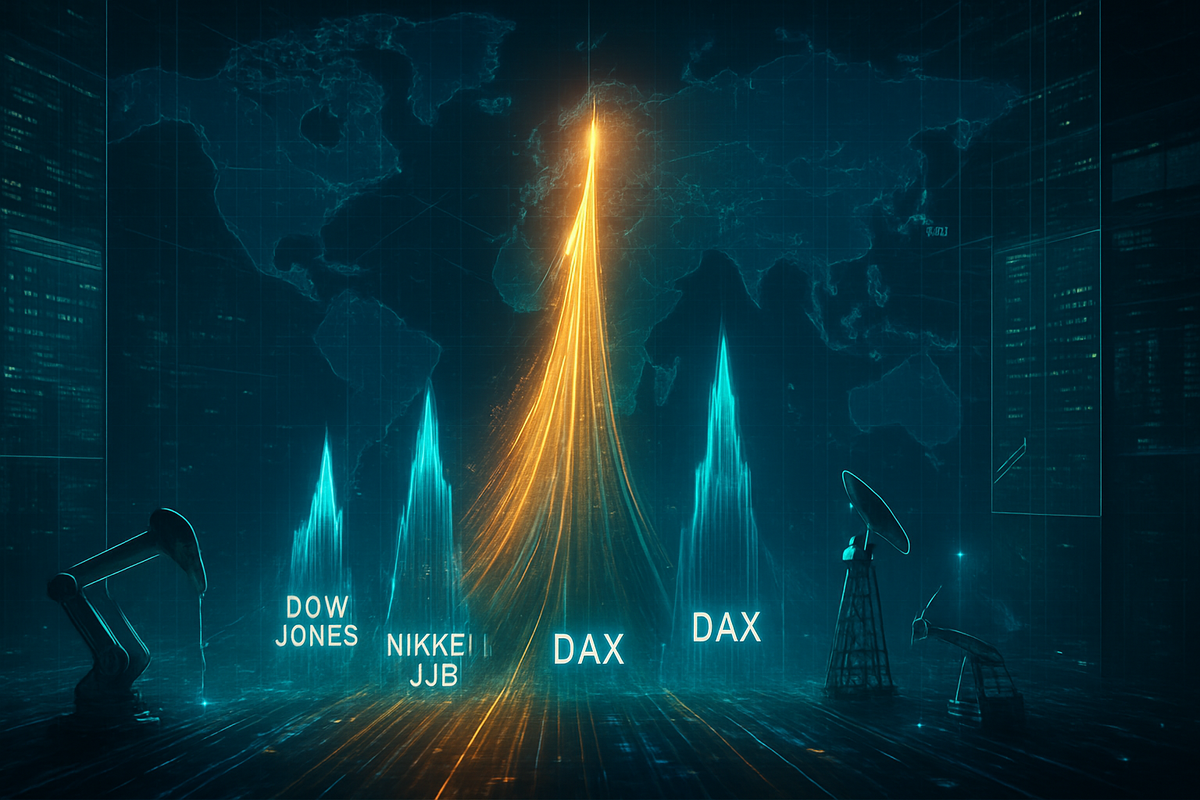
The first week of 2026 has witnessed an extraordinary and synchronized surge in global equity markets, as major indexes from New York to Tokyo reached unprecedented heights. Leading the charge, the Dow Jones Industrial Average (DJIA) climbed to an intraday record of 49,217 points on January 6, 2026, putting the psychological 50,000-point milestone within striking distance. This momentum was mirrored across the Atlantic and Pacific, with the FTSE 100 in London breaching the 10,000-point mark for the first time in history, while Germany’s DAX and Japan’s Nikkei 225 also set fresh all-time records.
This global "New Year Rally" suggests a profound shift in international economic sentiment, moving away from the inflation-induced anxieties of the mid-2020s toward a period of renewed fiscal expansion and technological optimism. However, beneath the surface of these record-breaking numbers lies a complex web of geopolitical shifts, legislative breakthroughs in the United States, and a fundamental evolution in the artificial intelligence sector that is beginning to redefine the industrial landscape.
A Perfect Storm of Policy and Geopolitics
The catalyst for this synchronized rally can be traced back to a series of high-impact events in late 2025 and the opening days of 2026. In the United States, the implementation of the One Big Beautiful Bill Act (OBBBA) has provided a massive fiscal tailwind. By making permanent the 2017 tax cuts and introducing new incentives—such as the elimination of taxes on tips and overtime—the act has significantly boosted consumer discretionary income and corporate earnings expectations for the coming year. Analysts estimate that the OBBBA could add as much as 1.2% to U.S. GDP in 2026, providing the fundamental support needed for the Dow's ascent.
Simultaneously, a dramatic geopolitical shift in South America sent shockwaves through the energy and defense sectors. The capture of Venezuelan leader Nicolás Maduro by U.S. forces in early January 2026 sparked a massive rotation into energy stocks, as investors bet on the eventual reintegration of Venezuela’s vast oil reserves into the global market under a more stable regime. This event, combined with escalating global tensions that have kept defense spending at record levels, provided a dual engine for growth in the more "traditional" sectors of the market.
Technology also played a pivotal role, specifically through the lens of CES 2026 in Las Vegas. The narrative of AI has transitioned from software-based chatbots to "Physical AI"—the integration of intelligence into robotics and industrial hardware. This shift was underscored by NVIDIA (NASDAQ: NVDA) and its unveiling of the "Vera Rubin" platform, which has moved into full production to meet the demands of a new era of autonomous industrial machines.
Winners and Losers in the New Economic Order
The current rally has created a distinct set of winners, particularly those positioned at the intersection of energy, defense, and advanced hardware. Energy giants like Chevron (NYSE: CVX) and ExxonMobil (NYSE: XOM) have seen their valuations soar on the prospect of new South American ventures. Similarly, defense contractors such as Lockheed Martin (NYSE: LMT), BAE Systems (LSE:BA.), and Rheinmetall (XETRA:RHM) are trading at record multiples as nations continue to modernize their military infrastructure in an increasingly volatile world.
In the financial sector, JPMorgan Chase (NYSE: JPM) and other major institutions have benefited from a "neutral" interest rate environment where the Federal Reserve has managed to stabilize the fed funds rate between 3.5% and 3.75%. This "Goldilocks" scenario—neither too hot to fuel inflation nor too cold to stifle growth—has allowed banks to maintain healthy net interest margins while seeing an uptick in investment banking activity as companies rush to fund new AI-driven capital expenditures.
However, the rally has not been universal, revealing a "K-shaped" divide in the corporate world. Retailers catering to middle-income families, such as Target (NYSE: TGT) and Kohl's (NYSE: KSS), have struggled as "sticky" inflation near 3% and high debt levels squeeze their core demographic. The "affordability crisis" has led many consumers to trade down to deep discounters, leaving mid-tier retail margins under pressure. Furthermore, legacy tech firms like Intel (NASDAQ: INTC) continue to lag behind, as the market remains skeptical of their long-term foundry transitions compared to the immediate gains seen by AI-first competitors like Advanced Micro Devices (NASDAQ: AMD).
The Wider Significance of the Synchronized Peak
The fact that the Dow, Nikkei 225, DAX, and FTSE 100 are all peaking simultaneously suggests that the "Great Decoupling" of the early 2020s may be giving way to a new form of global economic synchronization. This era is defined by a shared transition toward industrial automation and a move away from purely monetary-driven growth. For the first time in a decade, fiscal policy—led by the U.S. OBBBA and similar infrastructure-focused spending in Europe—is taking the lead from central banks in driving market sentiment.
Historically, such synchronized rallies have often preceded periods of intense industrial transformation. The current environment draws comparisons to the late 1990s tech boom, but with a crucial difference: today’s growth is increasingly rooted in "hard" assets and energy security rather than just "soft" digital services. However, this transition is not without its risks. The U.S. national debt, now exceeding $38 trillion, hangs over the market like a Damoclean sword. Investors are increasingly sensitive to bond yields; any spike in the 10-year Treasury toward the 5% mark could quickly turn this "Goldilocks" moment into a flight to safety.
Furthermore, the rise of protectionist policies and persistent tariffs has created a "Silver Trap" for hardware manufacturers. As the demand for precious metals like silver and gold—essential for AI circuit boards—reaches new heights, companies like Dell Technologies (NYSE: DELL) are facing a commodity supercycle that could eventually erode the very margins that the AI revolution promised to expand.
What Lies Ahead: The Q2 Debt Cliff
As we look toward the remainder of 2026, the short-term outlook remains bullish, but seasoned analysts are already eyeing a potential "Q2 Debt Cliff." A record amount of "Buy Now, Pay Later" debt accumulated during the 2025 holiday season is set to mature in the coming months, which could lead to a sharp contraction in consumer liquidity. How the market absorbs this "liquidity drain" will be a key test for the sustainability of the current rally.
Strategically, companies will need to pivot from "AI experimentation" to "AI implementation." The market is moving into a "prove it" phase, where the massive capital expenditures of firms like Microsoft (NASDAQ: MSFT) and Meta Platforms (NASDAQ: META) will be scrutinized for tangible returns on investment. Those that can demonstrate how Physical AI is actually reducing costs in warehouses or increasing efficiency in energy grids will likely continue to lead the market, while those stuck in the "hype" phase may see their valuations corrected.
Another critical factor to watch is the Bank of Japan’s move toward rate normalization. After decades of ultra-loose policy, any significant hike in Japanese rates could trigger a repatriation of capital, potentially causing volatility in the global bond markets that have become accustomed to cheap Japanese yen.
A New Frontier for Investors
The synchronized rally of early 2026 marks a historic milestone in the post-pandemic economic era. The breaking of the 10,000-point barrier for the FTSE 100 and the Dow’s proximity to 50,000 are more than just numerical achievements; they represent a global bet on a future powered by advanced robotics, energy independence, and fiscal expansion. For investors, the takeaway is clear: the market is rewarding companies that provide the physical infrastructure for the next industrial revolution while punishing those caught in the middle of a shifting consumer landscape.
Moving forward, the "Goldilocks" environment of moderate growth and neutral interest rates will be the primary narrative to track. However, the looming shadow of national debt and the potential for a "Q2 Debt Cliff" mean that volatility is likely to return before the year is out. Investors should maintain a diversified exposure to "Physical AI" leaders and energy majors while remaining cautious of debt-heavy retailers and legacy tech firms that have yet to prove their relevance in this new economic order.
The coming months will determine whether this rally is the start of a multi-year "Roaring Twenties" style expansion or a final peak before the weight of global debt and trade barriers forces a more painful adjustment.
This content is intended for informational purposes only and is not financial advice