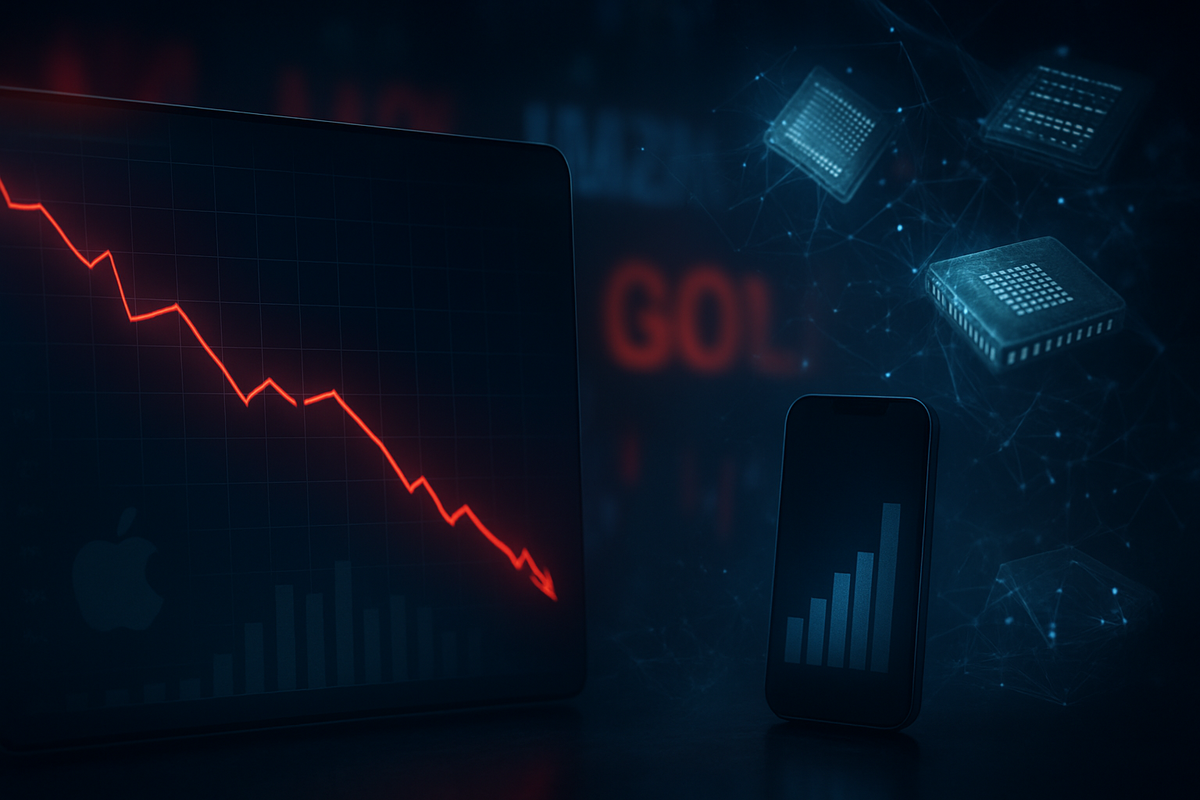
The first full week of 2026 has proven to be a sobering reality check for the world’s most recognizable technology giant. Shares of Apple Inc. (NASDAQ: AAPL) extended their early-year slide on Thursday, January 8, 2026, as a combination of surging component costs, a shifting macroeconomic landscape, and a massive rotation out of "Magnificent Seven" growth stocks weighed heavily on investor sentiment. After hitting a record high in early December 2025, the stock has now retreated approximately 7%, currently trading in the $260 range as the market grapples with a "Groundhog Day" scenario reminiscent of the sluggish start to 2025.
The immediate implications of this decline are being felt across the broader indices. While the S&P 500 and Dow Jones Industrial Average have managed to hover near record levels, Apple’s decoupling from the broader market highlights a growing skepticism toward high-valuation tech names that have yet to show clear monetization paths for their artificial intelligence (AI) investments. With a market capitalization now dipping below $3.85 trillion, Apple has officially ceded its position as the world's second-most valuable company to Alphabet Inc. (NASDAQ: GOOGL), marking a symbolic shift in the tech hierarchy as 2026 begins.
The Perfect Storm: Memory Spikes and Geopolitical Jolts
The downward trajectory for Apple began in earnest during the first three trading days of the year, following a significant downgrade by Raymond James (NYSE: RJF). Analysts at the firm shifted their rating to "Market Perform," citing "valuation exhaustion" and a concern that the much-anticipated "iPhone 17 supercycle" had already been baked into the stock’s premium price. This sentiment was compounded by a sudden spike in global DRAM and NAND flash memory prices, which are projected to rise between 40% and 70% in the first quarter of 2026. This "AI tax"—driven by the insatiable demand for high-performance memory in AI servers—threatens to squeeze Apple’s hardware margins just as the company prepares its 2026 product lineup.
Adding to the volatility was a geopolitical "risk-off" event known as the "Venezuela Jolt." Following a U.S. military operation on January 3 to capture Venezuelan President Nicolás Maduro, oil prices spiked, and investors reacted by pulling capital out of high-multiple growth stocks and into defensive sectors. Furthermore, Hon Hai Precision Industry Co., Ltd. (TPE:2317), better known as Foxconn, issued a warning regarding a seasonal slowdown in consumer electronics demand. These supply chain signals, coupled with reports of stagnating App Store revenue growth, have led many to question whether Apple’s high-margin Services division can continue to carry the weight of slower hardware sales.
Winners and Losers in the Great Rotation
The current market environment has created a stark divide between the "AI infrastructure" winners and the "consumer tech" laggards. Alphabet Inc. (NASDAQ: GOOGL) has emerged as a clear winner in early 2026, with its shares hitting new all-time highs as investors reward its dominant position in AI-integrated search and cloud services. Similarly, Nvidia Corp. (NASDAQ: NVDA) has remained resilient, gaining 1.2% this week as the primary beneficiary of the memory and chip shortage that is currently plaguing Apple’s cost structure.
On the losing side, Apple is joined by Microsoft Corp. (NASDAQ: MSFT), which saw a 2.1% dip as the market began to demand more concrete returns on its massive AI capital expenditures. However, the biggest "winners" aren't in tech at all; the first week of 2026 has seen a massive flow of capital into the Energy (+5.4%) and Financials (+7.2%) sectors. This "rotation trade" suggests that institutional investors are moving away from the crowded tech trade and into cyclical sectors that stand to benefit from "sticky" inflation and a Federal Reserve that has signaled a pause in its rate-cutting cycle.
AI Skepticism and the Shifting Industry Narrative
The broader significance of Apple’s slide lies in the changing narrative around artificial intelligence. For much of 2024 and 2025, Apple was given a pass on its "invisible AI" strategy—the idea that AI would be seamlessly integrated into the user experience rather than presented as a standalone product. However, by January 2026, that patience appears to be wearing thin. Competitors like Google and Microsoft have deployed more visible, generative AI tools, leaving Apple to face accusations of being an "AI laggard." The delay in a significant Siri overhaul has only fueled this perception.
Furthermore, this event fits into a broader trend of "margin compression anxiety" across the hardware industry. As AI server demand monopolizes the supply of critical components like high-bandwidth memory, consumer electronics companies are finding themselves at the back of the line, facing higher costs that they may not be able to pass on to a price-sensitive consumer base. This mirrors historical precedents where component shortages—such as the semiconductor crunch of 2021—led to prolonged periods of underperformance for hardware-heavy tech firms.
The Road to January 29: Earnings as the Ultimate Catalyst
In the short term, Apple must navigate a period of intense scrutiny leading up to its quarterly earnings report on January 29, 2026. This report will be the first major test for the company’s new CFO, Kevan Parekh, who took the reins at the start of the year. Investors will be looking for specific guidance on how the company plans to mitigate rising component costs and whether the iPhone 16 sales figures from the holiday season provided enough of a cushion to offset the current headwinds.
Long-term, Apple may be forced to accelerate its strategic pivot toward more aggressive AI monetization. This could include premium "AI-as-a-Service" tiers for iCloud or more advanced, paid features within the iOS ecosystem. The market is also looking for a definitive timeline for the next generation of spatial computing devices, as the Vision Pro line remains a niche product. If Apple can demonstrate a clear path to integrating generative AI into its 2026 hardware refresh, it could quickly regain its footing; otherwise, the "rotation trade" may continue to drain capital from the Cupertino giant.
Summary and Investor Outlook
The first week of 2026 has served as a reminder that even the most resilient companies are not immune to the gravity of valuation and macroeconomic shifts. Apple’s 7% decline is a result of a "perfect storm": a transition from AI hype to AI efficiency requirements, a sudden spike in component costs, and a broader market rotation fueled by geopolitical uncertainty and a pausing Federal Reserve. The key takeaway for investors is that the "Magnificent Seven" are no longer moving in lockstep; individual fundamentals and AI execution are now the primary drivers of performance.
Moving forward, the market will be hyper-focused on Apple’s January 29 earnings call. Investors should watch for commentary on gross margin guidance, updates on Siri’s generative AI capabilities, and any signals regarding the health of the Chinese consumer market. While Apple’s long-term ecosystem remains robust, the early days of 2026 suggest that the path to growth will be significantly more expensive and competitively fraught than in years past.
This content is intended for informational purposes only and is not financial advice.