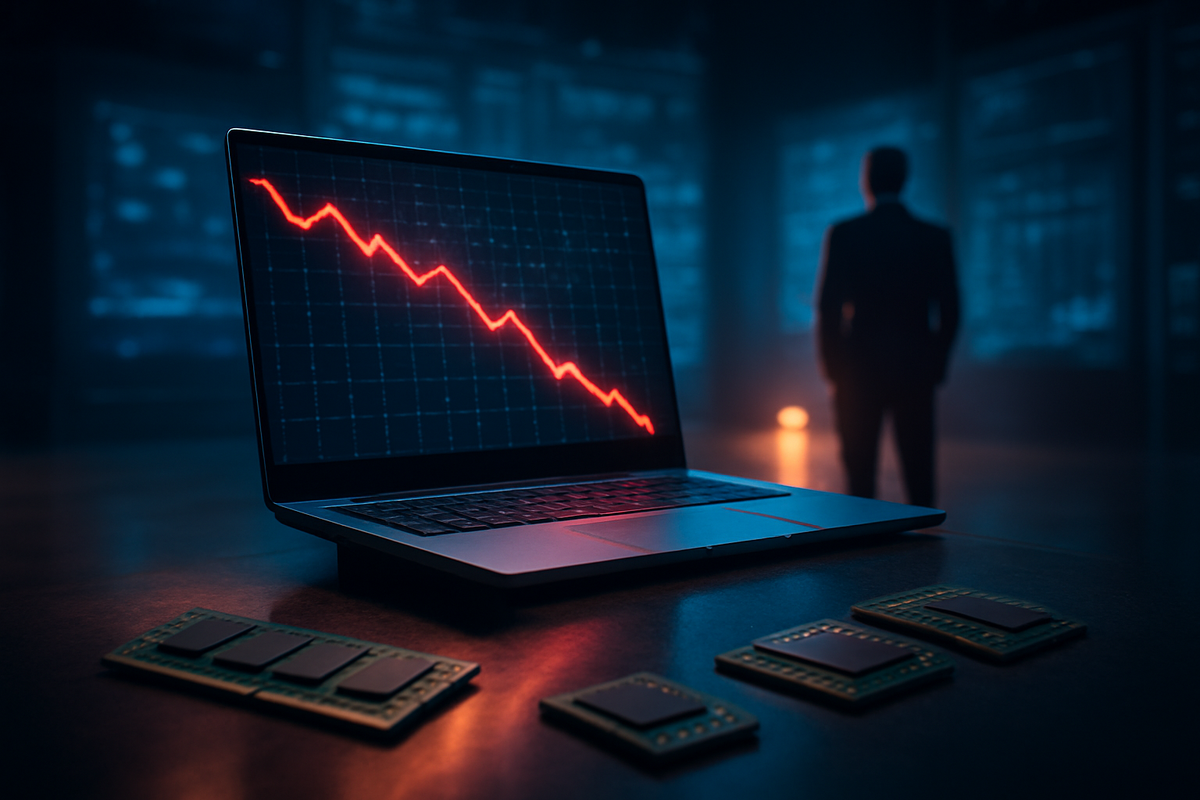
The annual Consumer Electronics Show (CES) in Las Vegas is typically a stage for unbridled corporate optimism, but for Dell Technologies (NYSE: DELL), the 2026 event has proven to be a sobering "reality check" that sent investors scurrying for the exits. Following a series of surprisingly blunt admissions from top executives regarding the failure of "AI PC" marketing and a looming supply chain crisis, Dell’s stock price tumbled by more than 4% by the close of trading on January 8, 2026.
The decline marks a sharp pivot in sentiment for a company that had spent much of the previous year riding the wave of artificial intelligence enthusiasm. While Dell’s enterprise server business continues to show strength, the company’s candid assessment of the consumer hardware market and its own tactical missteps has raised urgent questions about the sustainability of the current computer hardware recovery and the true value of AI-branded hardware for the average user.
A Mea Culpa in the Desert: The Road to the Decline
The trouble began on Wednesday, January 7, during a series of press briefings and analyst Q&A sessions. While Dell unveiled impressive new hardware, including a massive 52-inch 6K monitor and a refreshed laptop lineup, the conversation quickly shifted to the underwhelming performance of the "AI PC" category. Kevin Terwilliger, Dell’s Head of Product, and Sam Burd, President of the Client Solutions Group, delivered a startling admission: the industry-wide push to sell AI-integrated PCs to consumers had largely failed to resonate. Terwilliger noted that consumers are "not buying based on AI" and that the branding had likely caused more confusion than sales, a complete reversal from the "AI-first" narrative Dell championed at CES 2025.
This "honesty offensive" was compounded by comments from Jeff Clarke, Dell’s Vice Chairman and Chief Operating Officer. Clarke took the stage to address what he described as "unacceptable" performance in the consumer sector over the past year. In a rare public admission of a branding failure, Clarke conceded that the company had "gotten off course" in 2025 by retiring the iconic XPS brand in favor of a generic "Dell Premium" naming convention. While he used the event to announce the immediate return of the XPS 14 and 16 lines—even wearing an XPS-branded t-shirt as a symbolic "mea culpa"—the admission of past mismanagement did little to soothe nervous shareholders.
The final blow to investor confidence came when Clarke issued a stern warning about the 2026 fiscal year's cost structure. He revealed that Dell is entering the new year facing an "unprecedented" shortage of DRAM and NAND memory. According to Clarke, the insatiable demand for memory in AI data centers is effectively "sucking the oxygen out of the room" for the client PC market, leading to projected price hikes of up to 50% for critical components. This supply chain bottleneck suggests that Dell will soon face a difficult choice: raise prices on already-hesitant consumers or sacrifice its profit margins to maintain volume.
Winners and Losers in a Tightening Market
The immediate fallout from Dell’s CES disclosures has created a clear divide in the hardware and IT solutions sector. The primary "losers" in this scenario are the traditional PC OEMs who heavily invested in the "AI PC" narrative. Lenovo Group (HKEX:0992) and HP Inc. (NYSE: HPQ) saw their stocks trade lower in sympathy with Dell, as the market began to price in the possibility that the anticipated "supercycle" of PC upgrades—driven by local AI processing—may be more of a slow trickle than a flood.
Conversely, the "winners" appear to be the semiconductor giants that control the very supply Dell is worried about. Micron Technology (NASDAQ: MU) and Samsung Electronics (OTC:SSNLF) stand to benefit significantly from the "memory supercycle" Clarke described. As AI data centers continue to outbid consumer hardware makers for high-bandwidth memory and high-capacity SSDs, these component manufacturers are seeing their pricing power reach multi-year highs. Furthermore, Apple Inc. (NASDAQ: AAPL) may find itself in a position of relative strength; by maintaining its premium branding and vertically integrated supply chain, Apple has largely avoided the branding confusion and "commodity trap" that Dell admitted to falling into during 2025.
The End of the AI Hardware Honeymoon
Dell’s struggles at CES 2026 reflect a broader shift in the technology landscape: the transition from AI hype to AI utility. For the past two years, the industry has operated on the assumption that simply adding a Neural Processing Unit (NPU) to a laptop would be enough to trigger a massive replacement cycle. Dell’s admission that consumers don't care about the "AI PC" label suggests that the industry has failed to provide a "killer app" that justifies the premium price of this new hardware. This event fits into a historical pattern where hardware capabilities often outpace the software ecosystem, leading to a "trough of disillusionment" before real-world utility catches up.
The ripple effects of Dell’s supply chain warnings are also significant. The tension between the Infrastructure Solutions Group (ISG)—which builds the servers that run AI—and the Client Solutions Group (CSG)—which builds the PCs people use—is now a zero-sum game for components. This internal competition for resources could force a strategic realignment across the entire IT sector. If the "memory shortage" persists, we may see a regulatory or policy shift as governments look to prioritize component allocation for "critical" AI infrastructure over consumer electronics, further squeezing the margins of traditional PC makers.
Navigating the 2026 Hardware Squeeze
Looking ahead, Dell faces a challenging short-term horizon as it attempts to course-correct. The revival of the XPS brand is a necessary step to regain consumer trust, but it may take several quarters for the "Dell Premium" branding damage to be fully undone. In the long term, Dell’s massive $18 billion backlog in AI servers remains its strongest asset. Investors will likely see a strategic pivot where Dell de-emphasizes consumer "AI PC" marketing in favor of "AI-enabled productivity" for the enterprise market, where the return on investment for AI hardware is easier to quantify.
The potential for a market "overcorrection" is high. While the stock drop was sharp, some analysts argue that Dell’s transparency is a healthy sign of a company facing its problems head-on. The "memory supercycle" will eventually plateau, and if Dell can navigate the next six to twelve months without losing significant market share to HP or Apple, it may emerge with a leaner, more focused consumer business. However, the immediate challenge will be managing the "margin squeeze" caused by rising component costs in a stagnant demand environment.
The Reality Check for Investors
The events at CES 2026 have stripped away the glossy veneer of the "AI PC" revolution, revealing a market still tethered to the harsh realities of supply chain economics and consumer psychology. Dell’s willingness to admit that its marketing failed and its supply chain is under duress is a refreshing, if painful, moment of clarity for the industry. It serves as a reminder that even the most powerful technological trends cannot bypass the fundamental laws of value and scarcity.
Moving forward, investors should keep a close eye on Dell’s quarterly margin reports and the pricing trends of DRAM and NAND memory. The "AI PC" may yet have its day, but only when the software and the price point align with what the market actually needs. For now, the hardware sector is entering a period of consolidation and cautious realism, where "honesty" might be the best policy for companies, even if it hurts their stock price in the short term.
This content is intended for informational purposes only and is not financial advice.