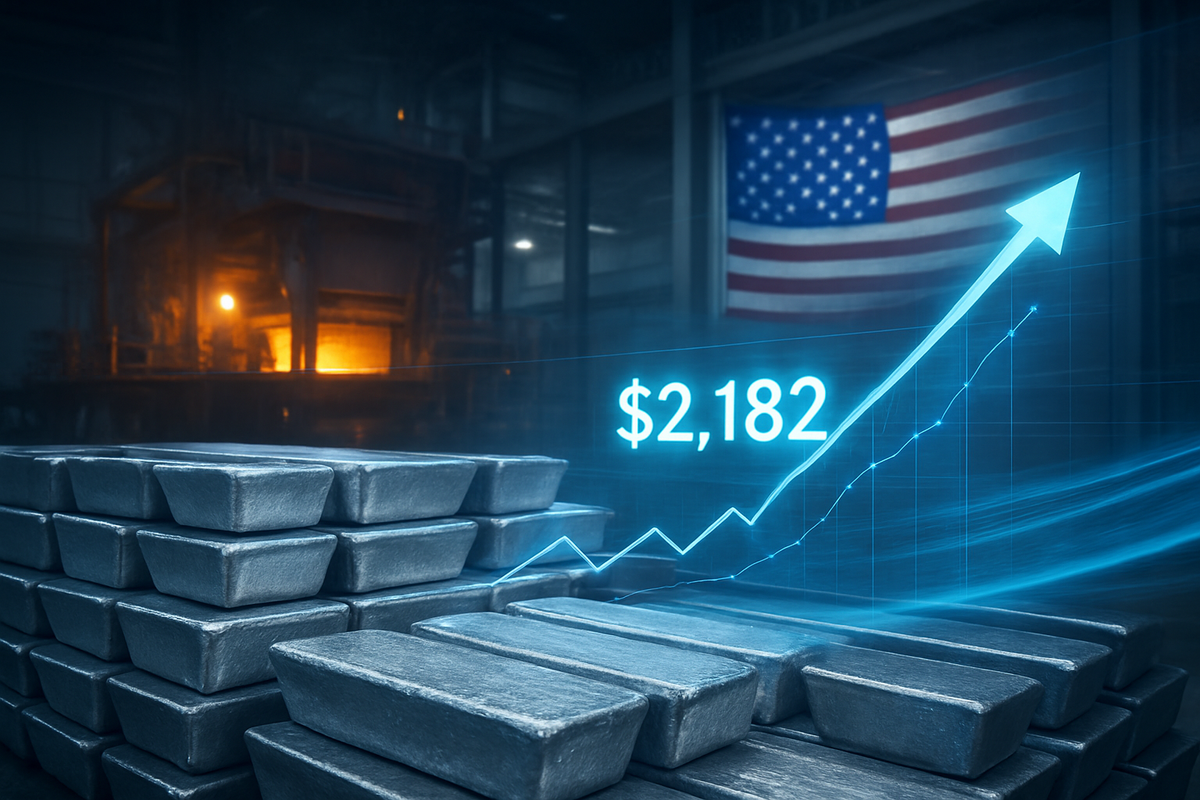
The American industrial landscape reached a historic inflection point this week as the US Midwest Premium for aluminum surged to a staggering $2,182 per tonne, surpassing the psychological $1-per-pound threshold for the first time in history. This unprecedented spike, driven by the aggressive 50% import tariffs under Section 232, has effectively decoupled the domestic aluminum market from global benchmarks, creating a massive price chasm between US manufacturers and their international competitors. While the London Metal Exchange (LME) remains relatively stable, US buyers are now paying an "all-in" price exceeding $5,340 per tonne, a figure that is sending shockwaves through the automotive and packaging sectors.
The market’s volatility reached a fever pitch following recent comments from Treasury Secretary Scott Bessent, who attempted to clarify the administration’s evolving trade stance. In a series of high-stakes interviews, Bessent signaled that while the administration is considering "narrowing" the scope of recent tariffs, any potential rollbacks would likely only apply to derivative products—finished goods like appliances or specific auto components—rather than the primary metal itself. This distinction has left domestic smelters breathing a sigh of relief but has sparked outrage among manufacturers who argue that taxing the raw material while exempting finished imports creates an impossible competitive disadvantage.
A Perfect Storm: The Path to $2,182
The ascent of the Midwest Premium has been both rapid and relentless. After breaking the $2,000 per tonne mark in early January 2026, the premium climbed steadily throughout February, peaking at $2,182 this week. This trajectory began in earnest in June 2025, when the administration hiked Section 232 tariffs on aluminum to 50%, up from the previous 25%. The move was intended to bolster domestic smelting capacity, but it has resulted in a 35% collapse in import volumes over the last nine months. With exchange inventories depleted and major industrial players like Arconic shifting almost entirely to the spot market to secure supply, the "duty-paid" premium has become the dominant driver of US aluminum costs.
The current pricing structure is further complicated by a recent Supreme Court ruling that challenged the use of the International Emergency Economic Powers Act (IEEPA) for broad trade restrictions. In response, the Treasury and Commerce Departments have pivoted to Section 122—a rarely used "Balance of Payments" authority—to act as a bridge, ensuring that the 50% levy remains functionally intact even as legal battles persist. This "tariff stacking" has created a floor for prices that many analysts believe will not lower anytime soon, as Secretary Bessent continues to champion the protection of the "core industrial base" over immediate consumer price relief.
Corporate Winners and Losers in the High-Tariff Era
The divergence in aluminum pricing has created a stark divide among public companies. Century Aluminum (NASDAQ: CENX) has emerged as the primary beneficiary of the 50% tariff wall. The company recently confirmed plans to break ground on a massive 750,000-tonne "green" smelter in Oklahoma—the first new US aluminum smelter in 45 years. However, its stock remains hypersensitive to policy shifts; shares of Century Aluminum dipped 10% earlier this week on fears that Bessent’s "narrowing" comments might eventually bleed into primary metal protections.
Conversely, Alcoa Corporation (NYSE: AA) faces a more complex reality. While Alcoa benefits from higher domestic prices, the company reported over $115 million in tariff-related costs in late 2025 due to its integrated global supply chain. Its stock fell 5% following the Treasury’s latest clarification, as investors weighed the benefits of high premiums against the rising costs of alumina and the risk of a domestic manufacturing slowdown. Meanwhile, Rio Tinto (NYSE: RIO) has been forced to adapt its North American strategy, increasingly sourcing from existing US inventories to bypass the 50% tariff on Canadian exports. In a move that highlights the extreme tightness of the market, Rio Tinto has reportedly begun adding "scarcity surcharges" of 1 to 3 cents per pound on top of the already record-high Midwest Premium.
Breaking the Global Benchmark: A Structural Shift
The current crisis represents a fundamental break in how aluminum is traded globally. Historically, the Midwest Premium was a minor add-on to the LME price, reflecting logistics and local demand. Today, the premium represents more than 40% of the total cost of the metal in the US. This "Great Decoupling" means that US-based manufacturers of everything from soda cans to the Ford F-150 are operating in a different economic reality than their rivals in Europe or Asia. Industry experts warn that this could lead to "material substitution," where engineers shift designs toward steel or composites to avoid the "aluminum tax."
Furthermore, Secretary Bessent’s focus on protecting "primary metal" while potentially exempting "derivatives" has introduced a new layer of regulatory risk. If a refrigerator made of high-tariff aluminum in Ohio must compete with a refrigerator imported from a non-tariffed country, the domestic producer is effectively penalized for using American-smelted metal. This policy tension suggests that the administration may be forced into a "Whac-A-Mole" style of trade enforcement, where tariffs must be expanded to more and more finished goods to protect the value of the raw material protections.
The Outlook: Volatility as the New Normal
In the short term, the US aluminum market is likely to remain in a state of "perpetual tightness." With the Midwest Premium at record levels, there is little incentive for importers to bring in metal unless they can guarantee a massive markup. For the automotive sector, this translates to an estimated $200 to $300 increase in the material cost of a standard vehicle. Manufacturers are now looking toward the mid-term elections and potential negotiations with Canada as the only realistic vents for this pricing pressure.
Long-term, the success of the administration's policy will be measured by whether the high prices actually lead to the promised "smelting renaissance." If companies like Century Aluminum can successfully bring new capacity online, the reliance on expensive imports may eventually fade. However, building a smelter takes years, and the industrial heartland may face a "valley of death" where high material costs drive manufacturing jobs offshore before domestic supply can catch up. Investors should brace for continued volatility and watch for any signs of a "truce" with Canadian suppliers, which remains the most significant potential downside risk for domestic premiums.
Navigating the Aluminum Supercycle
The climb to $2,182 per tonne is a clear signal that the era of cheap, globally-sourced aluminum is over for the United States. The Biden-Bessent trade framework has prioritised national security and domestic production capacity over the "just-in-time" global efficiency that defined the previous three decades. While this has created a windfall for domestic producers and spurred historic investment in new smelting technology, the collateral damage to downstream manufacturers is becoming harder to ignore.
Moving forward, the key metrics for investors to track will be the "all-in" price gap between the US and the LME, and the specific wording of any executive orders regarding derivative exemptions. If the Treasury successfully carves out derivatives without crashing the primary metal premium, it will be a major policy win for the administration. However, if the "narrowing" of tariffs leads to a flood of finished goods that undercut US factories, the record-high Midwest Premium may eventually become a monument to a policy that protected the metal but lost the market.
This content is intended for informational purposes only and is not financial advice.