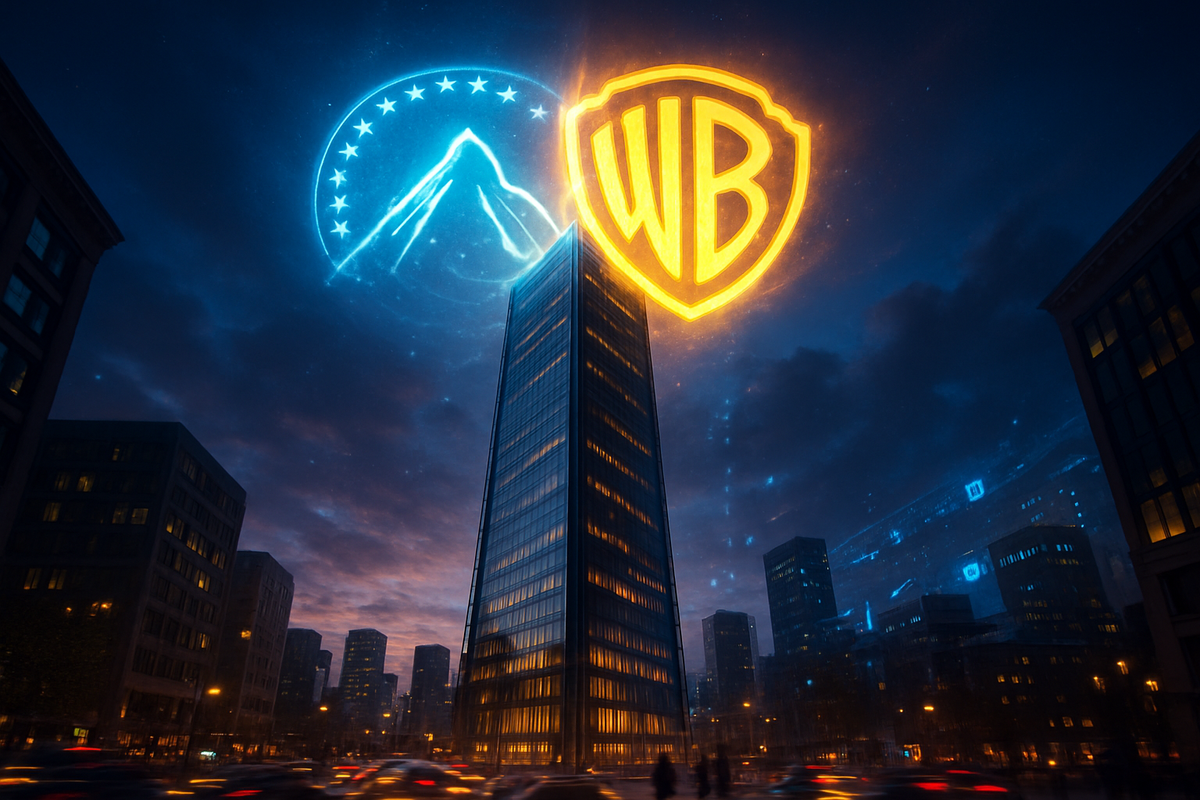
In a move that fundamentally redraws the map of the global entertainment industry, Paramount Skydance Corporation (NASDAQ: PARA) and Warner Bros. Discovery (NASDAQ: WBD) officially announced a definitive merger agreement on February 27, 2026. The all-cash transaction, valued at approximately $111 billion including the assumption of debt, represents the largest media consolidation in a decade and signals the end of the fragmented "streaming wars" in favor of a consolidated "national champion" model. Under the terms of the deal, Paramount Skydance will acquire WBD for $31.00 per share, a significant premium over its recent trading price.
The immediate implications for the market are profound. Shares of Warner Bros. Discovery surged nearly 18% in pre-market trading following the announcement, while Paramount Skydance shares remained steady as investors weighed the massive debt load against the immense scale of the combined entity. Analysts suggest that the merger will create a content library of unprecedented depth, uniting the legacies of HBO, Warner Bros. Pictures, Paramount Pictures, CBS, and CNN under a single corporate umbrella. This consolidation is expected to generate upwards of $5 billion in annual cost synergies, primarily through the integration of the Max and Paramount+ streaming platforms.
The Road to Consolidation: A High-Stakes Timeline
This historic agreement is the culmination of a tumultuous two-year period for both companies. The path was cleared in August 2025, when David Ellison’s Skydance Media successfully completed its $8 billion acquisition of National Amusements, effectively ending Shari Redstone’s control over Paramount Global. Following that merger, the newly formed Paramount Skydance, backed by the significant financial resources of the Ellison family and RedBird Capital Partners, immediately began scouting for a partner to achieve the scale necessary to compete with tech giants.
The pursuit of WBD was not without competition. In late 2025, Netflix (NASDAQ: NFLX) emerged as a surprise suitor, reportedly offering $83 billion for WBD’s premium studio and streaming assets while proposing to spin off its linear television networks. However, the WBD board, led by CEO David Zaslav, remained hesitant to carve up the company. The deadlock was broken on February 26, 2026, when Netflix officially withdrew its bid after Paramount Skydance submitted a "superior proposal" to acquire the entire company, including its legacy cable networks. This pivot by the WBD board paved the way for the February 27 signing.
Key players in the deal include David Ellison, who will serve as Chairman and CEO of the combined entity, and Jeff Shell, who has been instrumental in navigating the operational complexities of the merger as President of Paramount Skydance. David Zaslav, who spearheaded WBD’s aggressive deleveraging over the past two years, is expected to step down following a transition period, marking the end of a controversial but ultimately transformative tenure that saw WBD return to profitability in 2025.
Winners and Losers in the New Media Order
The clear winner in this transaction is David Ellison and the Ellison family. By leveraging the fortune of Oracle co-founder Larry Ellison, David Ellison has transformed a successful production boutique into a dominant global media powerhouse in less than three years. Shareholders of Warner Bros. Discovery also emerge as victors; after years of stock price stagnation and concerns over the company's "debt bomb," the $31.00 per share cash offer provides a lucrative exit strategy and validates the painful cost-cutting measures implemented throughout 2024 and 2025.
Conversely, traditional competitors like The Walt Disney Company (NYSE: DIS) now face a significantly more formidable rival. While Disney remains the leader in theme parks and franchise management, the Paramount-WBD combine will possess a larger total share of the domestic box office and a combined streaming subscriber base that could rival or surpass Disney+. Other "losers" include the high-level executives at WBD whose roles have become redundant; reports indicate a sweeping wave of layoffs is expected in middle and upper management as the two corporate structures are integrated throughout late 2026.
Netflix also finds itself in a strategic quandary. Having lost its bid for WBD’s premium content, the streaming pioneer must now decide whether to continue its heavy reliance on original production or seek another acquisition target—potentially looking toward gaming or smaller studios like Lions Gate Entertainment (NYSE: LGF.A). The tech-led streaming platforms, specifically Apple (NASDAQ: AAPL) and Amazon (NASDAQ: AMZN), may also feel the pressure, as the Paramount-WBD entity will have significantly more leverage when negotiating carriage deals and advertising partnerships.
A New Regulatory Era and Industry Shifts
The merger fits into a broader industry trend of "defensive consolidation," where legacy media companies are banding together to survive the onslaught of Big Tech. Historically, a merger of this magnitude—combining two of the "Big Five" movie studios and two major news organizations—would have faced insurmountable regulatory hurdles. However, the current landscape in early 2026 is markedly different. Under the second Trump administration, the Federal Trade Commission (FTC) and Department of Justice (DOJ) have adopted a more permissive stance toward domestic mergers, prioritizing the creation of "national champions" that can maintain American cultural dominance against international and tech-sector competitors.
Regulatory scrutiny will likely focus on the overlapping news divisions of CBS and CNN. To gain approval, many analysts expect the combined company may be required to divest one of these assets or operate them under a strict editorial firewall to preserve media plurality. This echoes the historical precedent of the Disney-Fox merger, where Disney was required to sell off regional sports networks to satisfy antitrust concerns. The current administration’s preference for structural remedies rather than outright blocks suggests the deal is likely to proceed, albeit with specific conditions.
The ripple effects will be felt across the advertising and sports rights markets. A combined Paramount-WBD will control a massive portion of live sports broadcasting, including NFL, NBA, and MLB rights. This concentration of power will give them unprecedented leverage in negotiations with professional sports leagues, potentially driving up the cost of rights for other broadcasters and changing how fans access live games in the late 2020s.
What Comes Next: Integration and Evolution
In the short term, the primary challenge for the new "Paramount-Warner" entity will be the technical and cultural integration of its streaming services. The industry expects a phased rollout where Paramount+ content is absorbed into the Max platform, creating a single "super-app" designed to reduce churn and maximize average revenue per user (ARPU). Strategically, the company will likely pivot away from the high-volume, low-margin content strategy of the early 2020s, focusing instead on high-budget "tentpole" franchises that can perform both in theaters and on streaming.
Over the long term, the success of this merger will depend on the company’s ability to manage its remaining debt—projected to be over $60 billion post-merger—while investing in emerging technologies like AI-driven content personalization and immersive media. Challenges may emerge from the continued decline of linear television; while the merger provides scale, it also increases the company's exposure to the shrinking cable bundle. Strategic pivots toward international expansion, particularly in high-growth markets in Asia and Latin America, will be essential to sustain growth as the domestic market reaches saturation.
Potential scenarios for late 2026 and 2027 include a further sell-off of non-core assets, such as local TV stations or specialized cable networks, to accelerate debt repayment. There is also the possibility that the combined company could become an attractive acquisition target for a tech giant like Amazon or Apple once the integration is complete and the balance sheet is stabilized.
Summary of the Media Landscape Moving Forward
The Paramount Skydance and Warner Bros. Discovery merger marks the definitive end of the "Redstone Era" and the beginning of the "Ellison Era" in Hollywood. The key takeaways for investors are the transition toward extreme consolidation and the shift in regulatory sentiment that has enabled this $111 billion tie-up. The market is moving toward a future dominated by a handful of massive entities—the "Big Three" of streaming—leaving little room for mid-sized players.
Moving forward, the market will be characterized by a focus on profitability over subscriber growth. The massive cost synergies promised by this deal will be the primary metric by which its success is judged in the coming quarters. Investors should watch for the official filing of the merger documents, the announcement of the combined company's new name, and any specific divestiture requirements mandated by the FTC.
As we look toward the second half of 2026, the success of this merger will serve as a bellwether for the entire media sector. If Ellison and Shell can successfully integrate these two giants without losing the creative spark that defines their respective brands, they will have built a fortress capable of weathering any shift in the digital landscape. For now, the industry holds its breath as the era of the Mega-Studio begins.
This content is intended for informational purposes only and is not financial advice.