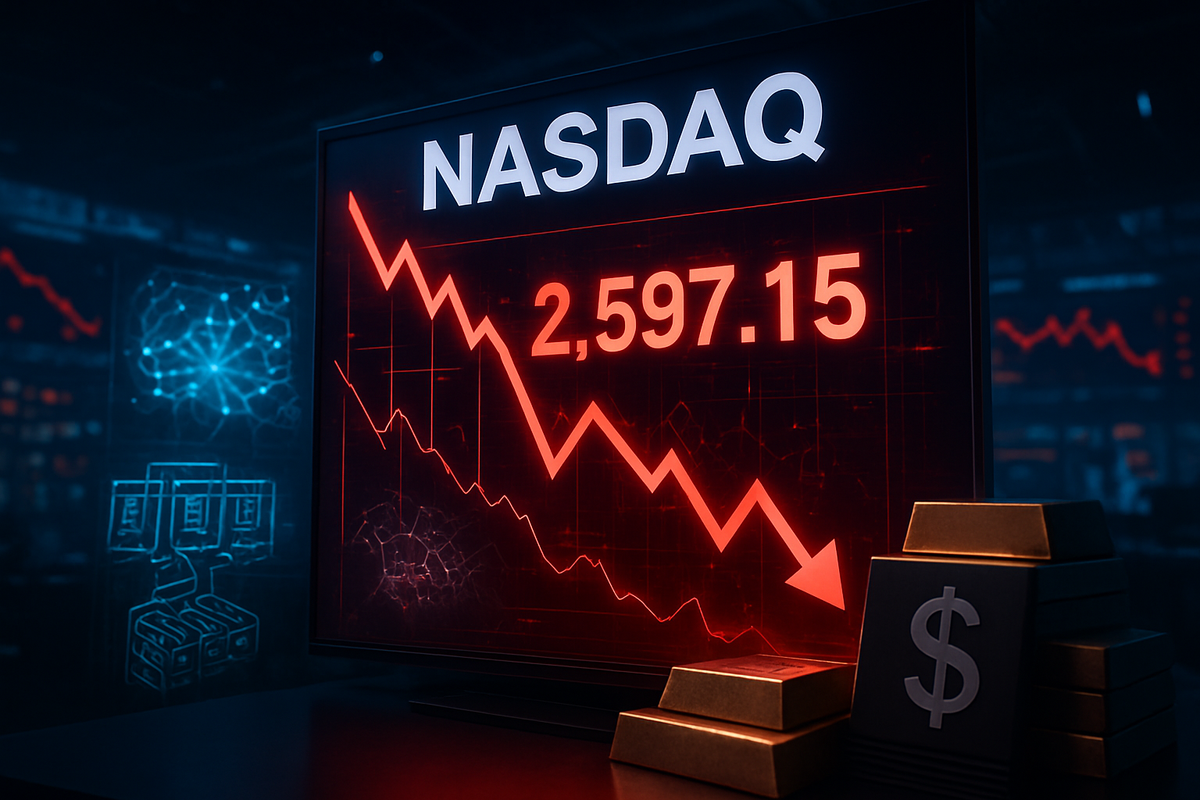
On February 13, 2026, the technology sector's long-standing honeymoon with artificial intelligence faced its harshest reality check to date. In a session defined by "Capex fatigue," the tech-heavy Nasdaq Composite plunged 2%, shedding 469.32 points to close at 22,597.15. The selloff was accompanied by a violent spike in the CBOE Volatility Index (VIX), which jumped nearly 18% to settle at 20.82, signaling a definitive shift from speculative exuberance to defensive posturing as the "fear gauge" breached the critical 20-point psychological threshold.
The immediate implications of this rout are clear: the market is no longer willing to grant an "AI premium" based solely on infrastructure growth and grand promises. After years of pumping billions into high-end silicon and massive data centers, investors are now demanding concrete evidence of return on investment (ROI). This "show me the money" moment has sent ripples through the entire financial ecosystem, forcing a rotation out of high-flying growth stocks and into defensive sectors like Utilities and Consumer Staples, even as the Dow Jones Industrial Average managed to cling to the 50,000 mark.
The Breaking Point: From Euphoria to "Capex Fatigue"
The collapse on February 13 was the culmination of a grueling three-session losing streak that saw the Nasdaq breach critical technical support levels, including its 50-day moving average. The primary catalyst was a growing realization that the aggregate annual AI infrastructure spend by the world's top five technology firms was projected to exceed a staggering $650 billion for 2026. This "compute arms race" has reached a scale that analysts warn may be unsustainable if software revenue does not begin to scale at a commensurate pace.
Adding to the tension was the lingering "DeepSeek Shock" of late 2025—an industry-shifting event where low-cost, highly efficient AI models emerged, suggesting that the massive GPU clusters currently being built might not provide the permanent competitive moat that many investors had priced in. Throughout the morning of the 13th, a wave of sell orders hit the tapes as financial institutions shifted their focus from "future potential" to "short-term transparency." The narrative has moved from how many chips a company can buy to how much durable, high-quality cash flow those chips are actually generating.
Key stakeholders, including institutional hedge funds and sovereign wealth funds, appear to be re-evaluating their weightings in the "Magnificent Seven." The day's trading volume was nearly 30% above the 30-day average, indicating a broad-based exit rather than a localized dip. Initial market reactions suggest that the period of "blind faith" in AI scaling laws has officially concluded, replaced by a rigorous scrutiny of quarterly depreciation schedules and the margins of AI-integrated software services.
The Giants Under Fire: Winners and Losers in the ROI Reckoning
NVIDIA (NASDAQ: NVDA) found itself in a paradoxical position during the selloff. Despite reporting record-breaking quarterly revenues near $70 billion with eye-popping 75% gross margins, its stock remained under heavy pressure, losing nearly $90 billion in market value since the start of 2026. The concern for Nvidia is the looming "CapEx cliff"—the fear that once its largest customers finish their initial infrastructure build-outs, demand will crater. Furthermore, reports of major clients like Meta (NASDAQ: META) shifting significant orders to AMD (NASDAQ: AMD) and the continued maturation of internal silicon like Alphabet’s (NASDAQ: GOOGL) TPUs and Amazon’s (NASDAQ: AMZN) Trainium chips are finally starting to chip away at Nvidia’s perceived monopoly.
Microsoft (NASDAQ: MSFT) also faced significant headwinds as its quarterly capital expenditure hit $37.5 billion, with two-thirds of that dedicated solely to AI hardware. While Azure's growth remained robust at 39% year-over-year, the selloff wiped roughly $613 billion off Microsoft’s valuation as investors worried that the extended depreciation of these massive assets would eventually crush earnings per share. The market is now questioning if Microsoft can convert its "Co-Pilot" ecosystem into a high-margin cash cow quickly enough to offset the interest and maintenance costs of its burgeoning data center empire.
On the other hand, defensive players and secondary AI beneficiaries have seen a relative boost in interest. Companies focusing on energy infrastructure and data center cooling are being viewed as "safer" ways to play the AI trend. However, for the primary "Hyperscalers" like Alphabet and Meta, the pressure is immense. Alphabet’s projected 2026 capex of $180 billion has left many wondering if its AI-integrated search can generate enough incremental ad revenue to justify the spend, while Meta’s $100 billion-plus commitment to "personal superintelligence" agents is being met with deep skepticism regarding their immediate monetization path.
A Structural Shift in the Tech Landscape
The February 13 selloff fits into a broader industry trend where the "hardware-first" phase of the AI revolution is transitioning into an "efficiency-first" phase. Historically, such shifts are painful; similar to the fiber-optic build-out of the late 1990s, the physical infrastructure often precedes the actual utility by several years. The "DeepSeek Shock" served as a historical precedent for 2026, much like how the emergence of open-source software challenged proprietary giants in previous decades. This shift suggests that the "moat" in AI may not be the amount of compute one owns, but the efficiency with which one uses it.
Regulatory and policy implications are also looming large. As these tech giants consolidate more power and capital into AI, they are facing increased scrutiny regarding energy consumption and anti-competitive behavior. The sheer scale of the $650 billion spend has drawn the attention of regulators who worry about a "silicon monopoly" that could stifle smaller innovators. This regulatory overhang, combined with the market's demand for ROI, creates a pincer move that is forcing companies to be more disciplined with their balance sheets.
The ripple effects are already being felt by partners and competitors alike. Smaller AI startups that rely on the venture capital spigot are finding that the "AI premium" has vanished, leading to a wave of consolidations and "acqui-hires" by the larger firms. The market is effectively separating the "AI pretenders"—those who used the buzzword to mask flagging core businesses—from the "AI contenders" who can prove margin expansion through automation and new product lines.
The Road Ahead: Strategic Pivots and Market Challenges
Looking forward, the tech sector must navigate a "valley of shadow" where infrastructure costs remain high but revenue remains in the adoption phase. Short-term, expect a series of strategic pivots. Meta is likely to double down on its ad-tech integration to prove immediate ROI, while Microsoft may look to raise subscription prices for its AI-enabled software to protect its margins. The potential for a "CapEx cliff" remains the single largest threat to the sector's stability in the second half of 2026.
Market opportunities may emerge in "AI-adjacent" industries that solve the bottlenecks of the current build-out, such as nuclear energy providers and advanced thermal management firms. However, the challenge for the Nasdaq will be regaining its record highs without the tailwind of unlimited speculative capital. We may see a period of "sideways" trading as the market digests the massive investments of the past three years. Potential scenarios range from a "soft landing," where AI revenue begins to catch up to capex by 2027, to a "hard correction" if the promised productivity gains fail to materialize in corporate earnings.
Conclusion: A New Era of Accountability
The events of February 13, 2026, mark the end of the "blank check" era for artificial intelligence. With the Nasdaq closing at 22,597.15 and the VIX signaling high anxiety, the market has sent a clear message: the era of infrastructure for infrastructure's sake is over. The focus has shifted decisively toward identifying which firms can successfully convert billions in silicon and electricity into profitable, recurring revenue streams.
Moving forward, investors should watch for specific AI monetization metrics in quarterly earnings calls—moving beyond "user growth" and focusing on "revenue per compute unit." The lasting impact of this selloff will likely be a more disciplined, value-oriented approach to tech investing. While the long-term potential of AI remains transformational, the path to getting there will be paved with rigorous financial accountability and a relentless focus on the bottom line.
This content is intended for informational purposes only and is not financial advice.