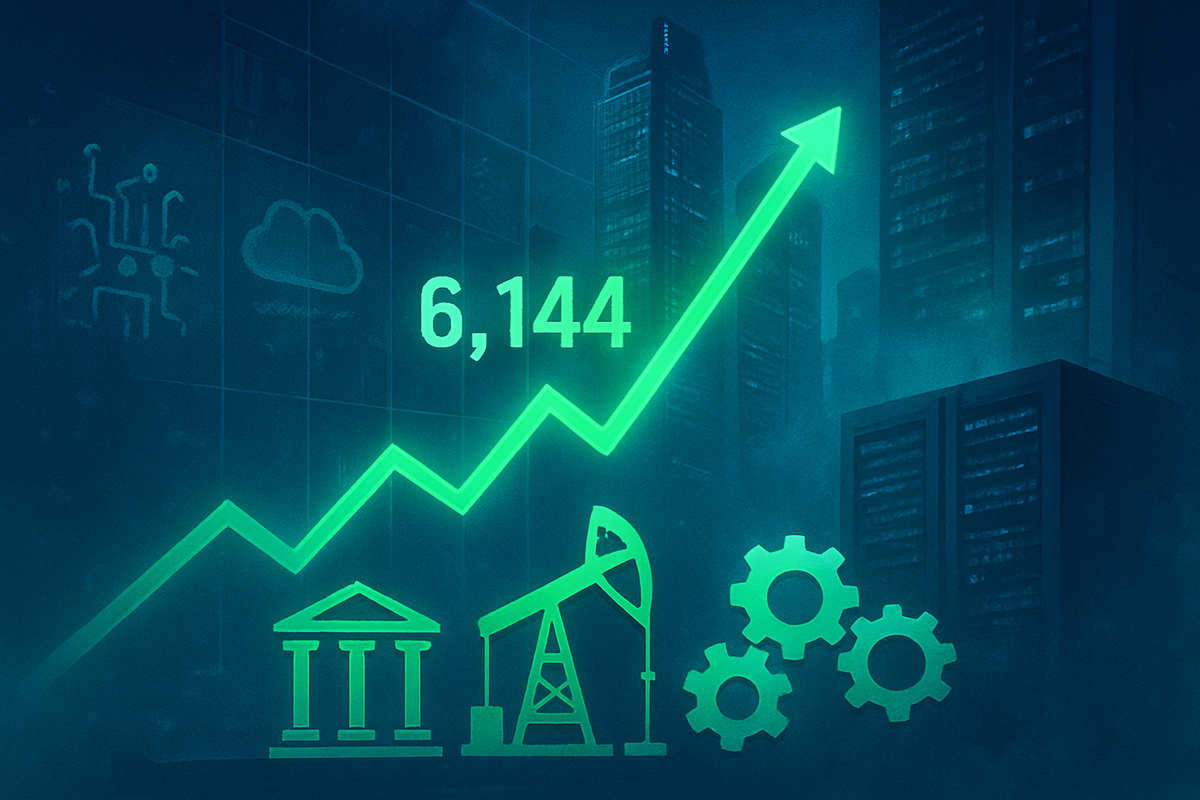
The S&P 500 has reached a pivotal juncture in early 2026, pushing toward the historic 6,144-point milestone, a level that has become a lightning rod for technical analysts and institutional strategists alike. This push to record highs comes at a paradoxical moment for Wall Street; while the headline index shows overall strength, the "Magnificent 7" technology giants that powered the rally of the previous two years are facing a stinging sell-off. Investors are increasingly rotating out of high-valuation growth stocks and into a broader array of sectors, signaling a fundamental shift in market leadership.
The divergence between the index's price and its traditional leaders highlights a burgeoning "Great Rotation." As the S&P 500 consolidates near its 6,144-point support/resistance zone, the market's internal health appears to be improving. The equal-weight S&P 500 is beginning to outperform its cap-weighted counterpart, a rare phenomenon in the AI era that suggests the rally is finally "broadening out" to the remaining 493 stocks. This transition is being fueled by a "Goldilocks" economic environment—characterized by steady GDP growth and a Federal Reserve that has begun to ease its restrictive stance.
A Tale of Two Markets: The Push to 6,144 and the Tech Retreat
The journey to 6,144 points has been marked by extreme volatility within the technology sector. On February 5, 2026, the market was rocked by a wave of earnings reports that triggered a "show me the money" reaction from investors. Amazon.com Inc. (NASDAQ: AMZN) saw its shares plunge over 7% in after-hours trading after the e-commerce and cloud giant revealed a staggering $200 billion capital expenditure plan for 2026. This followed a similar move by Alphabet Inc. (NASDAQ: GOOGL), which reported a 2026 AI spending guidance of $185 billion, causing its shares to slide 4% as investors questioned when these massive investments would translate into bottom-line free cash flow.
This "Capex fatigue" has created a vacuum in the tech sector, which has been the primary engine of the S&P 500 for years. Leading up to this moment, Microsoft Corp. (NASDAQ: MSFT) and Nvidia Corp. (NASDAQ: NVDA) also faced downward pressure as valuations reached levels that required flawless execution. However, the broader index remained resilient because of a surge in the "Old Economy" sectors. As tech stumbled, the S&P 400 MidCap Index and the Russell 2000 small-cap index surged, with the latter gaining nearly 8% in the first five weeks of the year. This shift was accelerated by the Federal Reserve's decision at its January 28, 2026, meeting to hold interest rates steady at 3.5%–3.75%, while signaling that further cuts could be on the horizon if inflation remains near the 2.7% mark.
Winners and Losers in the Great Rotation
The primary beneficiaries of this market pivot have been the Financials and Energy sectors. JPMorgan Chase & Co. (NYSE: JPM) and Goldman Sachs Group Inc. (NYSE: GS) have seen significant inflows as a steeper yield curve and a "soft landing" narrative boost banking margins. Regional banks, once the pariahs of the market, have also rebounded strongly, with the KBW Regional Banking Index hitting multi-year highs. Investors are betting that the "One Big Beautiful Bill Act" (OBBBA), signed into law in mid-2025, will continue to provide tailwinds through its permanent 100% bonus depreciation for domestic manufacturing investments.
On the losing side of the ledger, the mega-cap tech cohort is currently undergoing a valuation reset. Tesla Inc. (NASDAQ: TSLA) has struggled to maintain its premium as delivery growth remains uneven, despite a 44% surge in its energy storage business. Meta Platforms Inc. (NASDAQ: META) has fared slightly better than its peers due to a clearer AI monetization path through advertising, but it has not been immune to the sector-wide retreat. For these companies, the challenge in 2026 is no longer just demonstrating AI capability, but proving AI profitability. Analysts at J.P. Morgan Research have noted that "U.S. exceptionalism" is fading, and the market is now demanding a more balanced contribution from all sectors rather than relying on a handful of tech titans.
Broader Significance and Historical Precedents
The current market environment mirrors the late stages of the 1990s bull market in its enthusiasm for new technology, but with a critical difference: today's market leaders have massive cash reserves and real earnings. However, the concentration risk that defined 2024 and 2025 has reached a breaking point. The push to 6,144 points is significant because it represents a "de-risking" of the S&P 500. When a market hits record highs while its largest components are falling, it indicates that the "underlying base" of the economy is strengthening.
The OBBBA legislation has played a role similar to the tax cuts of previous eras, incentivizing companies like Exxon Mobil Corp. (NYSE: XOM) and Chevron Corp. (NYSE: CVX) to reinvest in domestic infrastructure. This has created a ripple effect across the Industrials and Utilities sectors, which are now seen as the "backbone" of the AI revolution. Data centers require power and physical structures, shifting the investment thesis from software (the "Magnificent 7") to hardware and energy providers. This diversification of the S&P 500’s growth engines is historically a bullish sign for the longevity of a market cycle, as it reduces the impact of a single-sector bubble burst.
The Road Ahead: Strategic Pivots and Market Outlook
Looking toward the remainder of 2026, the S&P 500's ability to hold the 6,144 level will depend on whether the "Catch-up" trade can sustain its momentum. Market participants are looking ahead to the June Federal Reserve meeting, where a potential 25-basis-point cut could provide another spark for small and mid-cap companies that are more sensitive to borrowing costs. For the "Magnificent 7," the next few months will require a strategic pivot. Companies like Apple Inc. (NASDAQ: AAPL) are already attempting this by bridging the AI gap through collaborations, such as the recently integrated Gemini-powered Siri, which aims to leverage existing hardware ecosystems rather than relying solely on massive new data center builds.
Opportunities are emerging in "AI Infrastructure" plays—utilities and energy firms that will power the massive Capex projects announced by Amazon and Alphabet. The challenge for investors will be navigating the volatility as the market decides whether the AI spending spree is a visionary investment or a cautionary tale of overextension. If the S&P 500 can successfully digest the tech sell-off while maintaining its 6,144 support level, it may set the stage for a push toward the 7,000-point mark later in the year, as projected by several more aggressive Wall Street targets.
Summary of Key Takeaways
The S&P 500’s push to 6,144 points is a landmark event that signifies a healthier, more balanced American equity market. While the headlines focus on the $200 billion spending plans of tech giants and the subsequent "Capex Reckoning," the real story is the resilience of the broader market. The transition from a concentrated rally to a broad-based advance is a welcome development for long-term investors, as it suggests the "soft landing" for the U.S. economy has taken firm root.
Moving forward, investors should keep a close eye on the earnings quality of the non-tech sectors and the trajectory of the Federal Reserve's interest rate policy. The "Great Rotation" is not a sign of a market peak, but rather a sign of market evolution. As the "Magnificent 7" learn to balance innovation with fiscal discipline, the rest of the market is finally getting its moment in the sun, proving that there is plenty of life in the S&P 500 beyond the world of mega-cap technology.
This content is intended for informational purposes only and is not financial advice.