The ghost of the 1970s has returned to haunt Wall Street. As of March 11, 2026, the primary narrative dominating financial markets is no longer a "soft landing" or a "no landing," but the far more treacherous specter of stagflation. A toxic combination of a hotter-than-expected January Producer Price Index (PPI) and a dramatic deceleration in fourth-quarter GDP growth to just 1.4% has left investors grappling with a reality where prices are rising while the economic engine sputters.
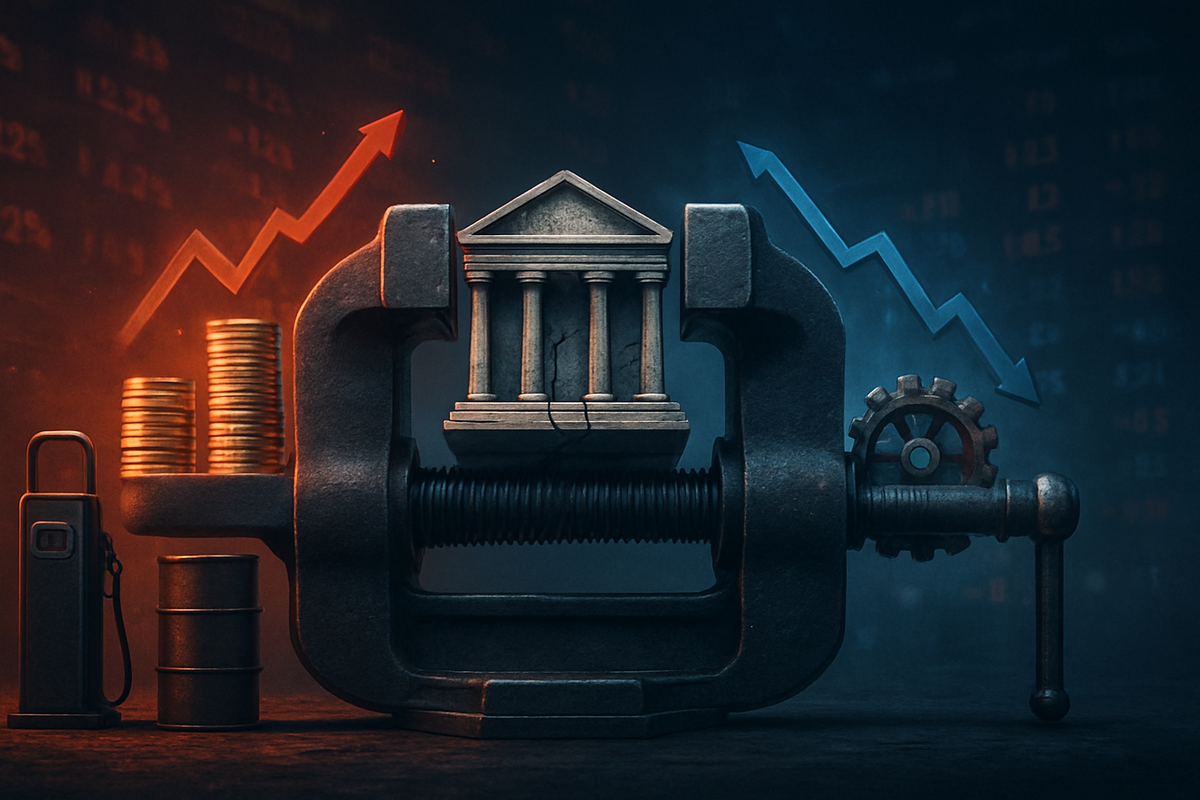
The implications for the Federal Reserve are severe. Just as the market was pricing in a pivot toward rate cuts to support a cooling labor market, the sudden spike in wholesale inflation has effectively pinned the Fed in a "vise." With the benchmark interest rate currently sitting between 3.50% and 3.75%, the central bank now faces the impossible choice of cutting rates to prevent a recession—thereby risking an inflationary spiral—or keeping rates high to fight prices, which could deepen the current economic slowdown.
The Perfect Storm: A Timeline of Economic Disruption
The current crisis began to coalesce in late February 2026. On February 20, the Bureau of Economic Analysis (BEA) released the advance estimate for 4Q 2025 GDP, revealing a meager 1.4% annual growth rate. This represented a staggering drop from the 4.4% expansion seen in the third quarter. Much of this drag was attributed to the historic 43-day government shutdown that paralyzed federal services from October to mid-November 2025, which the BEA estimates stripped a full percentage point from the quarterly growth figure.
However, the "stagnation" half of the equation was only part of the story. On February 27, 2026, the Department of Labor released January’s PPI data, which sent shockwaves through the Treasury market. Headline PPI rose 0.5% month-over-month, but the "Core" figure—excluding food and energy—leaped by 0.8%. This was the sharpest monthly jump in nearly two years, driven by a 0.8% rise in service costs and the lingering effects of 10–15% tariffs implemented in 2025. By the time February’s payroll data arrived in early March, showing a loss of 92,000 jobs—the first contraction in years—the stagflation narrative was firmly cemented.
The geopolitical backdrop has only exacerbated these domestic pressures. Military operations in the Middle East have sent WTI Crude Oil prices soaring from $60 in late January to peaks of $120 per barrel in early March. This energy shock acts as a regressive tax on consumers while simultaneously driving up input costs for manufacturers, creating a feedback loop of rising prices and falling demand that the Federal Reserve is ill-equipped to handle with traditional monetary tools.
Winners and Losers: Corporate America in the Crosshairs
The return of stagflation creates a stark divide between companies with pricing power and those vulnerable to margin compression. Target Corporation (NYSE: TGT) has emerged as a primary casualty of this environment. The retail giant saw its stock slide over 4.5% in early March as investors feared a "margin squeeze." Target is facing a double-edged sword: rising wholesale costs (PPI) that it cannot fully pass on to a consumer base already reeling from a slowing economy (GDP).
In contrast, Walmart Inc. (NYSE: WMT) has shown relative resilience. As a "flight to safety" destination, Walmart often benefits when consumers trade down from premium retailers. However, even the world's largest retailer is not immune; companies like Procter & Gamble Co. (NYSE: PG) have warned of significant hits to the bottom line—projected at over $1 billion—due to the cumulative impact of tariffs on raw materials. While Staples can pass some costs along, the slowing growth environment limits their ability to hike prices indefinitely.
In the technology sector, the high-flying giants that led the 2024-2025 rally are facing intense scrutiny. NVIDIA Corp. (NASDAQ: NVDA) and Apple Inc. (NASDAQ: AAPL) are now battling rising component and logistics costs just as capital expenditure budgets at major corporations begin to tighten. While the AI infrastructure boom remains a long-term tailwind, the immediate reality of higher-for-longer interest rates and surging energy costs is forcing a revaluation of their premium multiples. Conversely, the Energy sector has been the lone bright spot, with domestic oil producers reaping the benefits of $110+ crude, though these gains are effectively a transfer of wealth from the rest of the economy.
Broader Significance: The End of the Post-Pandemic Era?
This event marks a significant shift in the global macroeconomic regime. For the past two years, the market has operated under the assumption that inflation was a solved problem and that the Fed’s primary mission was to find the "neutral rate." The 2026 stagflation scare suggests that structural factors—including deglobalization through tariffs, geopolitical instability, and a tightening energy market—have made inflation far more "sticky" than previously anticipated.
Historically, stagflation is the most difficult environment for policy makers. In the 1970s, it took nearly a decade of economic pain and double-digit interest rates to break the cycle. While the current situation is often labeled "stagflation-lite" by analysts, the presence of a weakening labor market makes the Fed's dual mandate—price stability and maximum employment—directly contradictory. San Francisco Fed President Mary Daly recently characterized this as a "vise," noting that both sides of the central bank's mandate are now at risk simultaneously.
Furthermore, the timing of this economic pivot coincides with a leadership change at the central bank. The formal nomination of Kevin Warsh to replace Jerome Powell as Fed Chair in May 2026 adds a layer of uncertainty. Warsh, known for a more "rule-based" and often hawkish approach, will inherit an economy that may require the exact opposite: liquidity and support. The tension between the incoming Chair's philosophy and the administration's pressure for rate cuts is likely to create significant volatility in the bond market for the remainder of the year.
What Comes Next: Navigating the Vise
In the short term, the Federal Reserve is expected to remain in a "wait-and-see" mode, likely holding rates steady at their next meeting despite the deteriorating job market. The "hot" PPI print effectively killed the prospect of a March rate cut, pushing the earliest possible relief into the second half of 2026. Investors should prepare for a period of "sideways and volatile" action in the major indices as the market re-prices for a world where growth is scarce and inflation is persistent.
Strategic pivots will be required for both corporations and investors. Companies like Caterpillar Inc. (NYSE: CAT) may see continued demand from specific sectors like data centers and infrastructure, but they will need to aggressively manage energy and transportation costs to maintain profitability. For investors, the focus is shifting toward "real assets"—commodities, infrastructure, and high-quality companies with low debt and high cash flow—as the traditional 60/40 portfolio faces renewed pressure from the positive correlation between stocks and bonds in an inflationary environment.
Conclusion: A New Reality for Investors
The convergence of the 1.4% GDP growth rate and the 0.8% core PPI jump represents a watershed moment for the 2026 economy. The "Goldilocks" scenario that many had hoped for has been replaced by a much grimmer reality. The key takeaway for the market is that the Federal Reserve's path is no longer a straight line toward easing; it is now a jagged route fraught with the risk of either a deeper recession or a second wave of inflation.
Moving forward, the market will be hyper-focused on two things: the trajectory of oil prices and the resilience of the consumer. If oil continues to climb toward $130, the "stag" in stagflation will likely become more pronounced as discretionary spending collapses. Investors should watch the upcoming consumer spending data and the Fed’s summary of economic projections in late March for clues on how the central bank intends to navigate this "vise." For now, caution is the watchword, as the era of easy answers in monetary policy has officially come to an end.
This content is intended for informational purposes only and is not financial advice.