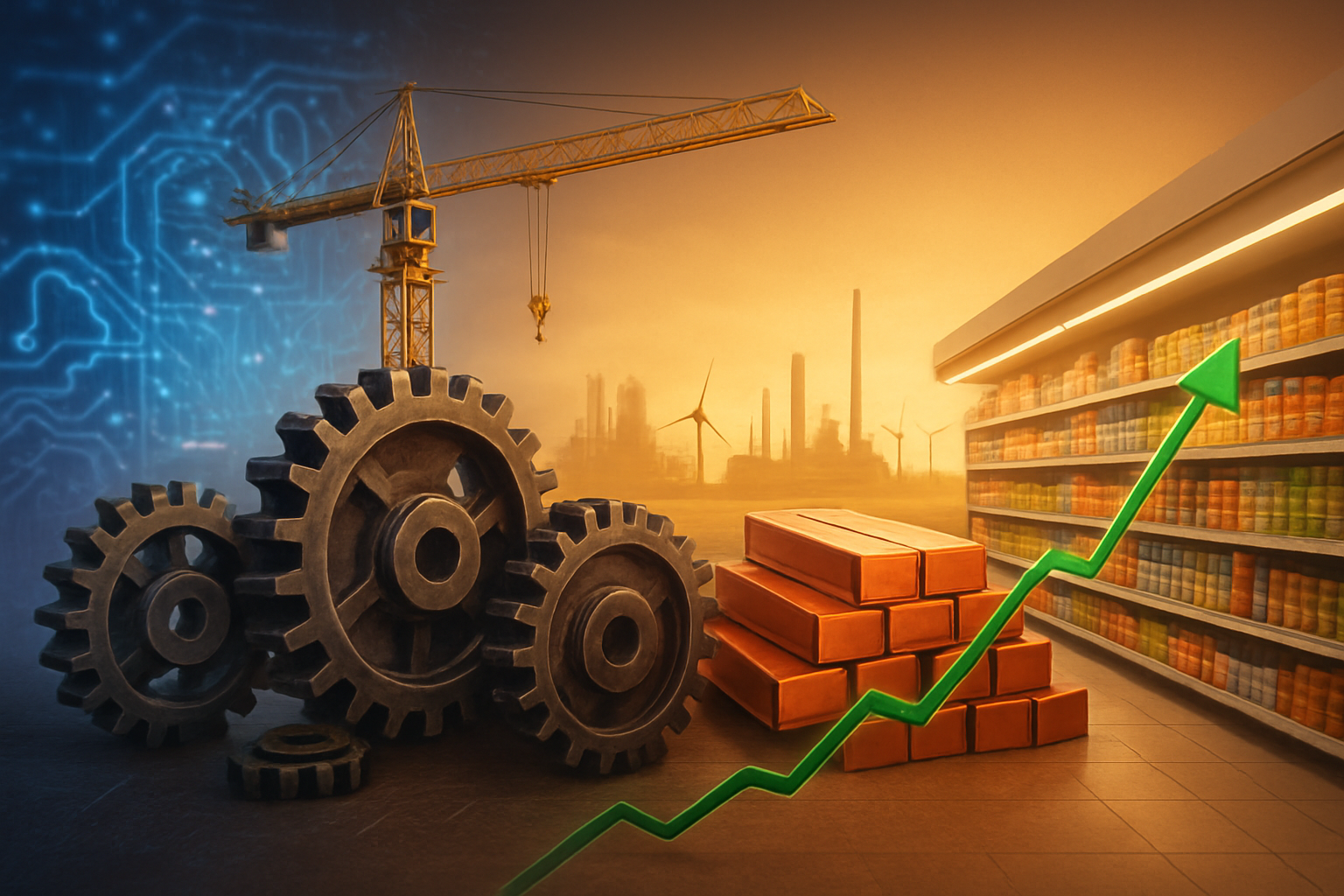
As of March 12, 2026, the financial landscape has undergone a seismic shift that few predicted with such velocity: the long-awaited "Great Rotation." After three years of dominance by artificial intelligence and mega-cap technology firms, capital is aggressively flowing out of Silicon Valley and into the "Real Economy"—specifically the industrial, materials, and consumer staples sectors. This movement marks a transition from speculative digital growth to tangible physical assets and defensive stability, fundamentally altering the trajectory of the S&P 500.
The immediate implications are stark. While the tech-heavy Nasdaq Composite has retreated by approximately 3.0% year-to-date, the S&P 500 Equal Weight Index has touched new record highs, driven by double-digit gains in cyclicals. This "broadening out" of the market suggests that while the AI hype cycle may be cooling, the underlying economy remains resilient, bolstered by significant fiscal stimulus and a pivot toward domestic manufacturing and infrastructure.
The Catalysts: A Two-Pronged Shift in Sentiment
The current rotation is the result of two major convergent events that occurred between late 2025 and early 2026. First was the "DeepSeek AI Shock" in early 2025, which gained full momentum this quarter. The emergence of highly efficient, low-cost open-source AI models proved that frontier-level performance could be achieved at a fraction of the cost previously projected by U.S. hyperscalers. This triggered a "valuation crisis" for the semiconductor and software sectors, as investors began to question the massive capital expenditure (CapEx) of the "Magnificent Seven" and the long-term ROI of expensive proprietary models.
Second, the "One Big Beautiful Bill Act" (OBBBA), signed in July 2025, reached its full implementation phase in January 2026. The legislation, which provides 100% bonus depreciation and aggressive tax incentives for domestic manufacturing, has funneled billions into the industrial and materials sectors. Combined with a Federal Reserve that has cut rates to a range of 3.50%–3.75%, the environment has become a "goldilocks" scenario for capital-intensive, "old economy" businesses that benefit from lower borrowing costs and massive fiscal tailwinds.
The timeline leading to this moment was punctuated by a disastrous February 2026 jobs report, which showed a loss of 92,000 jobs. This sparked fears of a cooling economy, prompting a flight to the safety of consumer staples, which had been trading at historically low valuations relative to tech. The result is a rare "multiple inversion," where defensive stalwarts are now commanding premium valuations over former growth darlings.
The Winners and Losers: A Tale of Two Markets
The most visible victims of this rotation are the former leaders of the AI revolution. NVIDIA Corporation (NASDAQ: NVDA) has faced significant volatility as the "valuation reset" takes hold, with investors moving away from high-end GPU hardware toward more diversified plays. Similarly, Microsoft Corp (NASDAQ: MSFT) and Apple Inc (NASDAQ: AAPL) have seen their valuation multiples contract as the market shifts focus from digital code to physical infrastructure. Meta Platforms, Inc (NASDAQ: META) has also struggled to justify its massive AI spending in an environment where investors are demanding immediate dividends and buybacks over long-term research bets.
Conversely, the winners of 2026 are found on the factory floors and in the grocery aisles. Walmart Inc (NYSE: WMT) recently made headlines by joining the $1 trillion market cap club in February, as its dominant scale and value-oriented model attracted investors seeking safety. Costco Wholesale Corp (NASDAQ: COST) has seen its price-to-earnings (P/E) ratio swell to 48x, significantly higher than many tech peers. In the industrial space, Caterpillar Inc (NYSE: CAT) and GE Vernova Inc (NYSE: GEV) have surged as they provide the heavy machinery and power systems required for the "Copper and Kilowatts" phase of the AI data center build-out.
The materials sector has also seen a massive resurgence. Freeport-McMoRan Inc (NYSE: FCX) and Rio Tinto Group (NYSE: RIO) are benefiting from the soaring demand for copper and rare earth minerals—the physical building blocks of the renewable energy and AI hardware transition. For these companies, the "Great Rotation" isn't just a market trend; it’s a reflection of a fundamental scarcity in the raw materials needed to power the next decade of global development.
Broader Significance and Historical Context
This rotation fits into a larger historical pattern often seen at the tail end of a massive technological adoption phase. Much like the post-dot-com era or the value-led recovery of 2022, the market is currently "flushing out" the excess of a speculative bubble. However, unlike the 2000 crash, the current shift is characterized by a "rebalancing" rather than a total collapse. The underlying AI technology is still perceived as transformative, but the market is now prioritizing the physical implementation of that technology over the digital promise.
The ripple effects are being felt across global supply chains. As capital flows into companies like United Rentals, Inc (NYSE: URI) and General Dynamics Corp (NYSE: GD), there is a renewed focus on domestic industrial capacity. This "Industrial Renaissance" is also a policy success for the current administration, proving that fiscal incentives like the OBBBA can successfully steer private capital toward national strategic interests.
From a regulatory standpoint, the rotation may ease some of the antitrust pressure on "Big Tech." As these companies lose their absolute dominance over market performance, regulators may find it harder to argue they are stifling all competition. Conversely, the "New Leaders" in staples and industrials may face increased scrutiny over pricing power and labor practices as they become the new heavyweights of the S&P 500.
What Comes Next: The Road Ahead for Investors
In the short term, the market remains in a state of flux. Investors should expect continued volatility in the tech sector as it searches for a "valuation floor." A potential "Software Renaissance" could emerge later in 2026 if the surviving tech firms can prove that AI is driving tangible margin expansion. However, for the next several quarters, the momentum clearly favors the "Real Economy" sectors that are benefiting from the OBBBA’s tax breaks and a more cautious consumer.
Strategically, public companies may need to pivot their messaging. Tech firms are already beginning to prioritize "capital discipline" and "shareholder returns" over raw AI spending, a trend initiated by Meta several years ago that has now become industry-standard. Industrial companies, on the other hand, must manage the challenges of scaling up manufacturing rapidly to meet the surge in demand, which could lead to supply chain bottlenecks and inflationary pressure in raw materials.
The biggest risk to this rotation is a potential "hard landing" for the U.S. economy. While consumer staples like The Procter & Gamble Company (NYSE: PG) and Coca-Cola Co (NYSE: KO) provide a defensive buffer, a deeper recession could eventually weigh on the industrials and materials sectors. Investors will be closely watching the upcoming Q1 2026 earnings reports to see if the fundamental earnings growth in the "S&P 493" can truly offset the slowing growth of the tech giants.
Summary and Market Outlook
The Great Sector Rotation of 2026 represents a healthy broadening of the market, moving away from a dangerous concentration in a handful of technology names. The primary takeaways are the resilience of the "Old Economy" under fiscal stimulus and a fundamental repricing of the AI dream. As the "Copper and Kilowatts" phase takes hold, the physical assets required to run our digital world are finally receiving the valuation premium they have long lacked.
Moving forward, the market is likely to remain diversified. While the mega-cap tech giants will eventually find their footing, the days of them accounting for nearly all of the market’s gains appear to be over for now. Investors should maintain a balanced posture, watching for stability in the materials sector and monitoring whether consumer staples can maintain their historically high multiples.
The key metrics to watch in the coming months will be the implementation of the OBBBA tax credits, the sustainability of copper prices, and the "AI ROI" reports from major enterprise software users. For now, the "Real Economy" is back in the driver's seat, and the "Magnificent Seven" must adapt to a world where they are no longer the only game in town.
This content is intended for informational purposes only and is not financial advice.