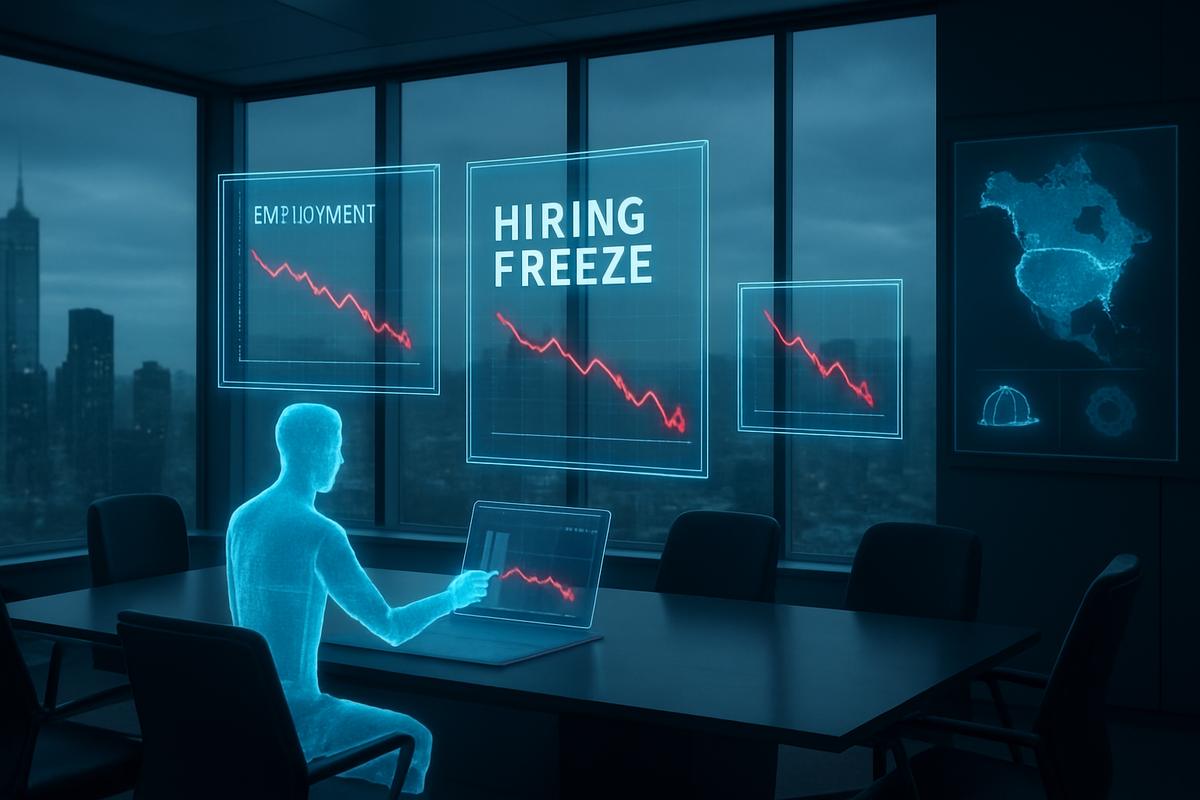
As of March 18, 2026, a chilling wind is blowing through the North American labor market, leaving economists and corporate executives at odds over the path forward. Despite stable GDP growth figures, a profound sense of pessimism has taken root among the continent’s risk management elite. More than half of North American risk leaders now expect a significantly weaker job market for the remainder of the year, a sentiment fueled by a brutal February jobs report that saw the U.S. economy shed 92,000 positions—a shocking miss against analyst expectations.
This downturn is not a traditional cyclical slump but rather the beginning of a "Great Recalibration." Corporate giants are pivoting away from human-centric growth models toward "Efficiency First" mandates, driven by the dual pressures of persistent high interest rates and the massive capital requirements of the generative AI revolution. As cautious corporate spending becomes the new executive orthodoxy, the immediate implication is a stagnant hiring environment where "job hugging"—workers staying in current roles at all costs—has replaced the fluidity of the early 2020s.
The Efficiency Push: A Timeline of Corporate Retrenchment
The current wave of pessimism began to swell in late 2025 as the Federal Reserve maintained a hawkish stance to combat oil-driven inflation, which has pushed crude prices toward $100 per barrel. By January 2026, the 2026 Emerging Risks Survey revealed that for the first time in over a decade, over 50% of risk leaders identified labor market weakness as a primary threat to enterprise stability. This anxiety was validated on March 6, 2026, when the Bureau of Labor Statistics reported that the national unemployment rate had climbed to 4.4%.
Key stakeholders, including CFOs whose optimism index has plummeted to 60.2 out of 100, are now prioritizing "disciplined execution" over expansion. The timeline of this shift was accelerated by a series of high-profile restructuring announcements from major tech and logistics firms. In the first ten weeks of 2026, Amazon (NASDAQ: AMZN) and Meta Platforms (NASDAQ: META) together eliminated over 30,000 roles, not due to lack of demand, but to free up capital for "Agentic AI" infrastructure. Market reactions have been polarized: while stock prices for "efficient" firms have seen short-term bumps, the broader consumer discretionary sector has softened as fears of a technical recession—currently pegged at a 33% probability by major banks—begin to weigh on household sentiment.
Winners and Losers in the AI-Driven Divergence
The 2026 landscape has created a stark divide between the "Infrastructure Kings" and "Legacy Laggards." On the winning side, Nvidia (NASDAQ: NVDA) continues to dominate as the backbone of the $650 billion global AI spend, with its new Vera Rubin architecture seeing record pre-orders. Similarly, Microsoft (NASDAQ: MSFT) and Palantir (NYSE: PLTR) have positioned themselves as the "operating systems" for corporate restructuring, helping traditional firms automate complex decision-making processes that previously required tiers of middle management. In the staffing sector, Robert Half (NYSE: RHI) and ManpowerGroup (NYSE: MAN) are seeing a counter-intuitive surge in demand as companies replace permanent roles with flexible, specialized contract labor to maintain agility.
Conversely, the "losers" are found in labor-heavy sectors and legacy tech firms failing to pivot. Oracle (NYSE: ORCL) is currently navigating a massive restructuring, with reports indicating a planned reduction of up to 30,000 roles to offset the costs of its new AI-focused data centers. In the retail space, Target (NYSE: TGT) and Under Armour (NYSE: UAA) are struggling with a "double whammy" of rising tariff costs and cooling consumer spending. UPS (NYSE: UPS) has also faced significant headwinds, announcing cuts to 30,000 operational jobs as it aggressively automates its fulfillment network to counter rising wage floors and logistical inefficiencies.
Policy Shifts and the "Revenge of the Trades"
The broader significance of the 2026 labor market cannot be understood without looking at the "One Big Beautiful Bill Act" (OBBBA), which went into full effect this year. This landmark legislation introduced a "No Tax on Tips and Overtime" provision, fundamentally altering the labor supply. This has led to a phenomenon dubbed the "Revenge of the Trades," where younger workers are bypassing traditional corporate entry-level roles—many of which are being automated by UiPath (NYSE: PATH) agents—to enter trade schools and service roles where income is now largely tax-free up to significant thresholds.
This policy shift fits into a broader trend of "strategic intentionality." While the general job market looks weak, specialized sectors like cybersecurity and AI model risk are seeing unprecedented wage growth. However, a "shadow" trend has also emerged: nearly 60% of hiring managers admit to using AI-driven restructuring as a "cover story" for general cost-cutting. This suggests a permanent shift in the social contract between North American corporations and their employees, as firms trade broad headcount for high-margin, automated productivity.
Future Outlook: The USMCA Review and Agentic AI
Looking ahead to the second half of 2026, two major factors will determine if this pessimism evolves into a full-scale downturn. The first is the mandated USMCA 2026 Review scheduled for July. This trade negotiation is expected to be contentious, with the U.S. pushing for stricter "rules of origin" on semiconductors and electric vehicles. Any breakdown in these talks could trigger a fresh wave of layoffs in the manufacturing heartlands of the U.S., Canada, and Mexico.
In the short term, companies will likely continue their pivot toward "Agentic AI"—systems that don't just suggest actions but execute them. This will lead to further "hiring freezes" for junior white-collar roles. However, a strategic adaptation is already underway; firms that can successfully integrate "Human-AI Teaming" models are expected to outperform. For the market, this means high-growth opportunities will remain concentrated in tech hardware and specialized services, while traditional retail and legacy software may face a multi-year "valuation reset."
Summary: Navigating a Fractured Recovery
The sentiment among North American risk leaders is not merely a reaction to a bad month of data; it is a recognition of a structural shift in how value is created. The "Great Recalibration" of 2026 is defined by a move away from the "growth-at-all-costs" mentality toward a lean, AI-integrated operational model. While this transition is painful for the labor market—evidenced by the rise in unemployment and the stagnation of salaried roles—it is also creating a more resilient, albeit more automated, corporate sector.
Moving forward, the market will remain volatile as it digests the implications of the OBBBA and the upcoming USMCA review. Investors should watch for the Q3 earnings reports of automation leaders like Arista Networks (NYSE: ANET) and Micron (NASDAQ: MU) for signs that the "Efficiency Push" is delivering on its promised margins. For the public, the 2026 labor market is a reminder that while the economy may be growing, the traditional "job" as we once knew it is undergoing a permanent and profound transformation.
This content is intended for informational purposes only and is not financial advice.