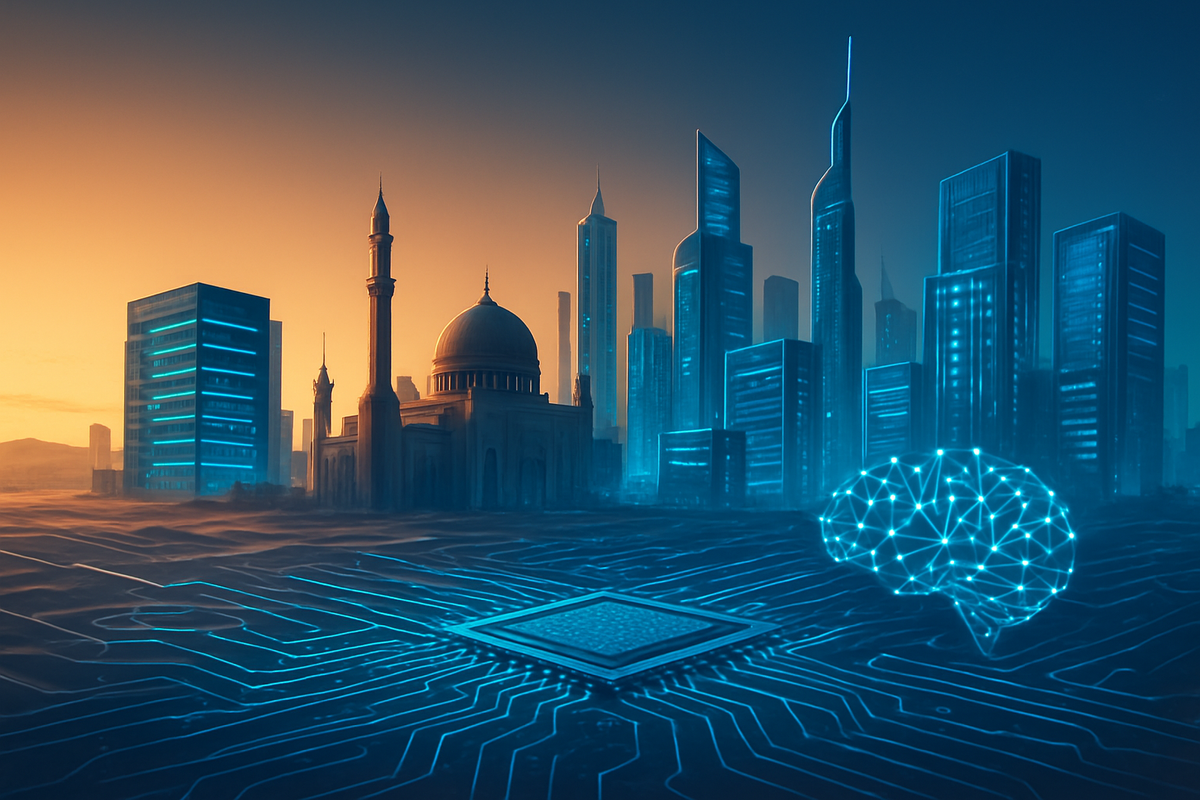
As of March 18, 2026, the global financial landscape is witnessing the culmination of one of the most significant strategic pivots in modern history. The United Arab Emirates (UAE), long synonymous with vast hydrocarbon reserves, has successfully rebranded itself as the "Silicon Oasis" of the Middle East. By leveraging its nearly $1.7 trillion in sovereign wealth, the federation has transitioned from a passive exporter of capital into an aggressive, vertically integrated architect of the global Artificial Intelligence (AI) ecosystem. This shift marks a fundamental change in how "middle powers" utilize wealth to secure a permanent seat at the table of the fourth industrial revolution.
The implications of this transition are immediate and profound. By moving beyond simple equity stakes in Silicon Valley and into the acquisition of core capabilities—ranging from semiconductor logic to massive sovereign compute clusters—the UAE is effectively de-risking its economy from the long-term decline of fossil fuels. This strategy has not only integrated Emirati capital into the heart of the U.S. technology stack but has also repositioned Abu Dhabi as a vital "trusted node" in the high-stakes geopolitical competition between Washington and Beijing.
From Oil Barons to Tech Architects: The Rise of MGX and the Triad of Power
The transformation began in earnest in March 2024 with the creation of MGX, a specialized technology investment firm mandated to build the physical and intellectual infrastructure of the AI era. Spearheaded by the Artificial Intelligence and Advanced Technology Council (AIATC) and chaired by Sheikh Tahnoon bin Zayed Al Nahyan, MGX joined forces with Mubadala and G42 to form what analysts now call the "Abu Dhabi AI Triad." Over the past 24 months, this entity has aggressively pursued a strategy centered on the "AI Stack": infrastructure, semiconductors, and core software models.
A pivotal moment occurred in April 2024, when Microsoft Corp (NASDAQ: MSFT) announced a $1.5 billion strategic investment in G42, the UAE's leading AI firm. By March 2026, this partnership has expanded into a massive $15.2 billion multi-year framework. Crucially, this deal required G42 to divest from Chinese hardware and software, aligning the UAE’s technological future directly with U.S. security standards. This "Pax Silica" alliance allowed the UAE to receive priority access to high-end chips, such as the NVIDIA Corp (NASDAQ: NVDA) Blackwell series, which are currently fueling the "Stargate UAE" initiative—a sovereign AI cluster deploying over 35,000 advanced GPUs to power regional innovation.
The Winners and Losers in the New Compute Economy
The primary beneficiary of this Emirati pivot has been Microsoft Corp (NASDAQ: MSFT), which has secured not only a massive capital partner but also a geopolitical gateway into the Global South. By partnering with G42 to build data centers in Kenya and beyond, Microsoft is utilizing UAE capital to expand its cloud footprint in emerging markets faster than its competitors. Similarly, NVIDIA Corp (NASDAQ: NVDA) has found a voracious customer in the UAE’s sovereign funds, which have bypassed traditional enterprise waitlists by funding the massive infrastructure projects necessary to house their chips.
BlackRock, Inc. (NYSE: BLK) has also emerged as a strategic winner through its lead role in the Global AI Infrastructure Investment Partnership (GAIIP). Launched in late 2024 alongside MGX and Microsoft, the partnership has already raised $12.5 billion of its $30 billion private equity target as of early 2026. This consortium recently closed a landmark $40 billion acquisition of Aligned Data Centers, securing the physical "real estate" of the AI revolution. Conversely, traditional energy companies that fail to pivot toward powering these data centers may find themselves sidelined. While companies like GlobalFoundries Inc (NASDAQ: GFS), which is majority-owned by Mubadala, continue to benefit from the UAE's push into semiconductor manufacturing, Chinese tech giants like Huawei have been the primary "losers," as they are increasingly excluded from the UAE’s most sensitive high-tech infrastructure.
Digital Sovereignty and the End of Passive Investing
This event fits into a broader global trend where sovereign wealth funds are no longer content with 5% returns from diversified stock portfolios. Instead, they are seeking "Digital Sovereignty"—the ability to own and control the data, the models, and the compute power that will drive future GDP. The UAE’s move is a sophisticated form of "Geopolitical Insurance." By making U.S. tech giants and Wall Street firms like BlackRock dependent on Emirati capital and energy for their AI infrastructure, the UAE ensures that its stability is an inextricable priority for American strategic interests.
Historical precedents for this shift can be found in the early 20th-century scramble for oil rights, but with a digital twist. Where the British and Americans once vied for access to Middle Eastern crude, the Middle East is now vying for access to American silicon and algorithms. This has forced a regulatory evolution in the U.S., where the Committee on Foreign Investment in the United States (CFIUS) has had to balance national security concerns with the reality that the trillions needed for AI infrastructure cannot be raised by the private sector alone.
The Next Frontier: Stargate and the European Expansion
In the short term, the market should expect the UAE to continue its expansion into the physical layer of AI. The recently announced "European AI Campus" in Paris, an €8.5 billion project funded by MGX, is slated to begin construction in late 2026. This project aims to bring 1.4 gigawatts of AI-optimized data center capacity to Europe, positioning the UAE as a major utility provider for the continent's tech sector. Investors should also watch for a potential public offering or further monetization of G42 as it matures into a global tech powerhouse.
Long-term, the UAE faces the challenge of maintaining its "neutral connector" status. While it has aligned with the U.S. on hardware, it continues to join blocks like BRICS, signaling that it intends to be the bridge for data flows between the East and West. The potential for strategic pivots remains high if trade tensions between the U.S. and China escalate further, possibly forcing the UAE to make even more stringent choices regarding its technological stack.
A New Era for Sovereign Wealth
The UAE’s shift from a capital exporter to a technology acquirer represents a watershed moment for the financial markets. It signifies the end of the "rentier state" model and the birth of the "computational state." By integrating its wealth into the core of the global AI supply chain, Abu Dhabi has ensured that it will remain relevant long after the last barrel of oil is pumped. The "Triad" of MGX, Mubadala, and ADIA provides a blueprint for how other resource-rich nations may attempt to navigate the energy transition.
Moving forward, the market will likely see a narrowing of the valuation gap between traditional infrastructure and high-tech assets, as they become increasingly indistinguishable in the AI era. For investors, the key takeaway is that the UAE is no longer just a source of liquidity; it is a strategic operator. Monitoring the allocation of high-end chips to the region and the progress of the GAIIP’s infrastructure projects will be essential for understanding the next phase of the AI bull market.
This content is intended for informational purposes only and is not financial advice.