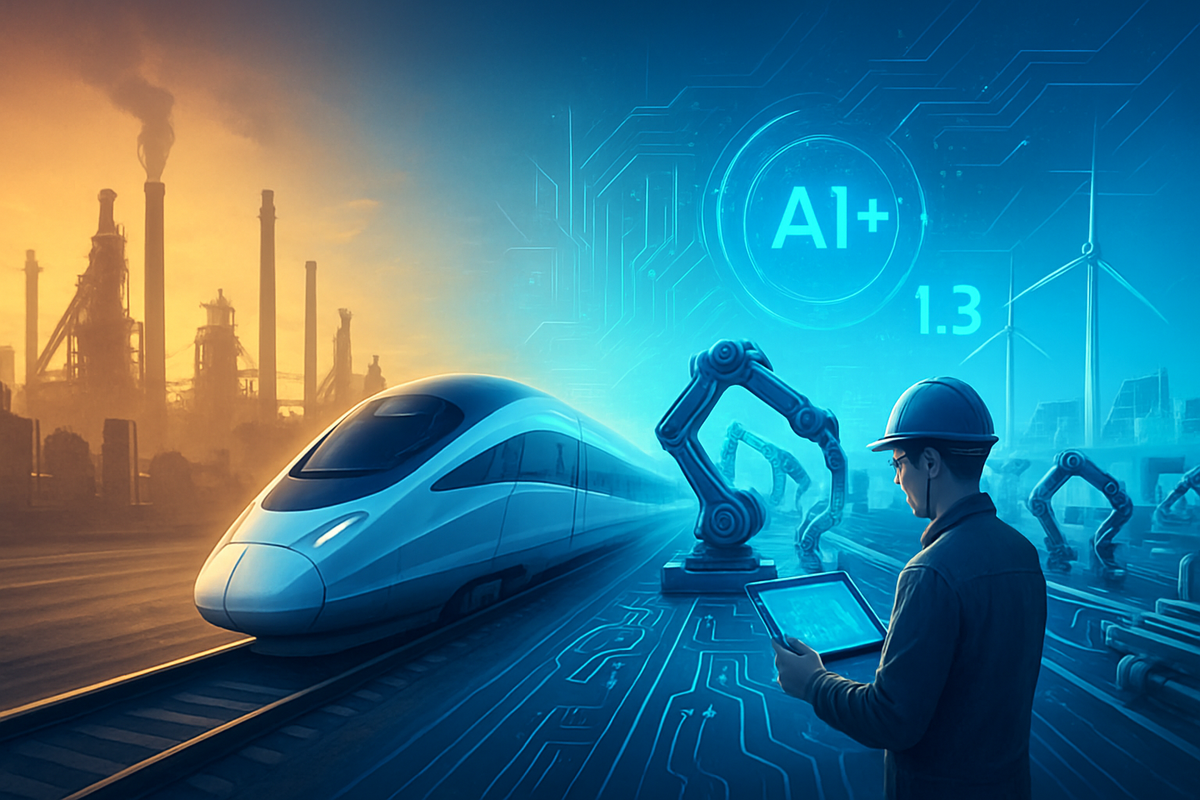
BEIJING — The landscape of global trade is undergoing a seismic shift as China officially moves to decouple its economic growth from the carbon-heavy, steel-intensive model that defined the last three decades. Following the conclusion of the 2026 "Two Sessions" (the National People's Congress and the Chinese People's Political Consultative Conference) earlier this month, Beijing has signaled a definitive pivot toward "High-Quality Development." This strategy, codified in the newly adopted 15th Five-Year Plan, prioritizes "New Quality Productive Forces"—a euphemism for high-tech manufacturing, Artificial Intelligence (AI), and green energy—over the traditional pillars of property development and heavy infrastructure.
The immediate implications are profound: the world’s largest consumer of raw materials is fundamentally changing its appetite. As Beijing deploys a record 1.3 trillion yuan ($180 billion) toward equipment upgrades and scientific research, the global "commodity super-cycle" that once fed on Chinese urbanization is being replaced by a "tech-cycle." For global markets, this means a permanent structural decline in demand for traditional industrial inputs like iron ore and crude oil, while sparking a fierce global scramble for the minerals that power the digital and green revolutions.
The 1.3 Trillion Yuan Mandate: A High-Tech Industrial Revolution
The 2026 Two Sessions, which concluded on March 12, marked the end of the "growth at all costs" era. Setting a pragmatic GDP target of 4.5%–5.0%—the lowest in modern history—Chinese policymakers led by the State Council have cleared the path for a painful but necessary structural adjustment. Central to this transition is a massive fiscal commitment: the issuance of 1.3 trillion yuan in ultra-long special treasury bonds. This capital is specifically earmarked for national strategic projects and a "large-scale equipment renewal" program designed to modernize the nation's aging industrial base with smart, AI-driven technology.
According to data released during the sessions, the government is also allocating a separate 1.3 trillion yuan specifically to Science & Technology (S&T) Research and Development for 2026, a double-digit increase that underscores the urgency of technological self-reliance. This funding is already flowing into "AI Plus" initiatives, where AI is integrated directly into manufacturing floors, and the rollout of the CR450 high-speed train, which utilizes 100% domestic intellectual property. The timeline leading to this moment has been years in the making, following the 2024–2025 property sector cooling, but the 2026 policy suite represents the final, formal abandonment of the "old" economic playbook.
Market reaction has been swift and polarized. While high-tech sectors in Shanghai and Shenzhen rallied on the news of the equipment upgrade fund, global commodity hubs from Perth to Houston are bracing for a chill. Analysts at The Goldman Sachs Group (NYSE: GS) have noted that the intensity of commodity use per unit of GDP in China is falling at its fastest rate since the 1990s.
Winners and Losers: The New Resource Hierarchy
The primary casualties of this shift are the "Big Three" iron ore miners: BHP Group (NYSE: BHP), Rio Tinto (NYSE: RIO), and Vale S.A. (NYSE: VALE). With China’s steel demand expected to contract to approximately 837 million metric tons this year—down from historical peaks near 1 billion—the era of $150/ton iron ore appears over. Forecasts suggest prices will languish in the $90-$100 range for the foreseeable future as Chinese property construction, which once accounted for 40% of global steel demand, remains in a structural "L-shaped" recovery.
Similarly, the oil giants are facing a "peak demand" reality sooner than anticipated. Exxon Mobil Corp (NYSE: XOM) and Saudi Arabian Oil Co. (TADAWUL:2222) are seeing their largest growth market stall. The explosive growth of electric vehicles (EVs) in China, led by BYD Company Limited (HKG:1211) and Contemporary Amperex Technology Co. Limited (SHE:300750) (CATL), is now displacing roughly 540,000 barrels of gasoline demand per day. Furthermore, the 2026 pivot toward LNG-powered heavy trucking is hollowing out diesel demand, leaving petrochemicals as the only remaining growth engine for crude in the Middle Kingdom.
Conversely, the "winners" are those positioned at the start of the high-tech value chain. Freeport-McMoRan Inc. (NYSE: FCX) is seeing robust demand for copper, essential for the electrical grids and EVs that underpin the "High-Quality Development" mandate. Albemarle Corporation (NYSE: ALB) and other lithium producers are also benefiting from the "Two New" policy (equipment renewal and consumer trade-ins), which is expected to drive over 2.6 trillion yuan in sales for new energy vehicles and smart appliances. Even AI chip leaders like Nvidia Corp (NASDAQ: NVDA), despite geopolitical export restrictions, find their technologies at the heart of the "AI Plus" manufacturing upgrades Beijing is now subsidizing.
Global Significance: The "Fortress China" Strategy
This pivot is more than just an economic adjustment; it is a geopolitical realignment. By moving away from iron ore (largely imported from Australia and Brazil) and crude oil (imported from the Middle East and Russia), China is attempting to reduce its vulnerability to maritime blockades and global price volatility. The "High-Quality Development" model focuses on "internal circulation," where demand is met by domestic high-tech manufacturing and energy is supplied by a massive build-out of domestic renewables.
Historically, this shift resembles the transition seen in post-war Japan or West Germany, where growth moved from heavy industry to precision engineering. However, the scale of China’s transition is unprecedented. The ripple effects are already being felt in emerging markets; countries like Indonesia and the Democratic Republic of Congo, rich in "transition metals" like nickel and cobalt, are seeing massive Chinese investment, while traditional iron-ore-heavy economies are being forced to diversify.
Furthermore, the "anti-involution" measures introduced during the Two Sessions—designed to stop domestic price wars among EV makers—signal that China is now prioritizing R&D and profit margins over pure market share. This could lead to a "quality over quantity" export surge, where Chinese high-tech goods become even more competitive in global markets, potentially triggering new trade frictions with the EU and North America.
What Comes Next: A Decade of Disruption
In the short term, the market should expect a period of "commodity volatility" as traditional miners and energy companies adjust their capital expenditure. We are likely to see more "Green Steel" initiatives and a pivot by companies like Rio Tinto (NYSE: RIO) toward copper and lithium assets. The long-term challenge for China will be whether the 1.3 trillion yuan investment in tech can create enough high-value jobs to offset the decline of the labor-intensive property sector.
Strategic pivots will be required for global investors. The "China Trade" is no longer a play on urbanization; it is a play on industrial automation and the energy transition. Market opportunities will emerge in "smart factory" providers, humanoid robotics—where Chinese firms like UBTECH are rapidly scaling—and the software layers that manage the new, electrified grid. However, the challenge remains the "middle-income trap," as Beijing must ensure that "High-Quality Development" leads to higher household consumption, not just more efficient factories.
Investor Wrap-Up: Navigating the Great Reset
The 2026 Two Sessions have made one thing clear: China’s economic identity has been permanently rewritten. The record 1.3 trillion yuan investment in equipment and S&T is the catalyst for a structural shift that will reverberate through global supply chains for the next decade. For investors, the takeaway is a clear divergence in the commodity space: the era of "bulk" (iron ore, coal, crude) is giving way to the era of "criticals" (copper, lithium, rare earths).
Moving forward, the market will be watching the "execution phase" of the 15th Five-Year Plan. Key indicators will include monthly EV penetration rates, the scale of robot deployment in Chinese factories, and the success of the ultra-long bond auctions. As Beijing trades "quantity" for "quality," the world must prepare for a China that is less of a hungry consumer of the earth’s crust and more of a dominant architect of the digital and green future.
This content is intended for informational purposes only and is not financial advice.