Market sentiment took a sharp turn into "risk-off" territory early Tuesday as a burgeoning diplomatic narrative began to unravel. S&P 500 futures fell 0.3% following high-profile denials from Tehran regarding the existence of "productive" peace talks, directly contradicting optimistic claims made by the White House only 24 hours prior.
The sudden reversal has reignited fears of a prolonged military engagement in the Middle East, which is now entering its fourth week. As of 5:48 a.m. EST on March 24, 2026, the S&P 500 (NYSE: SPY) futures had retreated from yesterday’s highs, erasing nearly half of the gains spurred by President Trump’s claims of a breakthrough. The volatility underscores a market trapped between the administration's "peace through strength" rhetoric and the stark reality of a conflict that has already shuttered the Strait of Hormuz and pushed global energy prices into a state of permanent agitation.
The current market retreat follows a weekend of intense speculation. On Monday, March 23, President Trump took to social media and live briefings to announce that the United States and Iran had engaged in "very good and productive conversations" over the previous 48 hours. The President went as far as to suggest a five-day "pause" on planned military strikes against Iranian energy infrastructure to allow for a 15-point peace plan to be finalized. These claims triggered a 1.15% rally in the S&P 500 on Monday, as investors bet on an early exit from a conflict that began on February 28, 2026, under the codename "Operation Epic Fury."
However, the optimistic narrative was punctured early Tuesday morning. Mohammad Bagher Ghalibaf, the Speaker of the Iranian Parliament, issued a scathing rebuttal, characterizing the U.S. claims as "fabricated news" intended to manipulate global financial and oil markets. Ghalibaf emphasized that "no negotiations have been conducted" and that Iran’s conditions for a ceasefire—which include the full withdrawal of U.S. assets from the Persian Gulf—remain completely unmet. This stark contradiction sent S&P 500 futures as low as -0.63% in pre-market trading before stabilizing slightly near the 0.3% mark.
The conflict, now in its twenty-fourth day, has seen significant escalations, including U.S. and Israeli strikes on Iranian nuclear and military facilities and the near-total closure of the Strait of Hormuz. With transits through the critical waterway down by 95%, the "war of words" has become as vital to market performance as the kinetic warfare itself. The CBOE Volatility Index (INDEXCBOE:VIX) has surged past the 30-point threshold this morning, reflecting the deep uncertainty among institutional investors regarding whose narrative to believe.
The seesaw of geopolitical headlines is creating a distinct divide between market winners and losers. Defense contractors remain the primary beneficiaries of the extended conflict. Lockheed Martin (NYSE: LMT) and RTX Corporation (NYSE: RTX) have seen their shares hover near all-time highs as the Pentagon accelerates the replenishment of munitions used during the opening weeks of the campaign. Similarly, Northrop Grumman (NYSE: NOC) continues to see support following the high-profile combat debut of the B-21 Raider stealth bomber earlier this month.
Energy giants like ExxonMobil (NYSE: XOM) and Chevron (NYSE: CVX) are also positioned to gain from the "risk premium" currently embedded in crude prices. While Brent crude briefly dipped to $102 per barrel on Trump’s peace overtures, the Iranian denial has pushed prices back upward. Analysts warn that if the five-day strike pause is abandoned, oil could challenge the $200 per barrel mark, providing a massive, albeit controversial, windfall for domestic energy producers with upstream assets shielded from Middle Eastern volatility.
Conversely, the "losers" in this environment are clearly defined: airlines and high-growth technology. United Airlines (NASDAQ: UAL) and Delta Air Lines (NYSE: DAL) are facing a double-edged sword of soaring jet fuel costs and disrupted international routes. Meanwhile, the broader tech sector, represented by the Nasdaq 100 (NASDAQ: QQQ), remains sensitive to the inflationary pressures that a prolonged war entails. While companies like Nvidia (NASDAQ: NVDA) have shown resilience due to AI-driven demand, the prospect of "higher-for-longer" interest rates—driven by energy-led inflation—continues to weigh on the valuations of the "Magnificent Seven."
This event fits into a broader industry trend where geopolitical risk has replaced monetary policy as the primary driver of daily market volatility. For much of 2025, investors were focused on the Federal Reserve’s "soft landing" path; however, the March 2026 crisis has forced a total recalibration. The "geopolitical seesaw" is not just a temporary fluctuation but a structural shift in how global supply chains and energy security are priced.
The ripple effects are being felt far beyond the defense and energy sectors. Cybersecurity firms such as Palantir (NYSE: PLTR) and Palo Alto Networks (NASDAQ: PANW) are seeing a surge in "digital defense" spending as state-sponsored cyberattacks become a standard component of modern hybrid warfare. This suggests that even if a kinetic ceasefire is reached, the "new cold war" posture of the global economy will likely persist, benefiting firms that specialize in national security and data sovereignty.
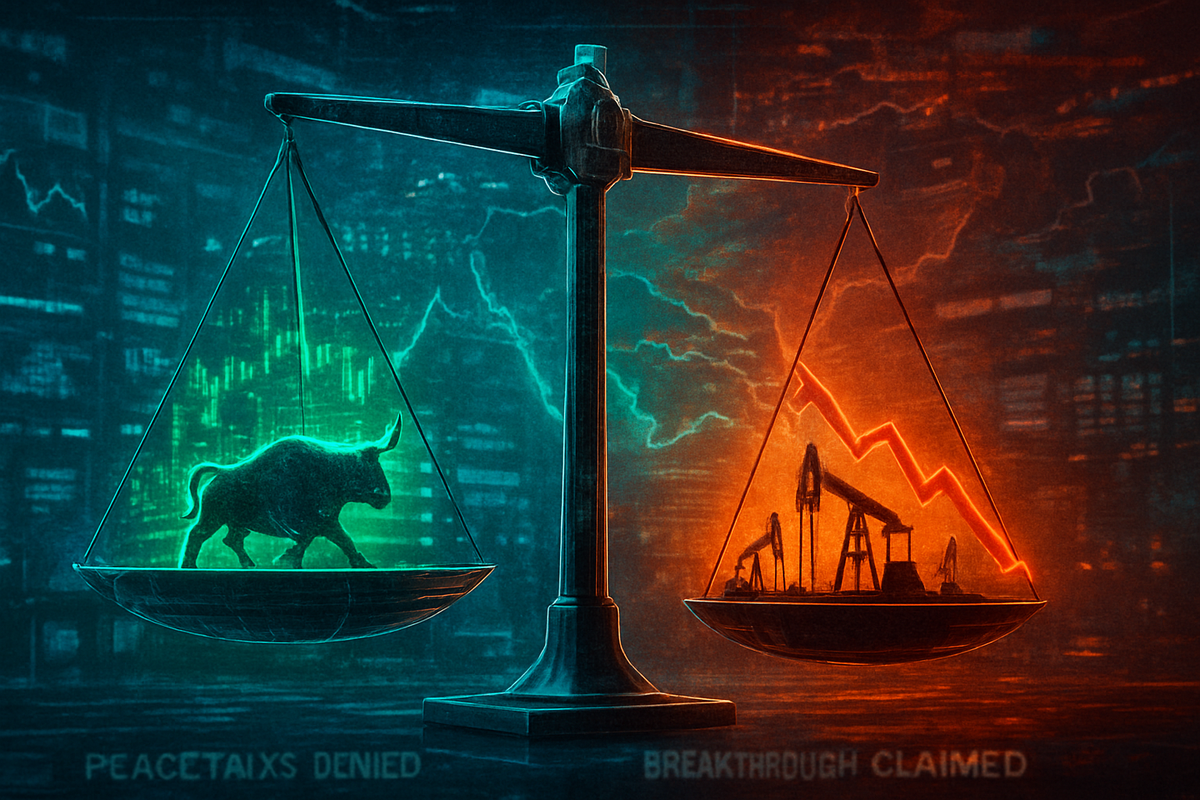
Historical precedents, such as the 1973 oil embargo or the lead-up to the 1991 Gulf War, suggest that markets can handle short-term shocks but struggle with protracted ambiguity. The current "war of narratives" between Washington and Tehran is particularly damaging because it prevents the market from accurately pricing "peak risk." When the President of the United States and the Iranian Parliament Speaker provide diametrically opposed accounts of diplomatic progress, the result is a "liquidity of confusion" where neither bulls nor bears can find a solid footing.
In the short term, all eyes will be on the expiration of the five-day strike pause. If the Friday deadline passes without a verified diplomatic breakthrough, the U.S. has signaled a "massive expansion" of targets, including Iran’s domestic power grid and refinery capacity. Such an escalation would likely send the S&P 500 into a technical correction (a 10% drop from recent peaks) and propel gold prices, currently near $4,400 per ounce, to even higher record levels.
Strategically, multi-national corporations may need to accelerate their "de-risking" from the Middle East, a pivot that was already underway following the tensions of 2024 and 2025. For investors, the challenge will be distinguishing between "headline noise" and fundamental shifts. A scenario where the U.S. achieves a "Trump-style" deal remains a possibility, but the market is increasingly demanding tangible proof—such as the reopening of the Strait of Hormuz—before it buys back into the peace narrative.
The primary takeaway from this morning's futures drop is that the "peace dividend" priced in during Monday's session was premature. The conflict in the Middle East remains the single most significant threat to global economic stability in 2026. While the White House maintains that a deal is within reach, the defiance from Tehran indicates that the path to de-escalation will be far more arduous than a few "productive" phone calls.
Moving forward, the market will likely remain in a state of high-alert, with the VIX serving as a better indicator of health than the S&P 500's price action. Investors should watch for any movement in the "intermediary" channels—specifically involving mediators from Qatar or Egypt—as these are often more reliable indicators of diplomatic progress than the public-facing rhetoric from either Washington or Tehran. For now, the "Geopolitical Seesaw" continues to swing, and the market is bracing for a bumpy ride through the end of the quarter.
This content is intended for informational purposes only and is not financial advice.