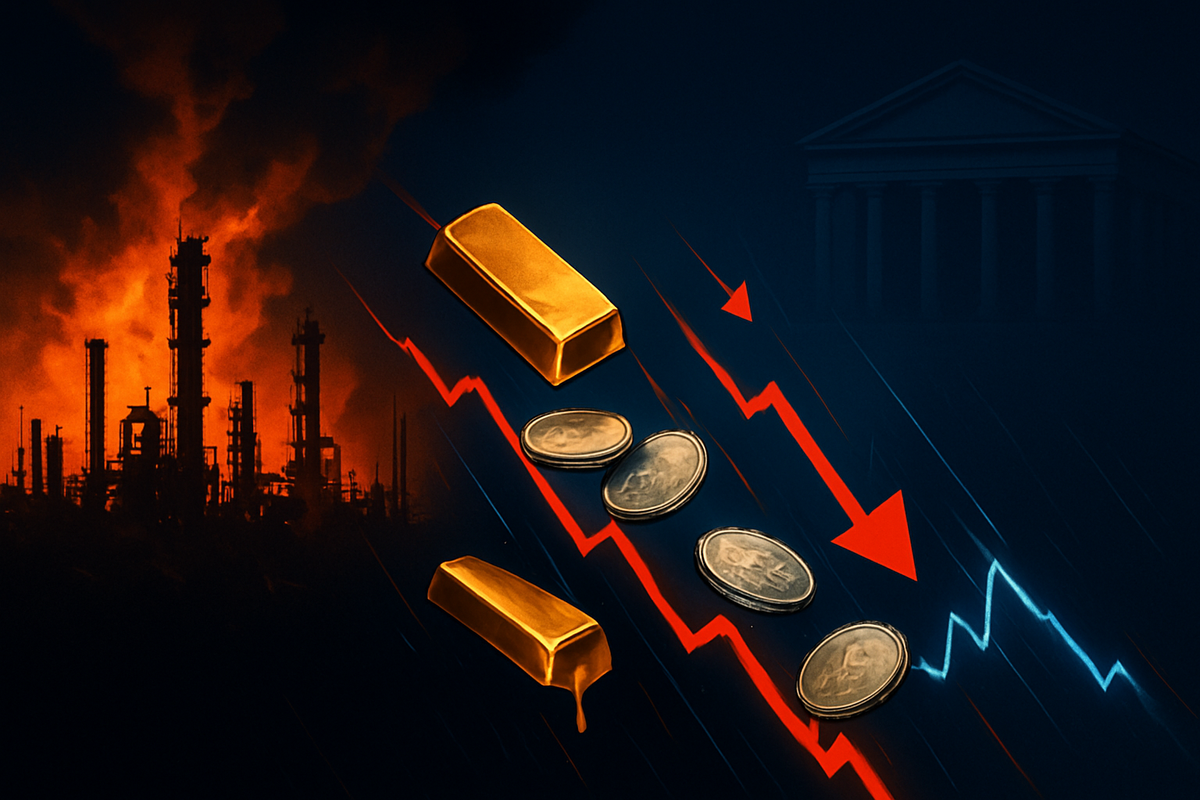
In a move that has left market traditionalists stunned, the classic safe-haven play is failing in its hour of greatest need. On March 19, 2026, as geopolitical tensions in the Middle East reached a boiling point, the precious metals market suffered a historic liquidation event. Gold plummeted to $4,600.70 per ounce, marking its lowest settlement since January 16, while silver endured a staggering 8.2% single-day collapse. This "Geopolitical Paradox" marks a fundamental shift in how markets respond to war-induced energy shocks and persistent inflation.
The immediate implications are clear: the traditional inverse correlation between geopolitical risk and precious metals has been severed by the sheer weight of energy-driven inflation. Instead of flocking to gold, investors are fleeing it to cover margin calls and pivot toward assets that benefit from a "higher-for-longer" interest rate environment. This sell-off has wiped out billions in market capitalization from mining majors and forced a re-evaluations of the "debasement trade" that had fueled the bull market of 2025.
The Hormuz Shock: Energy Spikes and Liquidation
The catalyst for this market upheaval was a series of Iranian attacks on critical Middle East energy facilities, which analysts have termed the "Hormuz Shock." On March 19, 2026, Iranian strikes targeted the Ras Laffan Industrial City in Qatar, the world's largest liquefied natural gas (LNG) complex. The attack successfully knocked out approximately 17% of Qatar’s export capacity, causing Brent crude to surge past $110 per barrel, with intraday peaks nearing $119.
This energy spike immediately stoked global inflation fears, prompting a swift and hawkish response from the world’s most powerful financial institutions. Rather than cutting rates to stabilize markets during a period of war, the U.S. Federal Reserve, the Bank of Japan, and the European Central Bank (ECB) held rates steady and signaled a resolute "higher-for-longer" stance. The Federal Reserve, maintaining the federal funds rate at 3.50%–3.75%, explicitly signaled that inflation risks from the energy sector would prevent any aggressive easing for the remainder of 2026.
This hawkish consensus has crushed non-yielding assets like gold and silver. Daniel Ghali, a senior commodity strategist at TD Securities, noted that the structural foundations of the recent rally are crumbling. "Gold is now a very widely held position for institutional investors—and that has been on the back of the debasement trade over the last year," Ghali stated. "But the foundations of that trade are now weakening." As money supply growth normalizes and real rates remain elevated, the incentive to hold precious metals as a hedge against currency debasement has evaporated.
Winners and Losers: A Tale of Two Sectors
The carnage in the metals market has been particularly devastating for major mining corporations. Newmont Corporation (NYSE: NEM) saw its shares drop more than 26% from its February highs, while Barrick Gold Corporation (NYSE: GOLD) lost roughly $27 billion in market value in the weeks surrounding the crash. Silver-focused miners fared even worse, with Hecla Mining Company (NYSE: HL) and Coeur Mining, Inc. (NYSE: CDE) seeing double-digit declines as the industrial demand outlook for silver dimmed alongside rising energy costs for extraction. Other significant losers included AngloGold Ashanti PLC (NYSE: AU) and Gold Fields Limited (NYSE: GFI), both of which were caught in the crosshairs of the liquidity crunch.
Conversely, the energy sector has emerged as the primary beneficiary of the geopolitical chaos. Integrated oil majors like Exxon Mobil Corporation (NYSE: XOM) and Chevron Corporation (NYSE: CVX) have surged toward 52-week highs, buoyed by the scarcity premium added to crude oil. BP p.l.c. (NYSE: BP) outperformed the broader market, gaining 4.27% on the day of the metals crash, as it became clear that the disruption in the Strait of Hormuz would keep prices elevated for the foreseeable future.
Furthermore, Cheniere Energy, Inc. (NYSE: LNG) saw a significant uptick in demand as European and Asian buyers scrambled to replace lost Qatari gas volumes. Petrobras - Petróleo Brasileiro S.A. (NYSE: PBR) also gained traction, as its production base outside the immediate conflict zone made it an attractive "safe harbor" for energy investors. Even diversified giants like Freeport-McMoRan Inc. (NYSE: FCX) saw their losses cushioned by their significant copper exposure, which is seen as more essential to the global infrastructure build-out than gold’s purely monetary role.
Breaking the Debasement Trade
The "Geopolitical Paradox" fits into a broader industry trend where central banks are prioritizing the fight against inflation over traditional market support. Historically, gold acts as a refuge when inflation is expected to debase the dollar. However, when inflation is driven by supply-side energy shocks, and central banks respond by keeping interest rates high, the opportunity cost of holding gold becomes too great. This has effectively broken the "debasement trade" that many hedge funds had built their 2026 strategies around.
This event also highlights the fragility of the "official sector" demand. While central banks in the Middle East and Asia were record buyers of gold in 2024 and 2025, the economic toll of the current conflict has forced some of these nations to halt their gold accumulation or even liquidate reserves to fund defense and infrastructure repairs. This shift from "net buyer" to "neutral" or "seller" has removed a critical floor for gold prices.
The regulatory and policy implications are equally significant. With energy prices threatening to spiral, there is renewed pressure on the G7 nations to implement emergency energy reserves or price caps, similar to those seen in 2022. However, with the Strait of Hormuz effectively a war zone, the physical delivery of oil and gas remains the primary bottleneck, regardless of policy maneuvers.
What Comes Next: Seeking a Floor
In the short term, the precious metals market is searching for a technical floor. Analysts at TD Securities suggest that gold could face further pain, potentially testing levels $1,000 lower than its current position before the technical bull market is considered truly dead. For silver, the outlook is even more precarious; as an industrial metal, it must contend with a potential global slowdown as high energy costs act as a "tax" on manufacturing and consumer spending.
A strategic pivot is already underway for many institutional investors. The focus is shifting from "inflation protection" via metals to "yield capture" via short-term treasuries and energy-linked equities. If the conflict in the Middle East escalates further, we may see a scenario where the dollar continues to strengthen as the ultimate safe haven, further suppressing gold and silver prices.
However, a long-term opportunity may emerge for the mining sector if metal prices stabilize and energy costs eventually retreat. The current sell-off has left many mining stocks trading at historically low price-to-earnings multiples. For the patient investor, the "Geopolitical Paradox" may eventually represent a generational entry point—once the current liquidity fire-sale has run its course.
Summary for the Forward-Looking Investor
The events of March 19, 2026, have fundamentally rewritten the playbook for geopolitical crisis management. The "Geopolitical Paradox" has proven that in a world of high energy costs and hawkish central banks, even gold is not immune to a liquidity-driven crash. Investors should watch for the next round of CPI prints and Federal Reserve commentary to see if the "higher-for-longer" narrative remains intact.
As we move through the rest of 2026, the primary focus for market participants will be the stability of the Strait of Hormuz and the ability of central banks to maintain their hawkish stance without triggering a deeper recession. For now, the "safe haven" of choice is not yellow or silver—it is energy and cash.
This content is intended for informational purposes only and is not financial advice.