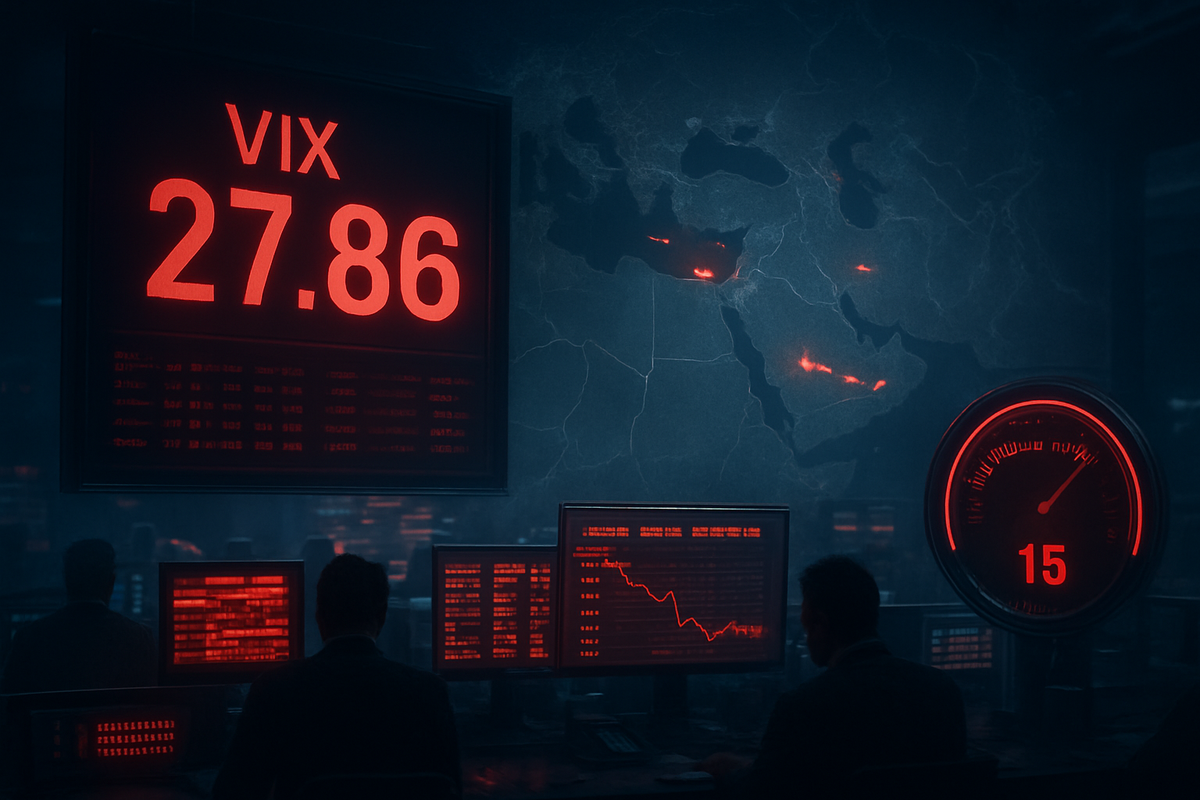
NEW YORK — Wall Street has descended into a state of "Extreme Fear" this Tuesday, March 24, 2026, as a perfect storm of geopolitical escalation and persistent inflationary pressures sent shockwaves through global exchanges. The Cboe Volatility Index (VIX), often referred to as the market's "fear gauge," surged toward the 27 level today, marking its highest sustained reading in over a year. Simultaneously, the CNN Fear & Greed Index plummeted to a reading of 15, signaling a decisive shift toward capital preservation and risk-off sentiment among institutional and retail investors alike.
The sudden evaporation of market confidence follows a tumultuous month defined by military conflict in the Middle East and a landmark shift in U.S. trade policy. As crude oil prices hover near $115 per barrel, the specter of "stagflation"—the dreaded combination of stagnant growth and rising prices—has returned to the forefront of the financial narrative, forcing a radical repricing of equity valuations across the S&P 500 and Nasdaq.
The Anatomy of the Spike: From 'Epic Fury' to Blockaded Straits
The current market anxiety is rooted in a "triple threat" of macro events that began unfolding in late February. The primary catalyst was the launch of "Operation Epic Fury" on February 28, 2026, a coordinated series of strikes by U.S. and Israeli forces against Iranian military infrastructure. This escalation led to the immediate and effective closure of the Strait of Hormuz by Iranian naval forces. As of this morning, March 24, shipping traffic through this vital artery—which carries 20% of the world’s petroleum—remains at a standstill, with over 150 tankers anchored in limbo.
Compounding the energy crisis is a sudden upheaval in global trade. Following a February Supreme Court ruling that limited executive emergency powers, the U.S. administration pivoted to Section 122 of the Trade Act of 1974, implementing a sweeping 10% global tariff on all imports effective February 24, 2026. This move has not only strained relations with the European Union but has also injected a fresh layer of "fiscal anxiety" into the markets, as companies scramble to adjust supply chains already burdened by high logistics costs.
Central banks have responded with a hawkish tone that has offered little comfort to investors. At its March meeting, the Federal Reserve maintained interest rates at 3.50%–3.75%, but Chair Jerome Powell’s warning of "inflationary ripple effects" from triple-digit oil prices has dampened hopes for a rate cut in the first half of 2026. The European Central Bank (ECB) similarly raised its 2026 inflation forecast to 2.6%, signaling that the era of restrictive monetary policy is far from over.
Strategic Beneficiaries and Cascading Casualties
While the broader indices have retreated approximately 5% since the conflict began, the volatility has created a sharp divide between market "winners" and "losers." Lockheed Martin (NYSE: LMT) has emerged as a primary safe haven for capital. Shares of the defense giant are up 38% year-to-date, trading near $676, as investors bet on a massive $1.5 trillion U.S. defense budget for 2027 and a record-breaking $194 billion backlog fueled by the demand for missile defense systems and F-35 fighter jets.
Similarly, Cboe Global Markets (BATS: CBOE) has capitalized on the chaos. As the parent company of the VIX, Cboe has seen a massive surge in trading volume for its volatility-linked products and options. Shares of CBOE have gained nearly 17% this year, significantly outperforming the broader financial sector, as traders use VIX calls and put options to hedge against further downside.
The energy sector remains a bastion of strength amidst the carnage. ExxonMobil (NYSE: XOM) and Chevron (NYSE: CVX) have both seen valuations climb by over 30% in 2026. Exxon’s strategic dominance in the Permian Basin and Chevron’s robust output from the Gulf of Mexico have allowed them to generate massive free cash flow while Brent crude remains entrenched above $110. Conversely, global players like Shell (NYSE: SHEL) have faced operational hurdles, declaring force majeure on certain LNG deliveries due to the instability in Qatari shipping lanes, though high prices have kept their valuations near record highs.
A Paradigm Shift: The Return of Macro Dominance
This current spike in the VIX represents more than just a temporary fluctuation; it signals a potential end to the "Goldilocks" environment of 2024 and 2025. The market is now grappling with the realization that geopolitical stability can no longer be taken for granted in a multipolar world. Historically, VIX readings near 30 often precede significant market bottoming processes, but analysts warn that the "inflationary floor" created by $115 oil may prevent a rapid recovery.
The regulatory implications of the new 10% global tariff are also beginning to ripple through the tech and discretionary sectors. Companies with heavy reliance on international component manufacturing are seeing their margins squeezed, leading to a rotation out of growth stocks and into "old economy" industrials and energy. This shift mirrors the market dynamics of the 1970s oil shocks, where commodity-rich firms outperformed while consumer-facing sectors languished under the weight of rising input costs.
Furthermore, the breakdown in trade negotiations between the U.S. and the EU—a direct result of the February tariff implementation—suggests a period of "deglobalization" that could keep volatility elevated for the foreseeable future. Competitors in the semiconductor and automotive space are now forced to weigh the costs of domestic production against the risks of international trade, a strategic pivot that could take years to resolve.
Navigating the Fog: What Lies Ahead for Investors
In the short term, all eyes remain on the Strait of Hormuz. Any sign of de-escalation or a successful reopening of the waterway could lead to a "volatility crush," sending the VIX back toward its long-term average of 20. However, should the conflict expand to involve a broader coalition of regional powers, market participants expect the VIX to test the 40-50 range, levels not seen since the early days of the 2020 pandemic.
Strategically, investors are increasingly looking toward "anti-fragile" assets. Beyond defense and energy, there is growing interest in volatility-harvesting strategies and short-duration Treasuries. The "high-for-longer" interest rate environment means that cash is once again a viable competitor to equities, especially when the Fear & Greed Index remains in the "Extreme Fear" zone below 20.
Potential scenarios for the next quarter include a "controlled burn" where markets trade sideways as they digest earnings, or a sharper correction if Q1 corporate reports reveal that the 10% tariff has hit bottom-line profits harder than anticipated. Investors will need to watch for the April ECB meeting and the next U.S. Producer Price Index (PPI) release to gauge if the inflationary spike is truly transitory or a new permanent fixture of the 2026 economy.
The Bottom Line: A Market on Edge
The jump in the VIX to 27 and the drop of the Fear & Greed Index to 15 are stark reminders that the market’s primary enemy is uncertainty. The convergence of a "hot" war in the Middle East and a "cold" trade war in the West has stripped away the complacency that defined the early 2020s. As of March 24, the "Risk-Off" sentiment is not just a trend; it is the dominant market regime.
Moving forward, the resilience of the U.S. consumer and the stability of the energy supply chain will be the two most critical factors for a market recovery. While the current panic offers potential buying opportunities in battered cyclical sectors, the high cost of energy and the threat of global trade disruptions suggest a cautious approach is warranted.
Investors should maintain a close watch on the daily movements of the VIX. A sustained stay above 25 would indicate that the market is bracing for a deeper recessionary period, while a dip back toward 20 would signal that the current "triple threat" is being successfully managed. For now, on the floors of the NYSE and the Nasdaq, the prevailing wisdom is simple: stay liquid and stay alert.
This content is intended for informational purposes only and is not financial advice.