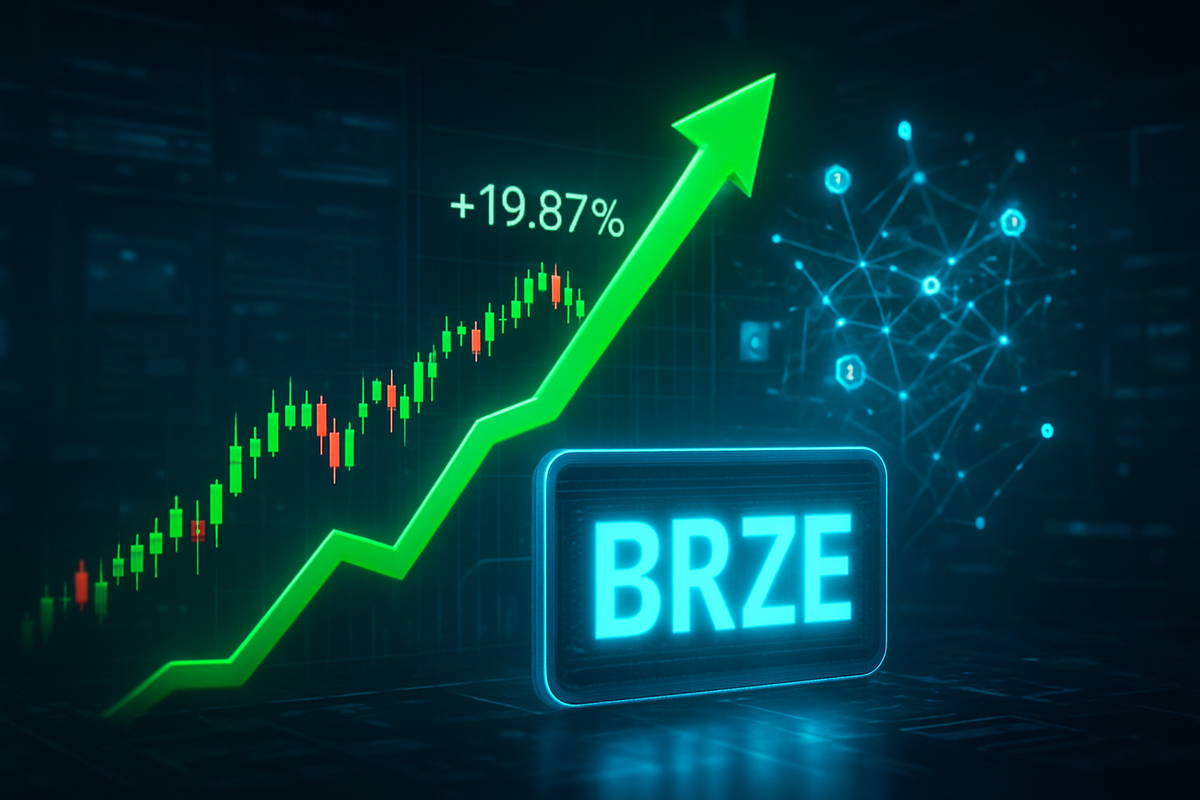
In a dramatic defiance of the broader market volatility currently plagueing the enterprise software sector, Braze Inc. (NASDAQ: BRZE) saw its shares skyrocket by 19.87% on Wednesday, March 25, 2026. The stock climbed from $18.02 to close at $21.60, marking its strongest single-day performance in over two years. This surge comes at a critical juncture for the "Software as a Service" (SaaS) industry, which has been grappling with what analysts are calling the "SaaSpocalypse"—a period of intense valuation compression driven by fears that artificial intelligence (AI) might render traditional subscription platforms obsolete.
The immediate implications of this rally are twofold: first, it establishes Braze as a leading survivor and beneficiary in the transition to AI-native marketing; and second, it provides a much-needed psychological floor for the MarTech (Marketing Technology) industry. By delivering a combination of robust financial growth and tangible AI monetization, Braze has effectively quelled investor jitters that had previously dragged the stock toward 52-week lows earlier this month.
A Perfect Storm of Growth and Strategic Execution
The catalyst for this historic move was the company's fiscal fourth-quarter 2026 earnings report, released after the bell on March 24. Braze reported Q4 revenue of $205.2 million, representing a 28% year-over-year increase and comfortably beating the consensus estimate of $198.2 million. More significantly, the company hit two major psychological and financial milestones: surpassing $800 million in Annual Recurring Revenue (ARR) and exceeding $1 billion in Remaining Performance Obligations (RPO). The latter, a key indicator of future revenue certainty, grew by 30% compared to the previous year.
The timeline leading up to this surge was marked by a strategic pivot toward "agentic AI." Throughout late 2025 and early 2026, Braze quietly rolled out its Braze AI™ suite, which includes the Decisioning Studio and Agent Console. Unlike traditional automation tools that require manual logic, these new tools utilize autonomous agents to optimize campaign timing, channel selection, and creative content in real-time. During the earnings call, management revealed that two-thirds of their customer base had already integrated these AI features into their daily workflows, proving that the company’s AI investments were generating immediate utility rather than just "vaporware" hype.
Adding fuel to the fire, the Board of Directors authorized a $100 million share repurchase program, with $50 million slated for an immediate accelerated buyback. This move signaled a high level of executive confidence in the company's intrinsic value and its long-term trajectory. Institutional investors, who had been sitting on the sidelines due to sector-wide uncertainty, responded by aggressively re-entering positions, triggering a high-volume breakout in the stock price.
Winners and Losers in the Wake of the Braze Breakout
While Braze Inc. (NASDAQ: BRZE) celebrated a banner day, the broader landscape for its competitors remained treacherous. Salesforce Inc. (NYSE: CRM) and HubSpot Inc. (NYSE: HUBS) found themselves on the losing end of the week's market movements. Just 24 hours prior to Braze's surge, both companies saw their valuations dip—Salesforce by 5.8% and HubSpot by 6.5%. The sell-off was sparked by updates from independent AI labs showing new "agentic" capabilities that could potentially bypass traditional CRM interfaces altogether, leading investors to fear that these legacy giants might be too slow to adapt.
Klaviyo Inc. (NYSE: KVYO), a direct rival in the marketing automation space, also struggled to keep pace. Despite launching its own AI tool, "Composer," on the same day as Braze’s rally, Klaviyo’s stock remained under pressure, trading nearly 47% below its six-month highs. Investors appear to be differentiating between platforms that have successfully transitioned to "AI-first" architectures and those perceived as "AI-added." Braze’s ability to show high adoption rates for its Agent Console gave it a distinct edge over Klaviyo, which has recently faced concerns regarding insider selling and slower enterprise-tier adoption.
On the higher end of the market, Adobe Inc. (NASDAQ: ADBE) continues to face a complex battle. While its Experience Cloud remains a dominant force, the stock has lingered near 52-week lows as it battles AI-native creative startups. The success of Braze suggests that the market is currently rewarding specialized, agile platforms that can demonstrate immediate "agentic" efficiency over broad, all-in-one suites that may carry more technical debt.
The Broader Shift Toward Agentic Marketing
The significance of Braze's performance extends beyond a single earnings beat; it represents a fundamental shift in how the industry views the intersection of SaaS and AI. For much of 2025, the prevailing narrative was that AI would destroy the "seat-based" pricing model of SaaS companies. Braze has countered this by proving that value-based pricing—centered on the performance and outcomes generated by AI agents—can drive even higher margins and stickier customer relationships.
This event mirrors historical precedents such as the mobile revolution of the early 2010s. Just as Braze rose to prominence as a "mobile-first" alternative to legacy desktop-centric email tools, it is now positioning itself as an "agent-first" alternative to legacy automation. The ripple effect on competitors will likely be a mad scramble to demonstrate similar "agentic" capabilities. We can expect an uptick in M&A activity as larger, slower-moving firms look to acquire AI-native startups to bridge the gap that Braze has so clearly identified.
From a regulatory standpoint, the success of these AI agents will likely draw increased scrutiny regarding data privacy and "autonomous" messaging. As Braze’s agents begin to make more decisions without direct human oversight, the industry will have to navigate evolving standards for algorithmic transparency, particularly in highly regulated regions like the European Union.
Looking Ahead: The Path to the $1 Billion Revenue Mark
In the short term, Braze is positioned to maintain its momentum as it executes its $100 million buyback program. The company’s guidance for fiscal 2027 is notably bullish, with revenue projected between $884 million and $889 million. Analysts are now looking toward the end of the 2027 fiscal year as the likely timeframe for Braze to join the elite "billion-dollar revenue club." To reach this, the company will need to sustain its 25%+ growth rate while continuing to expand its operating margins, which are expected to hit 8% this year.
However, challenges remain. The "SaaSpocalypse" has not ended for everyone, and the macro-economic environment remains sensitive to interest rate fluctuations and enterprise spending caution. Braze will need to ensure that its AI tools continue to deliver a high Return on Investment (ROI) for customers to justify their premium pricing. Any slowdown in AI adoption or a high-profile failure of an autonomous marketing agent could quickly reverse the current sentiment.
The primary strategic pivot to watch will be Braze’s expansion into deeper data integration. As marketing becomes more autonomous, the "battle for the data layer" will intensify. Investors should monitor how Braze integrates with data warehouses like Snowflake or Databricks, as the quality of an AI agent is fundamentally limited by the data it can access.
Summary and Investor Takeaways
The 19.87% surge in Braze Inc. (NASDAQ: BRZE) is more than just a reaction to a strong quarter; it is a signal that the market is ready to reward SaaS companies that can successfully navigate the AI transition. Key takeaways include:
- Earnings Excellence: Beating revenue estimates and hitting the $800M ARR milestone provided the fundamental floor for the stock rally.
- AI as a Catalyst: The successful deployment of the Decisioning Studio and Agent Console proved that Braze could monetize AI rather than be disrupted by it.
- Capital Allocation: The $100M buyback program acted as a powerful signal of management confidence during a volatile period.
Moving forward, the market will be looking for "proof of life" in other SaaS names. Investors should closely watch for whether competitors like HubSpot or Klaviyo can replicate Braze's success in AI adoption rates in their upcoming reports. For now, Braze has earned its status as a bellwether for the next generation of intelligent enterprise software.
This content is intended for informational purposes only and is not financial advice.