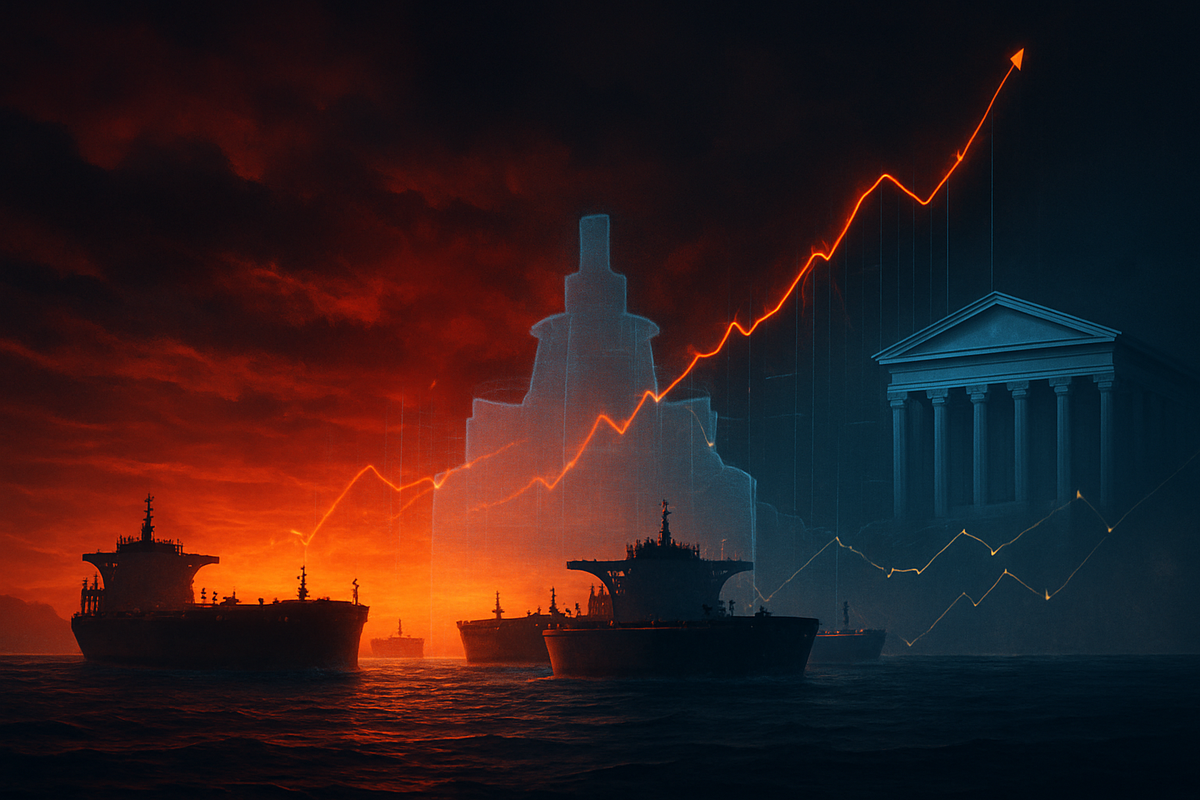
The global financial landscape reached a fever pitch this March as the world’s most influential central banks collectively slammed the brakes on market expectations for interest rate cuts. Despite cooling labor markets and a growing chorus of pleas from Wall Street for relief, the Federal Reserve, the European Central Bank (ECB), and the Bank of England (BoE) opted to hold rates steady, citing a volatile new variable: the "Hormuz Shock." This geopolitical crisis has sent energy prices into the stratosphere, effectively trapping central bankers in a hawkish corner and upending the traditional safe-haven status of gold and silver.
The standoff highlights a stark divergence between investor sentiment and the reality of a world re-confronting supply-side inflation. While the SPDR S&P 500 ETF Trust (NYSEARCA: SPY) had spent much of late 2025 pricing in a series of aggressive cuts, the reality of $120-per-barrel oil has forced a painful repricing of risk across all asset classes.
A Coordinated Stance Against Energy-Driven Volatility
The pivotal moment arrived on March 18, 2026, when the Federal Open Market Committee (FOMC) concluded its two-day meeting by maintaining the federal funds rate at 3.5%–3.75%. Federal Reserve Chair Jerome Powell delivered a somber address, acknowledging that while core inflation had shown signs of moderation earlier in the winter, the sudden effective closure of the Strait of Hormuz in late February changed the calculus. This critical maritime passage, which handles roughly 20% of the world’s seaborne petroleum and liquefied natural gas (LNG), saw traffic grind to a halt following escalating hostilities between regional powers.
Within 24 hours of the Fed’s announcement, both the European Central Bank and the Bank of England followed suit. The ECB, led by Christine Lagarde, maintained its deposit facility rate at 2.00%, while the Bank of England held its Bank Rate at 3.75%. The timeline of these decisions was heavily influenced by the "Black Monday" of energy markets on March 2, when Brent Crude leaped nearly $15 in a single session. By mid-March, as central bankers gathered, Brent was consistently trading above $120, and European natural gas futures had nearly doubled.
The initial market reaction was one of sharp disappointment. Traders who had bet on a 25-basis-point cut from at least one of the "Big Three" central banks were forced to liquidate positions. Bond yields surged, with the U.S. 10-year Treasury yield briefly touching its highest level in over a decade as the market accepted a "higher for longer" regime. The hawkish hold was not merely a pause but a defensive perimeter set by central banks against the threat of a secondary inflation wave triggered by the energy crisis.
Winners and Losers in a High-Octane Market
The fallout from the Hormuz Shock and the subsequent central bank freeze has created a distinct hierarchy of market performance. Leading the charge are the traditional "Oil Majors" like Exxon Mobil Corporation (NYSE: XOM) and Shell plc (NYSE: SHEL). While Shell has faced logistical nightmares regarding its Qatari LNG flows, the sheer scale of the price surge in hydrocarbons has boosted its short-term earnings projections. Conversely, transportation and logistics giants have seen their margins crushed by rising fuel costs and the need to reroute global shipping around the Cape of Good Hope.
The most unexpected development has been the brutal correction in the precious metals sector. Historically a safe haven during geopolitical strife, gold and silver became victims of their own success and the soaring U.S. dollar. After hitting a record peak of over $5,400 an ounce in early March, gold plummeted nearly 18% as institutional investors sold liquid assets to cover margin calls on falling equity positions. Major miners like Newmont Corporation (NYSE: NEM) and Agnico Eagle Mines (NYSE: AEM) have seen their stock prices battered by this "liquidity squeeze," as the high opportunity cost of holding non-yielding bullion became impossible to ignore in the face of 3.75% interest rates.
Streaming and royalty companies have also felt the pinch. Wheaton Precious Metals Corp. (NYSE: WPM) saw its shares decline as the dual pressure of lower silver prices and high discount rates weighed on the valuation of its future production contracts. On the brighter side, uranium producers like Cameco Corporation (NYSE: CCJ) have emerged as a hedge for investors looking toward nuclear energy as a long-term solution to hydrocarbon volatility, with their shares outperforming the broader mining index this month.
The Broader Significance: A Return to the 1970s Playbook?
The March 2026 central bank decisions signify a shift back to a "supply-side dominant" monetary policy, reminiscent of the 1970s oil shocks. For much of the past decade, central banks have focused on managing demand through the labor market and consumer spending. However, the Hormuz Shock has proven that geopolitical bottlenecks can override domestic economic data. This event has forced a re-evaluation of the "inflation target" narrative; if energy costs remain structural higher due to regional conflict, the 2% inflation goal may become an impossible relic of the pre-war era.
Furthermore, the ripple effects are being felt in the regulatory sphere. Governments in the Eurozone and North America are now fast-tracking energy independence initiatives, which could lead to massive public spending at a time when central banks are trying to tighten the money supply. This "fiscal-monetary tug-of-war" is likely to create persistent volatility in the bond markets, as seen in the recent fluctuations of major sovereign debt instruments.
The coordination between the Fed, ECB, and BoE also suggests a "Global Hawkish Front." In previous decades, central banks often moved out of sync based on local conditions. In 2026, the interconnectedness of energy markets means that an oil shock in the Middle East is an immediate inflation problem for London, Frankfurt, and Washington alike. This unified front serves as a warning to markets that the era of "easy money" will not return as long as global energy arteries are under threat.
What Comes Next: Navigating the Strait of Uncertainty
In the short term, all eyes remain on the Strait of Hormuz. Should diplomatic efforts succeed in reopening the passage, the energy-driven inflation spike could dissipate as quickly as it arrived, potentially opening the door for a late-summer rate cut. However, most analysts are bracing for a protracted "Cold War" scenario in the region. If the strait remains contested through the end of 2026, central banks may be forced to raise rates even further to prevent energy costs from embedding into wage expectations—a scenario that would almost certainly trigger a global recession.
Strategic pivots are already underway. Manufacturing firms are aggressively diversifying their supply chains to reduce reliance on energy-intensive processes, while financial institutions are increasing their holdings of the U.S. dollar as the ultimate liquidity tool. For precious metals, the path forward is murky. Gold and silver may eventually find a floor once the initial liquidity drain concludes, but they will likely remain under pressure as long as real interest rates stay positive and the dollar remains the primary vehicle for settling high-priced oil contracts.
Conclusion: A New Era of Risk Management
The March 2026 central bank meetings will likely be remembered as the moment the "Pivot Hope" died and the "Hormuz Reality" began. The Federal Reserve, ECB, and Bank of England have sent a clear message: price stability is their absolute priority, even at the cost of equity market growth or the stability of traditionally "safe" assets like gold.
For investors, the key takeaways are the resilience of the U.S. dollar and the ongoing importance of energy exposure in a diversified portfolio. The traditional 60/40 portfolio is being tested yet again as both bonds and stocks react to the same inflationary pressures. Moving forward, the most important metric to watch will not be the monthly jobs report, but the daily shipping throughput in the Middle East and the resulting fluctuations in the Brent Crude spot price. As long as the "Hormuz Shock" persists, the path of least resistance for interest rates remains sideways—or up.
This content is intended for informational purposes only and is not financial advice.