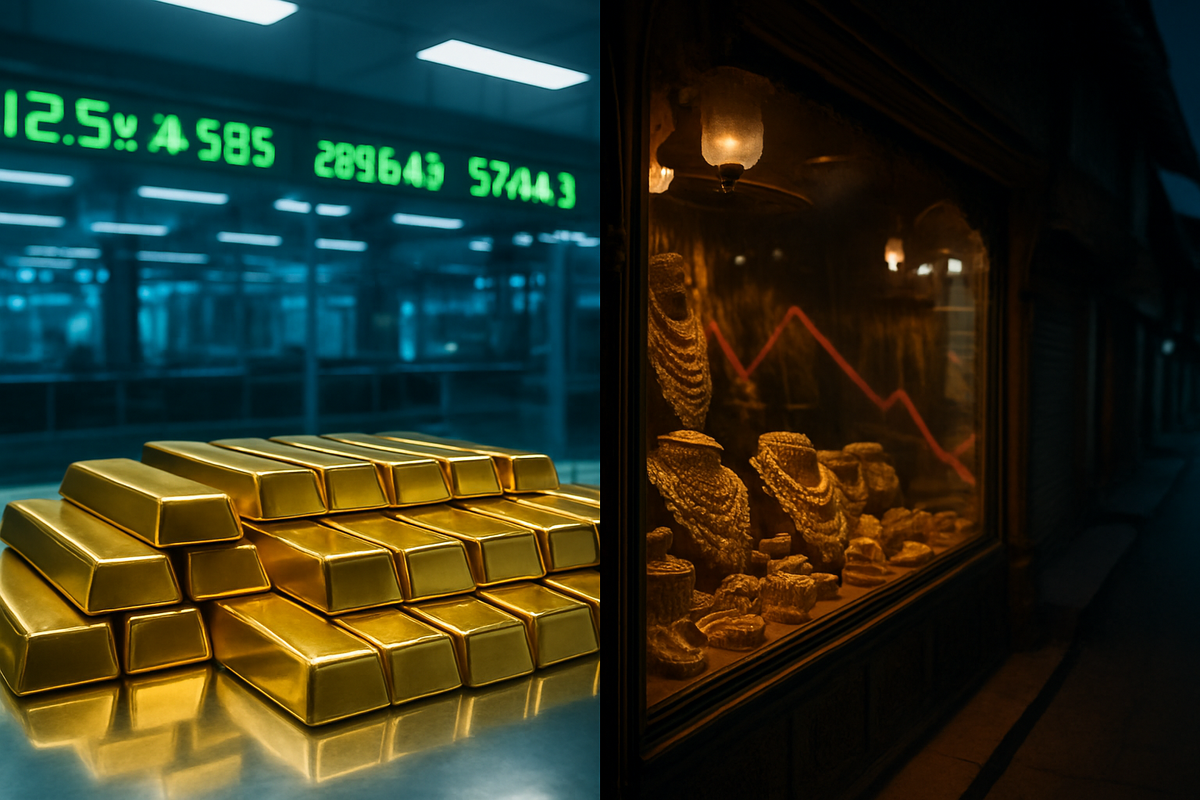
As of March 9, 2026, the global gold market is witnessing an unprecedented regional decoupling that has left analysts and bullion traders stunned. While the yellow metal has surged to historic highs—trading in a volatile range between $5,100 and $5,400 per ounce—the two largest physical consumers, China and India, are moving in diametrically opposite directions. In Shanghai, physical gold is commanding a robust premium of $30 to $35 per ounce over international spot prices, signaling a voracious appetite for safe-haven assets. Meanwhile, just a few thousand miles away in Mumbai, the market has entered a state of "demand destruction," with local prices trading at a record discount of $65 per ounce as the traditional "wedding season" fails to ignite consumer interest.
This massive $100-per-ounce spread between the two Asian giants highlights a structural shift in how the world’s most populous nations view gold. For China, gold has become a critical pillar of financial security amidst geopolitical tensions and a softening yuan. For India, however, the metal has crossed a psychological and financial Rubicon, pricing out the middle-class families who have historically been the backbone of the physical market. The resulting divergence is not just a statistical anomaly; it is a fundamental realignment of global liquidity and precious metal flows.
The Tale of Two Markets: Premiums, Discounts, and Central Bank Intervention
The divergence began to accelerate in early February 2026 and reached its peak in the first week of March. In China, the strength of the Shanghai Gold Exchange (SGE) is being bolstered by a relentless campaign of accumulation by the People’s Bank of China (PBoC). As of March 2026, the PBoC has extended its gold-buying streak to 16 consecutive months, bringing its official reserves to approximately 2,308 tonnes. This central bank activity, combined with retail investors seeking refuge from a shaky domestic property market, has kept Shanghai premiums consistently high. On March 2nd, some retail bars in China were reportedly fetching as much as $100 over the COMEX spot price during intraday peaks, driven by fears of further de-dollarization and regional instability.
In contrast, the Indian market is grappling with what economists call "price-induced paralysis." With local prices nearing ₹1.71 lakh per 10 grams, the traditional Indian wedding season—usually the busiest time for the industry—has seen a staggering volume slump. Indian bullion dealers, saddled with high-priced inventory that few can afford, have been forced to offer record discounts of $65 per ounce to entice any activity at all. This "demand destruction" is more than just a temporary lull; it represents a behavioral shift where families are increasingly recycling old jewelry or pivoting to 14k and 18k gold instead of the standard 22k purity to keep wedding costs manageable.
Corporate Winners and Losers in the New Gold Era
The current market environment has created a complex landscape for public companies involved in the mining and retail of precious metals. Leading global miners like Newmont (NYSE: NEM) and Barrick Gold (NYSE: GOLD) are currently operating in what analysts call the "Era of Super-Margins." With production costs relatively stable compared to the explosive growth in spot prices, these firms are generating record free cash flow. Newmont, for instance, recently reported a quarterly free cash flow of $7.3 billion, though it has cautioned investors about a "production trough" in 2026 as it prioritizes higher-grade ore to maximize returns in this high-price environment.
On the retail side, the impact is more nuanced. Titan Company (NSE: TITAN), India’s largest jewelry retailer, has seen its stock price remain resilient despite the volume slump. While physical sales by weight have dropped to five-year lows, the absolute value of sales remains high due to the price of gold. Titan has managed this transition by aggressively marketing its lab-grown diamond line and expanding its "Gold Exchange" programs, which allow customers to trade in old gold for new designs. Conversely, Hong Kong-based Chow Tai Fook (HKG: 1929) is thriving on the Chinese side of the divide. The company has successfully hiked prices on fixed-price products by 15-30% to maintain margins, capitalizing on the "gold fever" sweeping through mainland China's urban centers.
De-dollarization and the Structural Shift in Physical Flow
This divergence is a symptom of a much broader trend: the fragmentation of the global financial system. The PBoC’s aggressive buying is a clear signal of China’s long-term strategy to diversify its $3 trillion-plus in foreign exchange reserves away from the U.S. dollar. By making gold roughly 10% of its total reserve assets, China is insulating itself from potential sanctions and Western financial pressure. This institutional support provides a "floor" for the Shanghai market that the Indian market simply does not have.
Furthermore, the "demand destruction" in India reflects a maturation—or perhaps a forced evolution—of the Indian consumer. For decades, India was the world’s "sink" for physical gold. However, the rise of Gold ETFs and digital gold products in 2025 and 2026 has provided an alternative for investors who want price exposure without the burden of physical storage at record valuations. Investment demand now accounts for nearly 40% of total Indian gold consumption, a historic high that comes at the direct expense of the jewelry sector. This shift suggests that even if prices soften, the traditional "heavy jewelry" culture in India may never fully return to its former volumes.
Navigating the Volatility: What Comes Next?
In the short term, the market is watching for a potential "mean reversion" of the spread. If the PBoC pauses its buying or if the Indian government moves to lower import duties to stimulate the domestic sector, the $100 gap between Shanghai and Mumbai could narrow. However, as long as geopolitical tensions remain elevated, the Chinese "fear bid" is likely to keep premiums elevated. Market participants should also prepare for a potential supply glut in India if recycled gold—consumers selling back their holdings to lock in profits—continues to flood the market, further deepening the discounts.
Long-term, the divergence underscores a shift in gold’s primary function. It is transitioning from a consumer luxury item in the East to a strategic monetary asset. Retailers will likely need to continue their pivot toward "value-added" services, such as financing and high-margin gemstone settings, rather than relying on the sheer volume of gold sold. For miners, the focus will remain on capital discipline, as the market may eventually penalize firms that chase volume at the expense of margin if the high-price environment leads to a sustained global contraction in physical demand.
Market Outlook and Final Thoughts
The March 2026 gold market is a study in contrasts. The robust $30-$35 premiums in China reflect a nation arming itself financially for a multi-polar world, while the $65 discounts in India signal a consumer base that has finally been priced out of its own traditions. For investors, the takeaway is clear: the "gold price" is no longer a monolithic global figure but a series of regional realities driven by local central bank policy and consumer psychology.
As we move through the second quarter of 2026, the key metrics to watch will be the PBoC’s monthly reserve updates and the volume of gold imports into India. If the discounts in India persist despite the wedding season ending, it may signal a permanent downshift in the world’s largest physical market. Conversely, if China’s appetite continues to grow, it could provide the necessary momentum to push gold toward the once-unthinkable $6,000 mark. In this fragmented landscape, the only certainty is that the "glitter" of gold is being viewed through very different lenses in Beijing and New Delhi.
This content is intended for informational purposes only and is not financial advice.