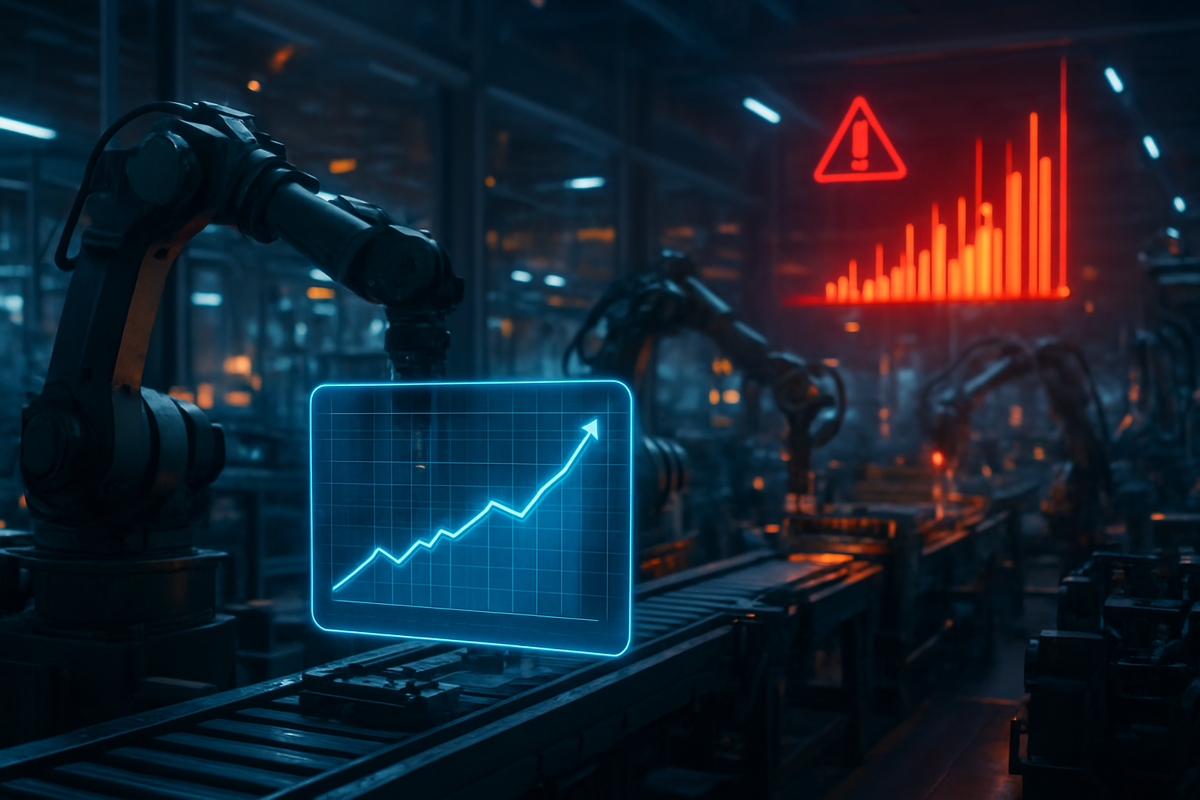
The American industrial engine showed surprising grit in March 2026, as the Institute for Supply Management (ISM) reported its third consecutive month of expansion. The headline Manufacturing Purchasing Managers' Index (PMI) climbed to 52.7, comfortably surpassing economist forecasts and signaling a sustained recovery for a sector that had struggled for much of the previous year. However, the upbeat headline figure masked a brewing storm of inflationary pressures and uneven demand, complicating the outlook for both Wall Street and the Federal Reserve.
While the expansion is a welcome sign of economic vitality, the underlying data revealed a sharp and concerning jump in the Prices Index to 78.3. This spike—driven largely by geopolitical instability and a tightening trade environment—suggests that the "cost of doing business" is accelerating far faster than production growth. For manufacturers, the current climate is one of cautious optimism tempered by the reality of a "high-inflation expansion," where top-line growth is increasingly threatened by bottom-line erosion.
A Complex Landscape of Growth and Inflation
The March ISM report, released on Wednesday, paints a picture of a manufacturing sector that is growing but under significant duress. The PMI reading of 52.7 indicates that the sector is expanding at its fastest pace in nearly two years. According to Timothy Fiore, Chair of the ISM Manufacturing Business Survey Committee, the expansion was supported by a steady flow of New Orders (53.5) and a jump in Production (54.2). This marks a significant turnaround from the stagnation seen in early 2025, suggesting that the "reshoring" movement is finally beginning to yield tangible industrial output.
However, the "Prices Paid" component of the report stole the spotlight, surging to 78.3—a level not seen since the supply chain crises of 2022. This massive jump indicates that nearly 80% of manufacturers are seeing higher prices for raw materials, particularly in the energy, chemicals, and metals sectors. The primary culprits include ongoing maritime restrictions in the Middle East and the implementation of the "Tariff Cliff" policies that have increased the cost of imported electronic components and specialized steel.
Despite the expansion, demand remains a "mixed bag." While the defense and aerospace industries reported record order backlogs, the consumer-facing sectors, such as electronics and appliances, noted a cooling in demand as higher retail prices began to bite. This divergence has created an atmosphere of uncertainty; 12 of the 18 manufacturing industries reported growth, but many cited concerns over inventory management and the risk of a "demand cliff" later in the year if inflationary pressures do not subside.
Winners and Losers in the Inflationary Expansion
In this environment of high costs and rising demand, the market is quickly bifurcating into winners who can pass on costs and losers who are being squeezed. The clear winners are the giants of the aerospace and defense sectors. Lockheed Martin (NYSE: LMT) and RTX Corporation (NYSE: RTX) are seeing unprecedented demand for advanced weaponry and missile defense systems, with government contracts providing a buffer against the rising cost of raw materials. Similarly, companies specializing in high-end industrial technology, such as NVIDIA (NASDAQ: NVDA) and Honeywell (NASDAQ: HON), continue to thrive as manufacturers invest heavily in AI-driven automation to offset soaring labor and material costs.
On the other side of the ledger, heavy equipment manufacturers and the automotive sector are feeling the brunt of the Prices Index spike. Caterpillar Inc. (NYSE: CAT), while benefiting from infrastructure spending, is facing a significant margin squeeze due to the high price of steel and specialized machinery parts. Agriculture-focused Deere & Company (NYSE: DE) is also under pressure, as farmers—facing their own rising costs—delay major equipment purchases.
The automotive sector remains particularly vulnerable. Ford Motor Company (NYSE: F) and General Motors (NYSE: GM) are navigating a difficult terrain where the cost of battery materials and imported semiconductors is rising just as consumer financing rates remain elevated. These companies may be forced to choose between absorbing the costs and losing profitability, or raising prices and risking a further drop in sales volume.
Broader Economic Significance and the Fed’s Dilemma
The March PMI data fits into a broader trend of "industrial re-localization," where US companies are bringing production home to avoid global supply chain volatility. However, the 78.3 Prices Index reading suggests that this shift comes with a high inflationary premium. This "New Normal" for manufacturing—expansion at a high cost—presents a significant challenge for the Federal Reserve. With prices at the factory gate rising so sharply, the central bank may be forced to delay the interest rate cuts that the market has been anticipating for 2026.
Historically, when the PMI stays above 50 while the Prices Index exceeds 75, it signals a period of "stagflationary risk" if demand falters. We saw a similar dynamic in mid-2022, which was followed by an aggressive series of rate hikes. While the current expansion is more moderate than the post-COVID boom, the persistence of price increases across 17 of the 18 tracked industries suggests that inflation is becoming structural rather than transitory.
The "mixed demand" signals mentioned by manufacturers are also a warning sign. If the expansion is concentrated only in government-subsidized sectors like defense and energy, rather than broad-based consumer demand, the sustainability of this growth cycle is in question. This creates a ripple effect for global partners, particularly in Europe and Asia, who are seeing their export markets to the US become more expensive and less predictable due to the fluctuating trade policies.
The Road Ahead: Adaptation and Scenarios
In the short term, manufacturers will likely focus on "cost-containment" strategies. This will involve a pivot toward more aggressive digital transformation and the adoption of "Agentic AI" to optimize supply chains in real-time. Companies that have already invested in these technologies will likely see a faster recovery in their margins. Investors should watch for strategic pivots toward vertical integration, as firms seek to own more of their supply chain to bypass the volatile spot markets for raw materials.
Looking further ahead, two scenarios emerge. The optimistic "soft landing" scenario sees supply chain pressures easing by the third quarter of 2026 as new domestic processing plants for lithium and steel come online, bringing the Prices Index back toward the mid-50s. The pessimistic scenario involves a "demand shock," where the combination of high prices and sustained high interest rates eventually breaks the back of the US consumer, leading to a contraction in new orders and a potential manufacturing recession by 2027.
Final Assessment: What to Watch
The March 2026 ISM Manufacturing report is a testament to the resilience of the American industrial base, yet it serves as a stark reminder of the inflationary dragon that remains unslain. The 52.7 PMI is a victory for growth, but the 78.3 Prices Index is a warning for the broader economy.
For investors, the coming months will require a discerning eye. The key metrics to monitor will be the "Supplier Deliveries" index—to see if logistics bottlenecks are worsening—and the upcoming "Consumer Price Index" (CPI) releases, which will reveal how much of these factory-gate costs are being passed on to the public. As we move further into 2026, the ability of companies to maintain margins in the face of these headwinds will separate the market leaders from the laggards.
While the factory floors are humming for now, the cost of keeping the lights on has never been higher.
This content is intended for informational purposes only and is not financial advice