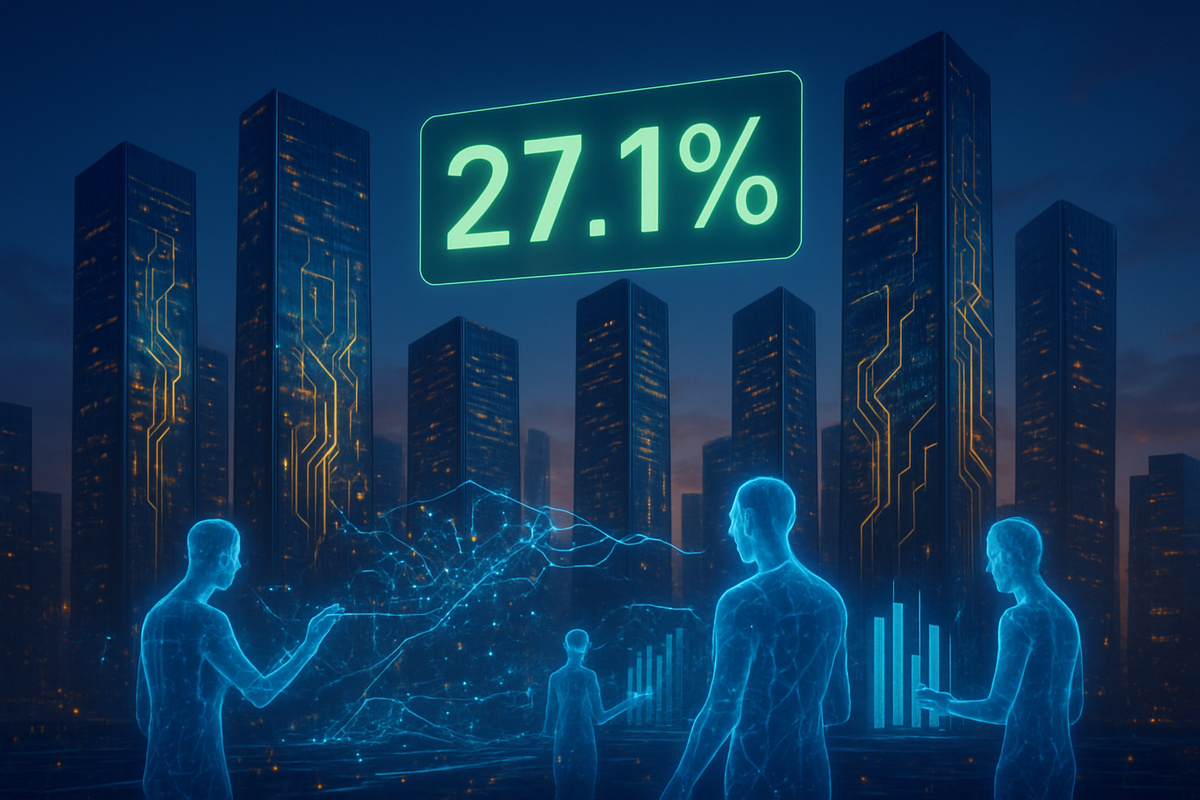
The eyes of the global financial community are fixed on the "Magnificent Seven" as the first-quarter earnings season of 2026 commences. Following a dramatic "April Breakout" that saw the Nasdaq 100 surge by nearly 4% in a single trading session on April 1st, institutional investors have effectively drawn a line in the sand. With the technology sector projected to deliver a staggering 27.1% year-over-year earnings growth, the pressure has shifted from speculative potential to tangible performance. For the tech titans, the coming weeks are not merely about beating estimates; they are about proving that the hundreds of billions of dollars poured into "Agentic AI" are finally translating into accelerated revenue streams.
The current market environment, as of April 10, 2026, is defined by a widening chasm between the tech-heavy indices and the broader market. While the S&P 500 is expected to post a blended earnings growth rate of 12.8%, that figure is heavily padded by the outperformance of the tech sector. Without the contribution of the Magnificent Seven, the aggregate earnings growth for the remaining 493 companies in the S&P 500 would plummet to a modest 5.6%. This heavy reliance on a handful of mega-cap stocks has created a high-stakes "gut check" for investors who have driven valuations to historic levels during the recent spring rally.
The 27.1% Milestone and the Institutional Pivot
The lead-up to this earnings season was marked by extreme volatility. In late March 2026, the market grappled with a "growth scare" fueled by "sticky" inflation and geopolitical tensions in the Middle East. However, the narrative shifted abruptly on April 1, 2026. Data from institutional "dark pools" revealed a massive accumulation phase during the March lows, including a notable $2.69 billion buy premium for NVIDIA (Nasdaq: NVDA). This "smart money" intervention served as the launchpad for the April breakout, propelling tech stocks past critical resistance levels and setting the stage for what analysts at Zacks Investment Research describe as a "make-or-break" quarter.
The projected 27.1% earnings surge for the tech sector represents more than just a recovery; it is a validation of the "Agentic AI" era. Unlike the generative AI hype of 2024 and 2025, which focused on chatbots and image generation, 2026 has been the year of autonomous systems. These agents, capable of executing complex workflows without human intervention, are now the primary driver of enterprise software demand. The market is now demanding "cold, hard evidence" that these technologies are moving the needle on the bottom line, especially as the Magnificent Seven’s collective annual capital expenditure (CapEx) for AI infrastructure is expected to exceed $200 billion this year.
Winners and Losers in the ROI Reckoning
Among the giants, NVIDIA (Nasdaq: NVDA) continues to occupy the pole position, buoyed by the "Terafab" chip initiative and a seemingly insatiable demand for the specialized hardware required to run agentic models. However, the scrutiny is intensifying on Microsoft (Nasdaq: MSFT) and Meta Platforms (Nasdaq: META). Both companies have seen their margins squeezed by massive infrastructure spending, and investors are looking for a significant uptick in Azure AI and Meta AI revenue to justify the costs. For Meta, the focus remains on whether its open-source "Llama" ecosystem has successfully monetized through enterprise services, while Microsoft is under pressure to show that "Copilot" has transitioned from a novelty tool to a mission-critical enterprise autonomous agent.
On the other hand, Amazon (Nasdaq: AMZN) enters the season with mixed signals. While Amazon Web Services (AWS) has seen a resurgence, growing at a 24% clip—its fastest since 2022—the retail giant is currently navigating a $1 billion civil penalty recently levied by regulators, alongside rising logistical costs. Alphabet (Nasdaq: GOOGL) has managed to shift the narrative from being "behind in AI" to being an "integrated AI leader." With the launch of Gemini 3.5, Alphabet is aiming to prove that its AI can manage entire user workflows across its ecosystem, from booking travel to managing corporate calendars, potentially revitalizing its core search and cloud businesses.
Conversely, Apple (Nasdaq: AAPL) and Tesla (Nasdaq: TSLA) face more uphill battles. Apple is currently riding the "iPhone 17 super-cycle" and the rollout of "Siri 2.0," yet it faces significant legal hurdles in China regarding AI patents and ongoing pressure from the EU's Digital Markets Act. Tesla remains the most divisive member of the group; despite a $20 billion CapEx budget dedicated to the "Optimus" humanoid robot and physical AI, the company missed Q1 delivery targets, sparking fears that its core EV business is cooling while its robotics future remains years away from profitability.
The Shift Toward Agentic AI and Structural Shifts
The wider significance of this earnings season lies in the "Great Convergence" of AI and enterprise utility. According to early 2026 data, approximately 79% of enterprises have now adopted some form of AI agent technology, with 43% of total AI budgets now allocated specifically to autonomous systems. This represents a fundamental shift in the industry's lifecycle—from infrastructure building to application and execution. The companies that can demonstrate a "3x higher ROI" from these agents, as early adopters have reported, will likely decouple from those still stuck in the pilot phase.
This transition is also occurring against a backdrop of increasing regulatory friction. The era of unchecked growth for Big Tech is being challenged by aggressive antitrust enforcement in both the U.S. and Europe. From the AdTech case against Alphabet to the interoperability mandates facing Apple and Meta, the legal landscape in 2026 is more hazardous than ever. These regulatory headwinds threaten the long-term margins that have historically sustained 20%+ earnings growth, forcing a strategic pivot toward "Privacy-First" AI and localized manufacturing—as seen in Apple's shift of 20% of its production to India.
Future Outlook: Beyond the Breakout
Looking ahead, the short-term possibility of a "sell-the-news" event remains high if the Magnificent Seven fail to exceed the 27.1% growth bar. However, the long-term trajectory suggests a broadening out of the bull market. While the tech titans have been the primary engine, the "S&P 493" is finally showing signs of life, with growth projections for the rest of the index rising toward 8.1%. This suggests that the productivity gains from AI are finally beginning to trickle down to other sectors, including healthcare and manufacturing.
Market opportunities in the coming months will likely emerge in "Physical AI" and autonomous logistics. As the digital agent market matures, the next frontier will be the integration of these brains into physical hardware—a move already being telegraphed by Tesla’s robotics focus and Amazon’s autonomous warehouse initiatives. For investors, the challenge will be distinguishing between companies that are merely "AI-enabled" and those that are "AI-native" in their revenue generation.
Closing the Loop on the 2026 Tech Rally
In summary, the Q1 2026 earnings season is the ultimate "gut check" for the AI-driven market. The 27.1% growth projection sets a high bar, but the institutional support witnessed during the April breakout suggests that the market’s largest players are well-positioned to meet it. The transition from generative to agentic AI marks a new chapter in the digital economy—one where autonomy, ROI, and execution are the only metrics that matter.
As the market moves forward, investors should watch closely for margin stability in the face of rising CapEx and the impact of regulatory penalties on cash flows. The Magnificent Seven have successfully led the market through the "breakout" phase; now, they must prove they can lead the "payoff" phase. Whether they succeed or fail will determine the direction of the global markets for the remainder of 2026.
This content is intended for informational purposes only and is not financial advice