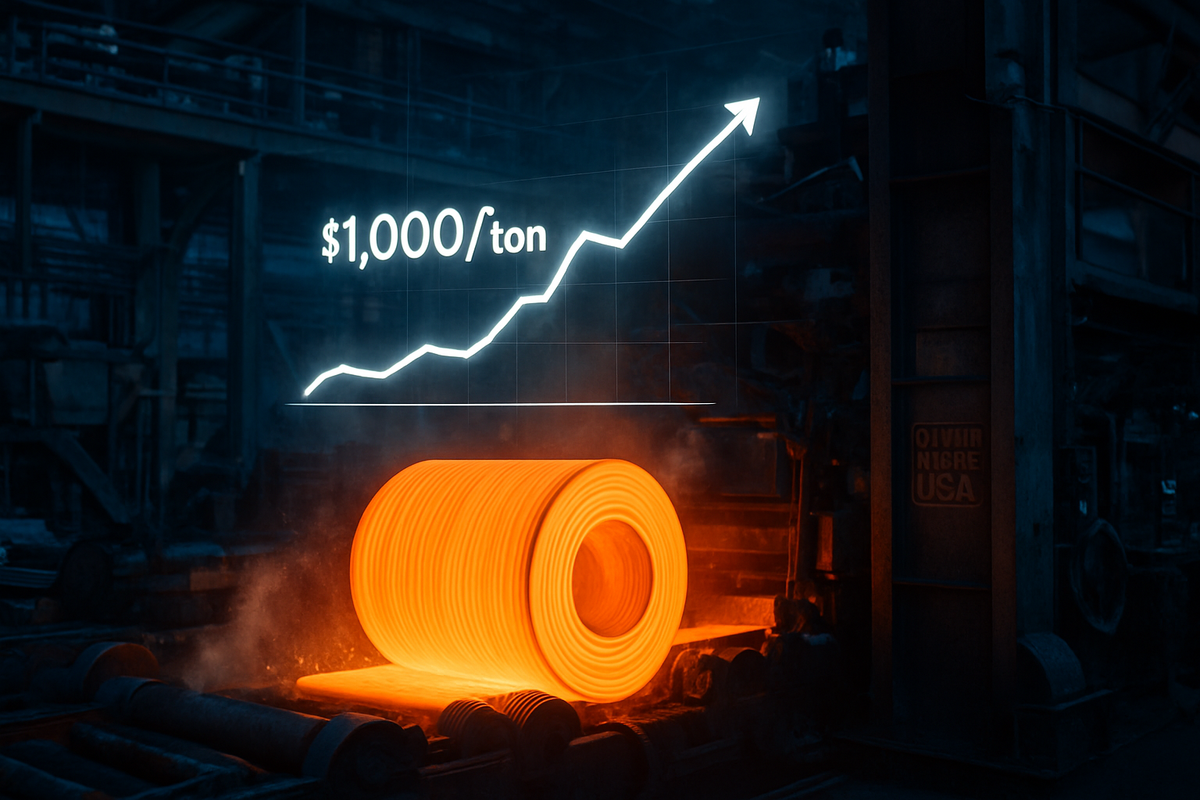
The domestic steel market has reached a fever pitch as hot-rolled coil (HRC) prices officially breached the $1,000 per ton milestone this week, the first time the benchmark has crossed this psychological and economic barrier since early 2024. The rally, which has been building momentum since late 2025, culminated in a series of aggressive price hikes led by industry titans. On April 2, 2026, spot prices for HRC were quoted as high as $1,074 per short ton, signaling a definitive shift in market dynamics that favors domestic producers over industrial consumers.
This pricing surge is being spearheaded by Nucor Corporation (NYSE: NUE), which recently raised its Consumer Spot Price (CSP) to $1,025 per ton. The move has effectively set a new floor for the industry, emboldening other major players to follow suit. Despite a backdrop of cooling demand in the residential housing sector, a combination of structural supply constraints, a doubling of import tariffs, and a cannibalistic competition for energy between steel mills and AI data centers has created a "Fortress America" pricing environment that shows no signs of relenting.
The Breach: How We Got to $1,000 Steel
The march toward $1,000 steel began in earnest during the final quarter of 2025, following a year of relative price stagnation. The primary catalyst for the current peak was the March 23 announcement by Nucor Corporation (NYSE: NUE) that it would raise its weekly CSP to $1,025, a move that caught many market participants off guard given the "uneven" state of the broader economy. By the end of March, Nucor pushed the envelope further, adjusting the rate to $1,035, while its West Coast operations at California Steel Industries saw quotes as high as $1,085 per ton due to localized shortages.
This milestone is a stark contrast to the conditions of 2024, when HRC prices frequently languished in the $600 to $700 range. The current price action is the result of deliberate "pricing discipline" among domestic mills. Rather than flooding the market to capture volume, major producers have curtailed production and extended lead times—now averaging 6.4 weeks—to ensure that spot availability remains tight. This tactical reduction in supply has forced buyers to accept higher prices or risk production delays in their own downstream operations.
The industry's reaction has been one of cautious triumph for producers and growing alarm for consumers. While buyers initially resisted the price hikes, citing soft demand in the single-family housing market, the lack of viable alternatives has left them with little choice. The domestic mills have successfully leveraged their dominant market position, turning a period of modest industrial growth into a windfall for their bottom lines.
Initial market data suggests that the "melted and poured" requirements for North American steel have finally closed the backdoors for cheap foreign imports. With the supply chain tightened and domestic mills acting in lockstep, the $1,000 threshold represents more than just a price point; it represents the total reclamation of pricing power by the U.S. steel industry after years of battling global oversupply.
The Beneficiaries: Winners and Losers in a High-Cost Era
The clear winners in this environment are the "Big Three" of American steel: Nucor, Steel Dynamics (NASDAQ: STLD), and Cleveland-Cliffs (NYSE: CLF). These companies have transitioned from being price-takers to price-makers. Steel Dynamics, for instance, has recently issued Q1 2026 guidance that nearly doubles its earnings from the same period last year, citing a 35% increase in order backlogs. Their ability to expand metal margins even as the cost of raw scrap rises is a testament to the current market's imbalance.
Cleveland-Cliffs (NYSE: CLF) is also reaping the rewards of this high-price environment. By terminating low-margin supply contracts and focusing on higher-value finished steel for the automotive sector, the company expects to see realized prices climb by over $60 per ton this quarter alone. Their strategic pivot away from raw slabs toward specialized electrical and automotive steel has allowed them to capture the "green premium" as manufacturers scramble to de-carbonize their supply chains using domestic resources.
On the losing end of the spectrum are the mid-sized manufacturers and construction firms. While large automotive OEMs (Original Equipment Manufacturers) often have long-term fixed-price contracts, small-to-medium enterprises (SMEs) in the construction and appliance sectors are being squeezed. The housing market, particularly single-family residential construction, is already struggling with high mortgage rates. Adding a 20-30% increase in the cost of structural steel components and appliances could further depress new housing starts, creating a secondary economic drag.
Furthermore, companies that rely on specialized imports are finding themselves in a precarious position. As the cost of foreign steel doubles due to tariffs, manufacturers of everything from heavy machinery to kitchenware are facing a "margin cliff." Those unable to pass these costs on to consumers are looking at significant profit warnings in the coming quarters.
Structural Drivers: The 50% Tariff and the AI Energy Crisis
The fundamental reason domestic mills can maintain $1,000+ prices despite soft housing demand lies in a radical shift in trade policy. On June 4, 2025, the U.S. administration officially increased Section 232 tariffs on most imported steel from 25% to 50%. This policy has effectively built a "tariff wall" that makes European and Asian imports non-competitive. With imports down 40% year-over-year, domestic mills no longer have to worry about being undercut by lower-cost foreign producers, giving them unprecedented control over the domestic price floor.
Beyond trade policy, a new and unexpected competitor has emerged for the steel industry: the AI data center. Steel production, particularly via Electric Arc Furnaces (EAF) used by Nucor and Steel Dynamics, is incredibly energy-intensive. As the AI revolution accelerates, massive data centers are competing with industrial plants for grid capacity. This has driven industrial electricity prices higher and introduced new volatility into production costs. When Winter Storm Fern hit in early 2026, several mills were forced to curtail production to save the grid, a move that further constricted supply and pushed prices higher.
Energy costs are also rising at the source. Natural gas prices at the Henry Hub are trending 15% higher than their 2024 averages, driven by global export demand and domestic infrastructure bottlenecks. For an industry that measures its profits by the cent-per-pound, these rising input costs necessitate higher finished goods prices just to maintain existing margins. The "energy transition" is proving to be a double-edged sword for steel; while it creates demand for wind turbines and electric vehicle components, it also drives up the cost of the power needed to make them.
This situation is a significant departure from historical precedents. In previous cycles, a softening housing market would have sent steel prices tumbling. However, the current era is defined by massive federal infrastructure spending and the "One Big Beautiful Bill" stimulus, which has redirected steel demand toward data centers, high-speed rail, and bridge reconstruction. The decoupling of steel prices from the residential housing market is perhaps the most significant structural change the industry has seen in a generation.
The Road Ahead: Sustainability or Demand Destruction?
The primary question facing investors and industry analysts is whether $1,000 HRC is sustainable. In the short term, the momentum appears to be on the side of the producers. Lead times remain extended, and the heavy infrastructure projects currently underway are price-insensitive compared to the residential market. As long as the 50% Section 232 tariffs remain in place, domestic mills will likely continue to test the upper limits of their pricing power.
However, the risk of "demand destruction" looms on the horizon. If steel prices remain above $1,000 for an extended period, manufacturers may begin to explore alternative materials, such as aluminum or advanced composites, where applicable. There is also the threat of a broader economic slowdown; if the cost of building new warehouses and factories becomes prohibitive, the very industrial demand currently propping up the market could evaporate. Strategic pivots may be required, with mills potentially needing to offer more flexible pricing tiers to retain their most price-sensitive customers.
In the long run, the market will likely reach a new equilibrium. Most analysts expect HRC to settle into a "new normal" range of $850 to $950, rather than returning to the $600 lows of the past. The combination of high energy costs, trade protectionism, and the "melted and poured" requirements has fundamentally raised the cost of doing business in the United States. The challenge for companies like Steel Dynamics and Cleveland-Cliffs will be to maintain their current profit margins as the initial shock of the $1,000 breach wears off and the market adjusts to the higher baseline.
Conclusion: A New Paradigm for American Industrialism
The breach of the $1,000 per ton milestone for HRC steel is a watershed moment for the U.S. economy. It signals the end of the "cheap commodity" era and the beginning of a more localized, protected, and high-cost industrial landscape. By raising its CSP to $1,025, Nucor Corporation (NYSE: NUE) has not only boosted its own revenue but has also signaled a broader confidence in the resiliency of American industrial demand, despite the headwinds facing the housing sector.
As we move through 2026, investors should keep a close eye on two key metrics: domestic mill capacity utilization and energy price volatility. If mills can keep utilization high without triggering an oversupply, the $1,000 price point could become a long-term fixture. Conversely, any easing of the Section 232 tariffs or a significant drop in AI-related infrastructure spending could quickly reverse these gains.
Ultimately, the current steel rally is a story of successful "Fortress America" policies and the prioritization of domestic supply chains. While this is a boon for the major steel producers and their shareholders, the rest of the economy must now learn to operate in an environment where the most basic building block of modern civilization has never been more expensive.
This content is intended for informational purposes only and is not financial advice.