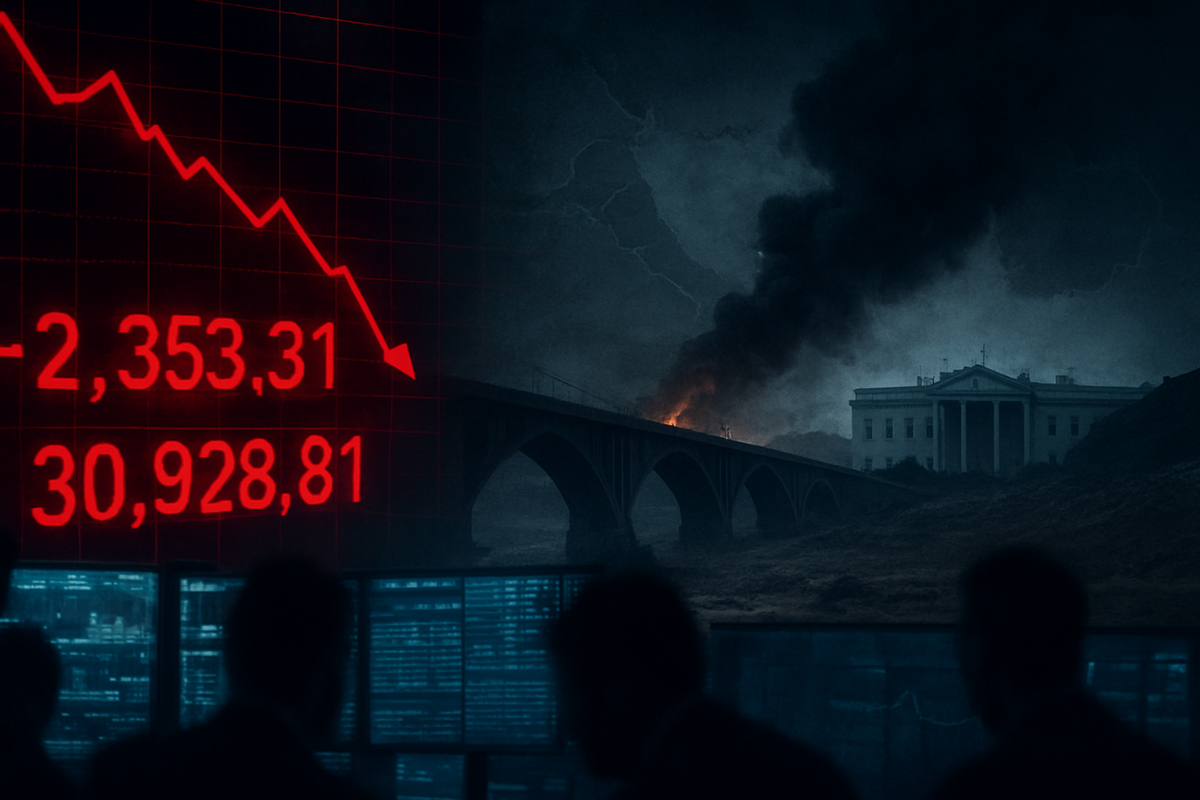
In a dramatic escalation of rhetoric that has rattled global financial centers, President Donald Trump warned on Wednesday, April 1, 2026, that the month-long conflict with Iran could persist for several more weeks, promising "extremely hard" strikes to neutralize the remaining military capabilities of the Islamic Republic. The President’s 19-minute address from the White House, while hinting at back-channel diplomatic efforts, emphasized a "maximum pressure" military phase intended to bring the Iranian leadership to its knees, causing immediate concern among investors who had hoped for a swifter conclusion to the hostilities.
The market reaction was swift and severe. On Thursday, April 2, the Dow Jones Industrial Average plunged 600 points in early trading, as the specter of a prolonged war and threats to regional energy infrastructure forced a massive sell-off in risk assets. With Brent crude prices surging toward $110 per barrel and the national average for gasoline crossing the $4.00 mark, the "Trump Slump" of early April has become the focal point for a market caught between the President’s aggressive military posture and his administration’s claims of a pending diplomatic breakthrough.
The "Extremely Hard" Phase: A Timeline of Escalation
The current conflict, which officially began on February 28, 2026, entered what the President called a "final, more intense phase" this week. During his April 1 address, Trump claimed the United States had already "decimated" the Iranian Navy and Air Force but warned that the mission would not be complete until the regime's command-and-control and nuclear infrastructure were entirely erased. In a particularly blunt moment, the President vowed to hit the nation "extremely hard," threatening to return the country to the "Stone Ages" if a settlement was not reached within the next 21 days. This rhetoric was punctuated by a video shared on social media showing the destruction of the B1 bridge near Karaj, which Trump described as the "biggest bridge in Iran coming tumbling down."
The timeline leading to this week’s 600-point market drop has been characterized by high-stakes brinkmanship. Following the initial strikes in late February that reportedly killed several high-ranking officials, including the former Supreme Leader, the conflict shifted into a war of attrition. The White House has maintained that its primary goals are the total destruction of missile production and the reopening of the Strait of Hormuz, which has been largely blockaded since early March. However, the President’s shift from celebrating "mission accomplished" milestones to warning of "weeks more of war" has introduced a level of uncertainty that institutional investors are finding difficult to price.
Key stakeholders, including the new Iranian leadership council led by President Masoud Pezeshkian and Parliament Speaker Mohammad Bagher Qalibaf, have sent mixed signals. While Trump claimed on social media that the "new regime" had requested a ceasefire, Iran's Foreign Ministry quickly dismissed the assertion as "false and baseless." The conflicting narratives have created a volatile environment where diplomatic hope is often eclipsed by the reality of continued kinetic operations. As of April 3, the U.S. has reportedly entered a five-day pause on certain infrastructure strikes to allow for Omani-mediated talks, yet the threat of a total regional energy shutdown remains the market's primary fear.
Winners and Losers in a War-Torn Market
The defense sector has been the most visible beneficiary of the ongoing conflict, though even these giants have seen increased volatility as the war enters its second month. Lockheed Martin (NYSE: LMT) saw its stock price reach all-time highs of $676.70 in early March, though it has since consolidated to $622.79 as of April 2. Similarly, RTX Corporation (NYSE: RTX) has remained robust, trading at $196.21, as the Pentagon moves to replenish stockpiles of Tomahawk missiles and air defense interceptors used in the Iranian theater. While these companies face multi-year backlogs that secure their long-term revenue, the "conflict premium" is now being weighed against the risk of broader economic stagflation.
Energy companies have also seen record gains, albeit with significant daily swings. ExxonMobil (NYSE: XOM) and Chevron (NYSE: CVX) have been top performers in 2026, with XOM hitting a high of $171.47 in late March. However, both stocks faced selling pressure following Trump's recent comments, as investors worried that the destruction of Iranian oil infrastructure might lead to a permanent shift in global supply chains or invite retaliatory strikes against Saudi or Emirati facilities. Chevron (NYSE: CVX) traded at $198.97 on April 2, down from its recent peak, reflecting a market that is increasingly wary of the "extremely hard" strikes potentially damaging the very global energy stability the U.S. seeks to protect.
Conversely, the technology and consumer discretionary sectors have emerged as the primary losers. The Nasdaq Composite fell 1.6% following the President’s remarks, as rising energy costs and the threat of prolonged inflation dampened the outlook for growth-oriented firms. Companies with significant international exposure, particularly those relying on stable Middle Eastern shipping lanes, have seen their margins squeezed. The broader market's 600-point drop highlights a growing "flight to safety," with capital moving out of tech and into commodities and defensive industrials. Even safe havens like gold, represented by the SPDR Gold Shares (NYSEArca:GLD), have seen increased activity as investors hedge against a potential regional conflagration.
Analyzing the "Maximum Pressure" 2.0 Strategy
The current situation is widely viewed as an evolution of the "Maximum Pressure" campaign seen during Trump's first term, but with far more significant military consequences. By targeting critical infrastructure like the B1 bridge and threatening electric generating plants, the administration is attempting to force a diplomatic capitulation that avoids a full-scale ground invasion. This strategy fits into a broader industry trend where geopolitical risk has once again become the primary driver of market volatility, displacing more traditional metrics like interest rate forecasts or corporate earnings.
The ripple effects extend far beyond the borders of Iran. Competitors in the energy space and partners in the Middle East are recalibrating their long-term strategies to account for a potentially "closed" Strait of Hormuz. For many analysts, this event echoes the oil shocks of the 1970s, though with the added complexity of modern algorithmic trading and globalized supply chains. The regulatory and policy implications are also vast; the U.S. is likely to accelerate domestic energy production and defense manufacturing, potentially leading to new subsidies or fast-tracked environmental reviews for drilling on federal lands as a matter of "national security."
Historically, such conflicts have seen a "rally around the flag" effect in the markets, followed by a period of exhaustion. The comparison to the 2020 Soleimani strike is frequently made, but the 2026 conflict is fundamentally different due to its duration and the direct targeting of sovereign infrastructure. Investors are now forced to process a "new normal" where military action is no longer a localized event but a central pillar of economic policy. The "extremely hard" strike warnings suggest that the administration is willing to accept short-term market pain—like the 600-point Dow drop—to achieve a long-term strategic realignment in the Middle East.
What Comes Next: Diplomacy or Destruction?
In the short term, all eyes are on the proposed talks in Islamabad. Mediators from Pakistan, Oman, and Qatar are working to convert the current five-day pause in strikes into a formal ceasefire. If successful, markets could see a massive "relief rally," potentially recovering the recent 600-point loss in a single session as oil prices retreat. However, any failure in these negotiations—or a perceived lack of sincerity from the Iranian council—could trigger the "Stone Age" strikes Trump has threatened, potentially pushing the Dow toward a deeper correction and oil toward the $125 mark.
Long-term, companies will need to adapt to a world where "just-in-time" supply chains are increasingly vulnerable to geopolitical disruptions. We may see a strategic pivot toward "friend-shoring" and increased regionalization of energy resources. For investors, the challenge will be identifying which sectors can thrive in a high-inflation, high-volatility environment. Defense contractors and North American energy producers are likely to remain staples of a war-hedged portfolio, but the broader market will require a definitive end to the conflict before it can resume its upward trajectory.
A Crucial Turning Point for Global Markets
The recent volatility triggered by President Trump's warnings marks a crucial turning point in the 2026 Iran conflict. The initial 600-point drop in the Dow is more than just a reaction to aggressive rhetoric; it is a signal that the market's patience with geopolitical uncertainty is wearing thin. While the "extremely hard" strike warnings satisfy a base-level desire for decisive action, the practical implications for global energy supplies and inflation are weighing heavily on the minds of institutional investors and the general public alike.
Moving forward, the market will likely remain in a "wait-and-see" mode, fluctuating with every Truth Social post and diplomatic leak from Islamabad. The key takeaway for investors is that the "war premium" is now a permanent fixture of the 2026 economic landscape. Watch for any movement in the Strait of Hormuz and the success of mediation efforts in the coming weeks. Whether the conflict ends in a "grand bargain" or a "Stone Age" devastation, the financial map of the Middle East and the industrial priorities of the United States have been fundamentally altered.
This content is intended for informational purposes only and is not financial advice.