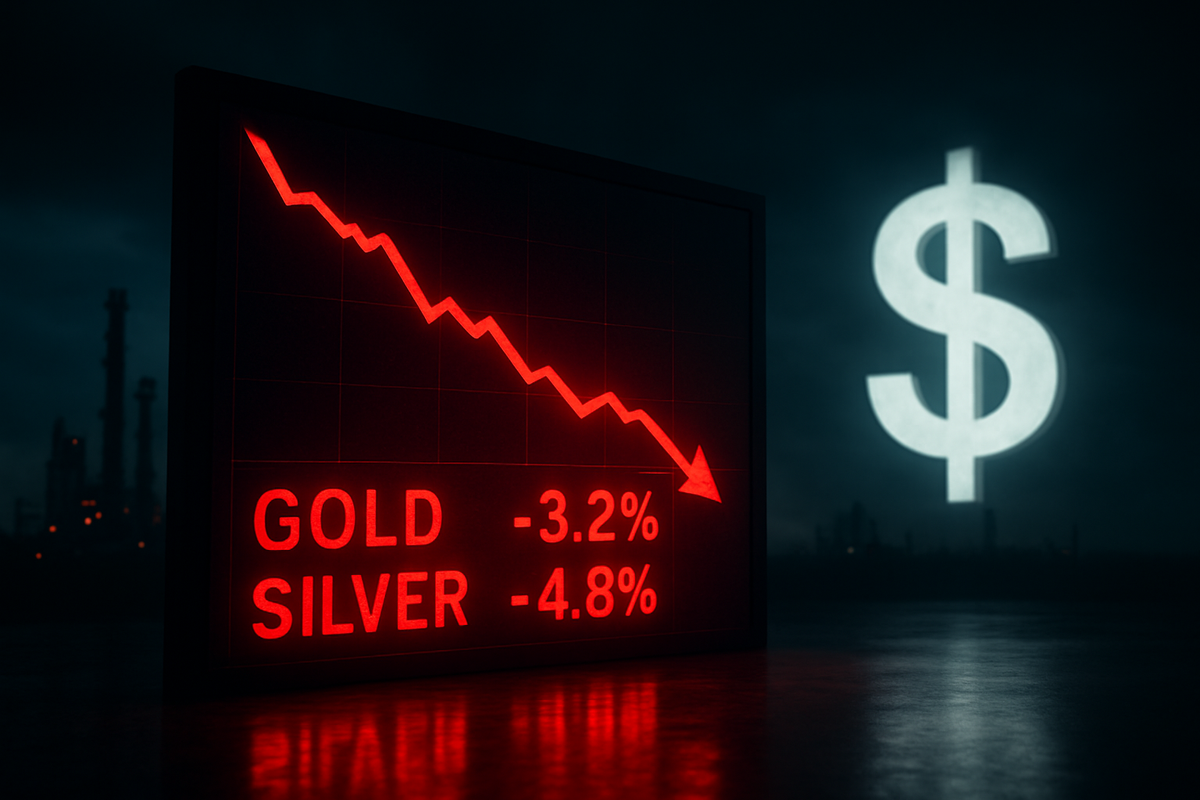
The precious metals market suffered a historic collapse on April 2, 2026, as a "perfect storm" of geopolitical aggression and hawkish monetary policy sent investors fleeing for the exits. In a single chaotic session, the multi-year bull run that had propelled gold to record heights came to a screeching halt. The June 2026 Gold Futures contract (COMEX: GCM26) plummeted to an intraday low of $4,580.40, a staggering retreat from the $4,825 levels seen just 24 hours prior. Silver fared even worse, enduring a 5.5% crash that decimated retail portfolios and triggered a wave of algorithmic margin calls across global exchanges.
The immediate implications of this "Bullion Bloodbath" are clear: the narrative of gold as the ultimate "safe haven" has been temporarily usurped by a resurgent U.S. Dollar. As President Trump adopts a "total victory" stance regarding the Iran conflict and the Federal Reserve prepares for a high-rate environment to combat oil-driven inflation, the fundamental floor for precious metals has been ripped away. Traders who once bet on a pivot toward lower interest rates in 2026 have now completely priced out any cuts, pivoting instead toward a reality of "higher for longer" under a new, more aggressive Fed leadership.
The Trigger: 'Operation Epic Fury' and the Warsh Pivot
The carnage began following a primetime address by President Donald Trump late on April 1, which carried over into a series of blistering remarks on the morning of April 2. Detailing the next phase of "Operation Epic Fury," the President warned that the U.S. military is prepared to strike Iran’s power plants, bridges, and critical oil infrastructure within the next two to three weeks if the regime does not capitulate. While such geopolitical tension typically drives gold higher, the President's simultaneous dismissal of the Strait of Hormuz crisis—telling allies to "just take it" by force—suggested a shift toward a decisive, military-enforced resolution rather than a prolonged stalemate. This led to an unexpected "peace trade" liquidation, where investors bet on a short, sharp conflict rather than a long, drawn-out war of attrition.
Compounding the pressure was a seismic shift at the Federal Reserve. With inflation expectations surging due to oil prices hovering above $110 per barrel, the Fed's hawkish wing has taken full control. The nomination of Kevin Warsh to succeed Jerome Powell as Fed Chair—set to take effect on May 15—sent shockwaves through the bond market. Warsh is widely viewed as a "Dollar Hawk" who favors aggressive rate hikes to defend the greenback's purchasing power. By the afternoon of April 2, the U.S. Dollar Index (DXY) had surged past the 100.00 mark to reach 100.08, making gold significantly more expensive for international buyers and removing the incentive to hold non-yielding assets.
The timeline of the collapse was almost clinical in its brutality. At 9:30 AM ET, the COMEX open saw immediate selling pressure. By 11:00 AM, as details of the Warsh nomination circulated, the 10-year Treasury yield spiked to 4.34%. By 2:00 PM, the "June Gold" contract had breached its $4,600 support level, bottoming out at $4,580.40. Silver, which had been trading near $76, saw a vertical drop to $70.50, as stop-loss orders from institutional hedge funds were triggered in rapid succession.
Mining Titans and ETFs in the Line of Fire
The equity side of the bullion trade was equally ravaged. Newmont (NYSE: NEM), the world’s largest gold producer, saw its shares tumble by more than 11% in a single session as investors repriced the company's future cash flow projections against a rapidly declining spot price. Barrick Gold (NYSE: GOLD) followed a similar trajectory, shedding nearly 10.5% of its market capitalization. For these mining giants, the "bloodbath" is a double-edged sword; while they are still benefiting from historically high prices compared to 2024, the sudden evaporation of the "war premium" and the rising cost of diesel for operations—driven by the same oil spike that is fueling the Fed's hawkishness—threatens their profit margins.
Exchange-traded funds (ETFs) also saw massive outflows. The SPDR Gold Shares (NYSE: GLD) dropped to $429.34, down from its January peak of nearly $496. This reflects a broader institutional pivot; the "crowded long" position in gold that dominated the first quarter of 2026 is now being unwound in favor of the iShares 20+ Year Treasury Bond ETF (NASDAQ: TLT) and cash equivalents. The iShares Silver Trust (NYSE: SLV) was perhaps the most volatile vehicle of the day, reflecting the 5.5% crash in the physical metal and leaving retail "silver squeeze" proponents nursing significant losses.
Conversely, the "winners" in this environment are the mega-cap banks and currency traders. Institutions with heavy exposure to the U.S. Dollar and short positions in the commodities complex, such as JPMorgan Chase (NYSE: JPM) and Goldman Sachs (NYSE: GS), are poised to benefit from the increased volatility and the strengthening of the DXY. As long as the dollar remains the preferred safe haven over bullion, the financial sector may see a boost in trading revenue at the expense of the mining industry.
A Fundamental Shift in the Inflation Playbook
This event marks a significant departure from historical market precedents. Traditionally, high inflation driven by energy shocks—like the current "Iran war energy shock"—is a catalyst for gold to move higher. However, the 2026 market is behaving differently. The "Warsh-led" Fed has successfully convinced the market that it will not hesitate to sacrifice economic growth to maintain the dollar’s integrity. Consequently, the correlation between oil and gold has decoupled; while oil remains high due to supply fears, gold is falling because the cost of holding it (real interest rates) is rising too fast.
The ripple effects are being felt across all asset classes. Competitors to the U.S. dollar, such as the Euro and the Yen, are weakening, which in turn forces foreign central banks to consider their own rate hikes, further sucking liquidity out of the global system. This "Great Tightening" of 2026 mirrors the Volcker era of the early 1980s, where aggressive rate hikes eventually broke the back of a gold bull market that many thought would never end. The policy implication is clear: the U.S. government is prioritizing the "Dollar as a Weapon" strategy, using high rates to attract global capital while President Trump uses military posturing to reshape the Middle East.
The Road Ahead: Support Levels or a Freefall?
In the short term, the market is looking for a floor. Technical analysts are eyeing the $4,500 level for June gold as the next major psychological support. If the conflict in Iran escalates into a full-scale regional war without a swift resolution, the supply-chain disruptions might eventually force a return to gold as a hedge against systemic collapse. However, for the next 30 to 60 days, the momentum is firmly with the bears. Strategic pivots are already underway at major hedge funds, moving away from "inflation hedges" and toward "yield plays" as the 2026 interest rate cut narrative is officially buried.
Longer-term, the market must grapple with the reality of a Kevin Warsh-led Federal Reserve. If the Fed follows through on the 20% probability of a rate hike currently being priced in by the CME FedWatch Tool, gold could see a "lost year" in 2026. Investors should watch for the April 15 inflation report; a hotter-than-expected print will likely embolden the hawks even further, potentially pushing silver below the $65 mark and gold toward $4,400.
Closing Thoughts for the Modern Investor
The April 2 Bullion Bloodbath serves as a stark reminder that no rally lasts forever and that geopolitical "safe havens" are only as strong as the currency they are priced in. The dominance of the U.S. Dollar has returned with a vengeance, fueled by a combination of Trump’s "America First" military doctrine and a Federal Reserve that has rediscovered its hawkish teeth. For the first time in years, the "inflation trade" is no longer synonymous with "buying gold."
Moving forward, the key metrics for any investor will be the U.S. Dollar Index (DXY) and 10-year Treasury yields. As long as these two stay on their current upward trajectory, precious metals will remain under immense pressure. The significance of this event cannot be overstated; it represents a fundamental re-calibration of the global macro landscape. Investors should remain cautious, watch for stability in the silver markets as a lead indicator for gold, and be prepared for continued volatility as the "Epic Fury" in the Middle East and the "Warsh Pivot" in Washington continue to unfold.
This content is intended for informational purposes only and is not financial advice.