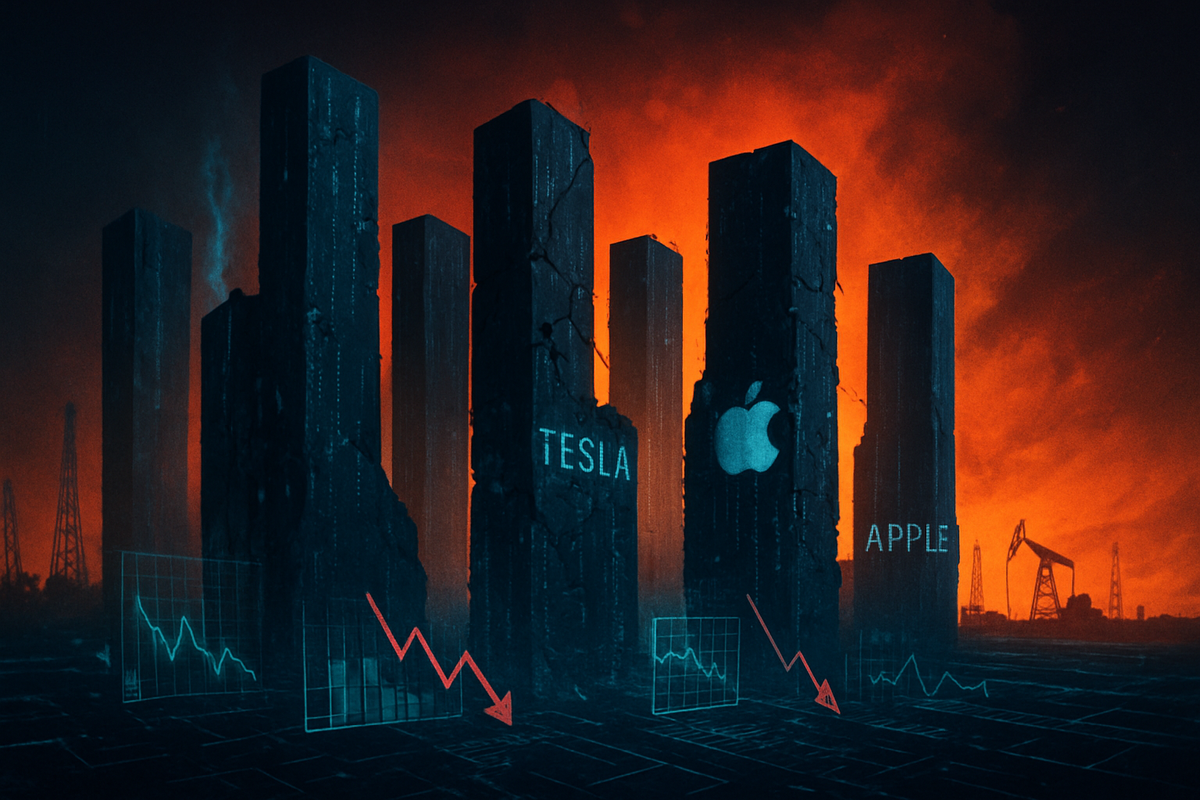
The narrative of the American stock market took a dramatic turn in early 2026 as the "Magnificent Seven" technology leaders—once the untouchable engines of global growth—descended into a collective slump. As of April 7, 2026, a "perfect storm" of geopolitical instability in the Middle East and a harsh re-evaluation of Artificial Intelligence (AI) spending has stripped trillions in market value from these industry titans. The Nasdaq Composite has officially entered a technical correction, dropping more than 10% from its January highs, as investors pivot from the digital promise of the future to the harsh inflationary realities of the present.
This downturn marks a definitive end to the unbridled optimism that characterized the 2024-2025 bull run. The catalyst for this shift was two-fold: a sudden spike in crude oil prices following the outbreak of conflict in the Strait of Hormuz and a growing skepticism regarding the massive capital expenditures (CapEx) required to fuel the AI revolution. For the first time in years, the market's heavyweights are no longer seen as safe havens, but as over-leveraged bets on a technology that has yet to deliver the high-margin returns promised to shareholders.
The Perfect Storm: A Timeline of the 2026 Tech Rout
The cracks in the tech sector first began to show in late January 2026, when Microsoft (NASDAQ: MSFT) reported record-breaking revenue but saw its shares plummet by nearly 10% in a single day. The culprit was a 66% surge in quarterly CapEx to $37.5 billion, a figure that terrified analysts who began to fear an "AI CapEx Trap." This sentiment worsened on February 28, 2026, when the outbreak of the U.S.-Israeli-Iranian conflict led to a blockade of the Strait of Hormuz, through which 20% of the world's oil flows. Within weeks, U.S. Crude prices skyrocketed to over $115 per barrel, creating an inflationary pincer that forced the Federal Reserve to maintain interest rates at a restrictive 3.5%–3.75%.
Specific companies have borne the brunt of this transition. Tesla (NASDAQ: TSLA) has emerged as the group's primary laggard, with shares down over 20% year-to-date following a disastrous Q1 delivery miss of 358,023 vehicles against a 372,160 estimate. Meanwhile, Nvidia (NASDAQ: NVDA), the erstwhile poster child of the AI boom, has seen its momentum stall. Despite maintaining 73% year-over-year revenue growth, its stock is down 5.8% for the year as investors grow wary of the $700 billion collective AI infrastructure spend projected for 2026. Apple (NASDAQ: AAPL) has also struggled, facing a 5.9% decline as reports surfaced that its first foldable iPhone failed engineering tests, pushing its mass production into late 2027.
The market reaction has been swift and unforgiving. By early April, the S&P 500 was testing its 200-day moving average, a key technical indicator of long-term health. The nomination of Kevin Warsh, a known "higher-for-longer" advocate, to replace Jerome Powell as Fed Chair in May has only added to the unease. Investors are no longer willing to pay a premium for growth-at-any-cost; they are now demanding tangible evidence of AI profitability and resilience in a world where energy costs are a permanent drag on corporate margins.
The Great Rotation: Winners and Losers of the Energy Shock
The decline of the Magnificent Seven has paved the way for a resurgence in "Old Economy" sectors. As tech stocks bled, the S&P 500 Energy Index surged 33% in the first quarter of 2026. Exxon Mobil (NYSE: XOM) hit an all-time high of $176, gaining 43% year-to-date, while Chevron (NYSE: CVX) reached a record $214. These companies have become the new "safe havens," benefiting directly from the energy supply crunch and offering the dividend stability that tech giants currently lack.
Defense contractors have also seen a "parabolic" rally. Following the White House’s $1.5 trillion FY 2027 defense budget proposal in response to global tensions, companies like Lockheed Martin (NYSE: LMT) and RTX (NYSE: RTX) have seen massive inflows. These firms are now viewed as "critical infrastructure" by a market that is increasingly prioritizing national security and physical assets over digital services. Furthermore, value-oriented consumer staples like Coca-Cola (NYSE: KO) and McDonald's (NYSE: MCD) have delivered steady 7-8% returns, serving as "hiding places" for capital fleeing the high-beta tech sector.
On the losing side, the "hyperscalers"—Amazon (NASDAQ: AMZN), Meta (NASDAQ: META), and Alphabet (NASDAQ: GOOGL)—are struggling to justify their massive investments. Alphabet, in particular, was rocked in late March after a Los Angeles jury found the company liable in a landmark social media addiction case, raising the specter of multi-billion dollar class-action liabilities. The "AI CapEx Trap" has turned these former growth engines into capital-intensive behemoths that are sensitive to both interest rate hikes and energy price fluctuations, as the cost of running massive data centers rises in tandem with oil and gas prices.
Broadening the Horizon: AI Fatigue and the Return to Tangibility
The current slump fits into a broader historical pattern where revolutionary technologies undergo a period of "irrational exuberance" followed by a painful reality check. Much like the dot-com crash of 2000, the 2026 tech rout reflects a disconnect between technological potential and short-term economic feasibility. The $650-$700 billion being funneled into AI infrastructure is unprecedented, yet the "killer app" that justifies this level of investment for the average consumer remains elusive. Regulatory headwinds, such as the Alphabet liability ruling, suggest that the era of "move fast and break things" is being replaced by a more litigious and costly environment.
The ripple effects extend far beyond the stock market. With energy prices elevated, the "higher-for-longer" interest rate environment is likely here to stay. This puts pressure on tech competitors and startups that rely on cheap capital for growth. We are seeing a strategic pivot toward "Analog" chip players and industrial automation, as companies seek to improve efficiency in the physical world rather than just the digital one. The blockade of the Strait of Hormuz has served as a wake-up call, reminding the market that global trade and energy security are the true foundations of the economy, even in an age of AI.
Historically, this shift resembles the mid-1970s, where an oil shock combined with high inflation ended a period of dominance for the "Nifty Fifty" stocks. In 2026, we are seeing a similar transition from "growth at any price" to "value and tangible assets." The policy implications are also significant; the Fed is now caught between supporting a slowing economy and fighting energy-driven inflation, a "stagflationary" scenario that hasn't been a major threat to tech investors for decades.
The Road Ahead: Strategic Pivots and Scenarios
In the short term, the tech sector will likely remain under pressure until there is a clear resolution to the Strait of Hormuz conflict or a significant cooling of oil prices. Companies like Nvidia and Microsoft may be forced to scale back their CapEx plans or provide more granular data on how AI is actually contributing to their bottom lines. We might also see a wave of consolidation, as smaller tech firms that cannot afford the high cost of AI development are acquired by the cash-rich members of the Magnificent Seven, such as Apple, which maintains a massive cash pile despite its current product delays.
Long-term, the Magnificent Seven must prove they can innovate their way out of this slump. For Tesla, this means successfully launching its low-cost EV platform to combat slowing demand. For Apple, it requires a successful entry into the AI-integrated hardware market, perhaps with the eventual release of its foldable devices and AI-powered "Siri 2.0." If these companies can demonstrate that AI can significantly lower operating costs or create entirely new revenue streams, a recovery could begin as early as 2027. However, if energy prices remain above $100, the "valuation reset" may be permanent.
Wrap-Up: What to Watch in the Coming Months
The April 2026 slump in the Magnificent Seven is more than just a market correction; it is a fundamental shift in investor psychology. The "Digital Gold Rush" has met the "Hard Asset Reality," and the result has been a painful but perhaps necessary rebalancing of the global economy. The key takeaway for investors is that the era of relying solely on mega-cap tech for portfolio growth is over. Diversification into energy, defense, and value-oriented sectors has become a necessity rather than an option.
Moving forward, investors should keep a close eye on three things: the stability of the Strait of Hormuz, the quarterly CapEx reports of the hyperscalers, and the rhetoric of the incoming Fed Chair, Kevin Warsh. Any sign of a de-escalation in the Middle East could spark a massive relief rally in tech, but the underlying concerns about AI ROI will not vanish overnight. The coming months will determine whether the Magnificent Seven can reclaim their throne or if a new generation of "Real World" leaders will continue to dominate the market landscape.
This content is intended for informational purposes only and is not financial advice