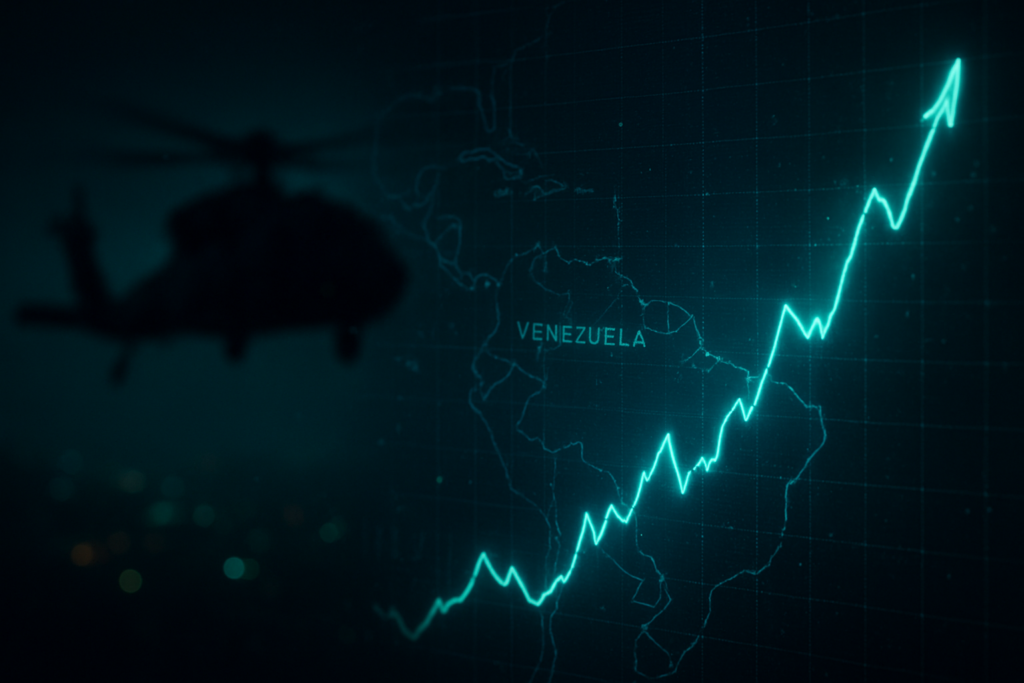
The early morning hours of January 3, 2026, will be remembered for the thundering rotors of U.S. special operations forces over Caracas. But for the high-stakes world of decentralized finance, the real "shock and awe" happened hours earlier on a digital scoreboard. As the world slept, an anonymous trader on the prediction platform Polymarket turned a relatively modest $34,000 into a staggering $410,000 windfall. The timing was more than suspicious—it was nearly telepathic.
Just 48 minutes before President Trump reportedly signed the final execution order for "Operation Absolute Resolve"—the military raid that captured Venezuelan leader Nicolás Maduro—the anonymous account began aggressively buying "Yes" shares on the prospect of Maduro’s downfall. By the time news organizations like The New York Times Co. (NYSE: NYT) confirmed the capture, the market had spiked from a niche 8% probability to a virtual certainty, leaving regulators and the public asking a chilling question: Did a government insider just monetize a military secret?
The Market: What's Being Predicted
The controversy centers on several high-liquidity contracts hosted on Polymarket, a decentralized platform built on the Polygon blockchain. The primary market, "Will Nicolás Maduro be out of office by January 31, 2026?", had seen tepid volume throughout the winter, with many analysts assuming the Venezuelan strongman would remain entrenched despite growing international pressure.
In the final days of December 2025, the "No" side of the trade was dominant, pricing the odds of Maduro's removal at less than 10%. However, blockchain data reveals that between 9:00 PM and 10:00 PM ET on January 2, a single wallet—created only days prior—conducted 13 separate transactions to scoop up nearly all available "Yes" shares at roughly 8 cents on the dollar.
The liquidity for these trades was deep enough to absorb the $34,000 without immediate price slippage, but the sheer aggression of the buy orders eventually pushed the market to 25% just before the first reports of explosions at Fort Tiuna. While traditional financial markets were closed for the weekend, Polymarket traded 24/7, providing a real-time heatmap of a geopolitical earthquake.
Why Traders Are Betting
The debate over the Maduro trade has split the prediction market community into two camps. On one side are the "Oracle" proponents, who argue that prediction markets are doing exactly what they were designed to do: aggregate all available information, including whispers and "soft" signals, into a single, accurate price.
"The market didn't just predict the raid; it announced it," said one prominent DeFi analyst. Traders point out that movements on Polymarket often precede official announcements because the financial incentive to be first is so high. Some suggest the trader might not have been a high-ranking official, but perhaps a logistical contractor or a staffer who noticed unusual activity at Florida's Southern Command and decided to "bet their hunch."
However, the "Insider" camp is much more skeptical. The precision of the 9:58 PM ET wager—just minutes before the "go" order—suggests access to the most sensitive of state secrets. This has sparked a secondary controversy regarding a separate contract on whether the U.S. would "invade" Venezuela. While the capture of Maduro was undisputed, Polymarket initially hesitated to resolve the "invasion" contract as "Yes," sparking a backlash from traders who used platforms like Alphabet Inc. (NASDAQ: GOOGL) and Meta Platforms, Inc. (NASDAQ: META) to organize protests against the platform's "arbitrary" definitions of military action.
Broader Context and Implications
This event has catapulted prediction markets into the crosshairs of federal regulators. While the Intercontinental Exchange, Inc. (NYSE: ICE) manages traditional commodities and futures with strict insider trading prohibitions, decentralized platforms like Polymarket operate in a legal gray area.
The Maduro trade has already triggered a legislative firestorm. Democratic Representative Ritchie Torres has introduced the Public Integrity in Financial Prediction Markets Act of 2026, which specifically seeks to criminalize the use of non-public government information on these platforms. "We cannot have a system where the decision to go to war is treated as a tip for a crypto-gambler," Torres stated in a recent press briefing.
Historically, prediction markets have been praised for their accuracy in elections, but the Maduro trade represents a "dark frontier." It suggests that as these markets grow in liquidity, they may become unintended "leaks" for intelligence, where the price of a contract becomes a proxy for classified briefings. This creates a perverse incentive structure where those with the power to make events happen—politicians and generals—could theoretically profit from their own decisions.
What to Watch Next
In the coming weeks, all eyes will be on the Commodity Futures Trading Commission (CFTC) as they investigate the source of the funds used in the $34,000 trade. If the agency can trace the wallet to a U.S. person with security clearance, it could lead to the first major criminal prosecution for "event contract" insider trading.
Furthermore, the resolution of the "invasion" contract remains a flashpoint. Polymarket's internal "Umpire" or decentralized governance mechanisms must decide if a targeted snatch-and-grab extraction by special forces constitutes a "invasion" of a sovereign nation. The outcome of this dispute will likely set the precedent for how future military and geopolitical contracts are phrased and resolved.
Finally, keep a close watch on the "Maduro Trial" markets. Contracts are already appearing regarding the likelihood of a conviction in the Southern District of New York and the potential for a plea deal. These markets are currently seeing heavy volume as legal experts and political junkies weigh the strength of the narco-terrorism evidence against the complexities of international law.
Bottom Line
The "Maduro Trade" is a watershed moment for prediction markets. It proved that these platforms can indeed function as a "super-oracle," identifying events before they happen with uncanny accuracy. Yet, it also exposed a massive ethical and regulatory vacuum. If the public loses faith in the "fairness" of these markets—fearing they are playing against insiders with a 20/20 view of the future—liquidity could dry up just as the industry is reaching the mainstream.
For now, the anonymous trader sits on a $410,000 profit, and the world has a new, albeit controversial, way to monitor the secrets of the state. Whether this remains a legitimate tool for forecasting or becomes a "black market for secrets" will depend on the regulatory actions taken in the wake of Operation Absolute Resolve.
This article is for informational purposes only and does not constitute financial or betting advice. Prediction market participation may be subject to legal restrictions in your jurisdiction.
PredictStreet focuses on covering the latest developments in prediction markets.
Visit the PredictStreet website at https://www.predictstreet.ai/.