As of January 16, 2026, the geopolitical landscape is being rewritten not just in the halls of diplomacy, but across the digital ledgers of global prediction markets. In a startling shift of sentiment, traders on platforms like Polymarket, Manifold Markets, and Kalshi are pricing in a historic "Winter of Discontent" for two of the world’s most enduring autocratic regimes: Iran and Cuba. For the first time in decades, the "wisdom of the crowd" suggests that the survival of the Islamic Republic and the Cuban Communist Party is no longer a safe bet, with leadership turnover odds in both nations soaring past the 60% mark.
This surge in activity is being fueled by a series of black-swan events that have unfolded in the first two weeks of 2026. From the "Winter Uprising" in Tehran to the seismic "Maduro Shock" in the Caribbean, speculative volume has reached record highs. On Polymarket alone, the "Iran Leadership" market has seen over $4.1 million in trading volume, as participants bet on the departure of Supreme Leader Ali Khamenei before the year’s end. These markets are increasingly being viewed by analysts at firms like Meta Platforms, Inc. (NASDAQ: META) and Alphabet Inc. (NASDAQ: GOOGL) as vital indicators of on-the-ground reality in regions where traditional media access is restricted.
The Market: What's Being Predicted
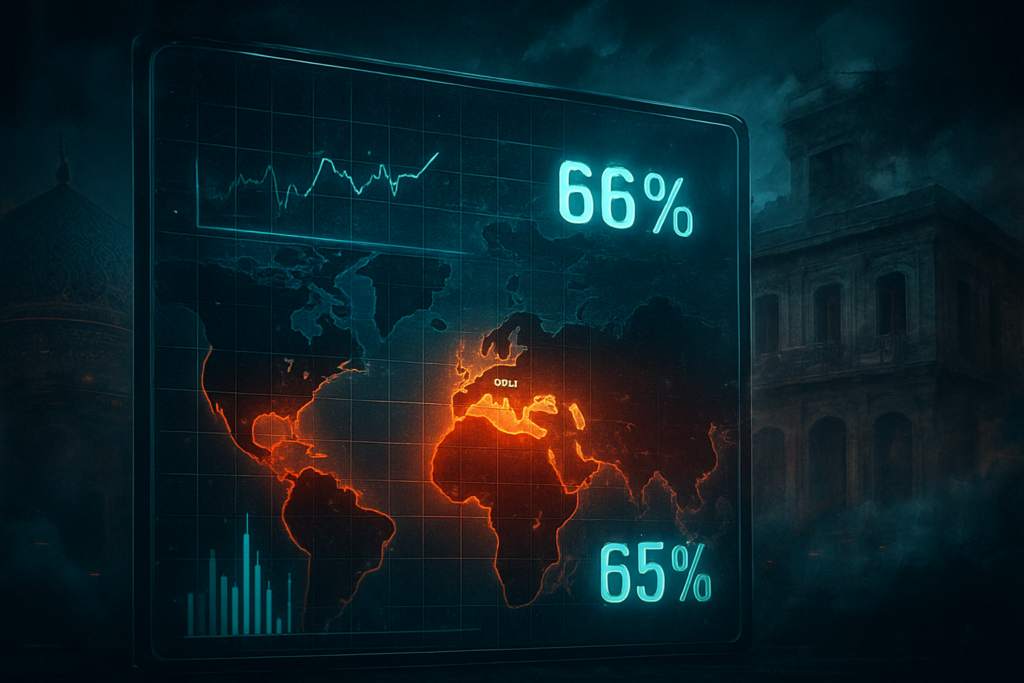
The current focus of geopolitical traders is split between two distinct but related outcomes: leadership transition and total regime collapse. In the Iran markets, there is a marked divergence in probability. On Polymarket and Kalshi, the odds that Ayatollah Ali Khamenei (86) will exit his post—whether by death, resignation, or ouster—by the end of 2026 are currently hovering between 56% and 66%. However, the probability of a total "regime fall"—defined as the dissolution of the Islamic Revolutionary Guard Corps’ (IRGC) clerical authority or a change in the constitution—remains lower, at approximately 34% on Manifold Markets and only 5% on the more conservative Metaculus.
In Cuba, the sentiment is even more bearish for the status quo. Following the reported capture of Venezuelan President Nicolás Maduro by U.S. forces on January 3, 2026, the market for President Miguel Díaz-Canel’s ouster has spiked to 65%. Traders on Manifold are essentially betting on "economic terminal entropy," where the loss of Venezuelan oil subsidies—the island’s "energetic floor"—leads to an irreversible breakdown of state control.
The resolution criteria for these markets are notoriously strict. For a "Yes" resolution on regime change, most platforms require verification from a consensus of international news organizations like Reuters or the Associated Press. On Metaculus, the bar is even higher, requiring that the government lose de facto control of more than 50% of its territory and that the term "Islamic Republic" or "Communist Party" be removed from the nation's governing documents.
Why Traders Are Betting
The primary driver for the Iran markets is the catastrophic collapse of the Iranian Rial, which hit an all-time low of 1.65 million per USD this week. This currency devaluation has sparked the "Winter Uprising," a wave of protests spanning 92 cities. Unlike previous movements, traders are betting that the current unrest is different due to the perceived fragility of the succession plan. With rumors of Khamenei’s failing health circulating on social media platforms like X, speculators are divided on whether the transition to his son, Mojtaba Khamenei, will trigger a "sclerotic" council takeover or a full-scale revolution.
External pressure is also a significant factor. The second Trump administration has signaled a "maximum pressure 2.0" campaign, threatening 25% tariffs on any nation trading with Iran. On Polymarket, a specific contract for a "U.S. Military Strike on Iran by June 30, 2026" is currently trading at 74%, reflecting a high degree of confidence in "Operation Iron Strike."
In Cuba, the "Maduro Shock" has completely altered the risk profile. Without the lifeblood of Venezuelan oil, which traditionally flowed through tankers operated by companies like Chevron (NYSE: CVX), the Cuban state is facing permanent blackouts in its interior provinces. Traders are betting that the "hollow state" phenomenon—where the government maintains control of Havana while losing the provinces of Santiago de Cuba and Holguín—will eventually lead to "elite fragmentation" following the inevitable passing of 94-year-old Raul Castro.
Broader Context and Implications
The rise of these markets marks a paradigm shift in how global intelligence is aggregated. Traditionally, the stability of the Iranian or Cuban regimes was the purview of think tanks and classified intelligence briefings. Today, prediction markets provide a real-time, incentivized alternative. "Prediction markets are essentially the ultimate bullshit detector," says one high-volume trader on Manifold. "You can't hide a currency collapse or a military mobilization from a market that is looking for a 1% edge in satellite imagery or social media sentiment."
This has significant real-world implications. Multi-national corporations and logistics giants are increasingly using these odds to hedge their regional risks. If the markets suggest a 65% chance of a Cuban regime change, insurance premiums for shipping in the Caribbean may adjust accordingly. Furthermore, the accuracy of these markets has historically outperformed traditional forecasting; for instance, prediction markets were faster to price in the instability of the 2024 Iranian helicopter incident than most geopolitical journals.
However, the regulatory environment remains a hurdle. While Kalshi has fought for its right to host election-related and geopolitical contracts in the U.S., the Commodity Futures Trading Commission (CFTC) continues to eye these "event contracts" with skepticism, citing concerns about "public interest" and the potential for market manipulation by foreign actors.
What to Watch Next
The coming weeks will be critical for the resolution of these contracts. In Iran, all eyes are on the upcoming anniversary of the 1979 Revolution in February. A failure by the state to mobilize its usual pro-regime rallies, or a surge in "counter-rallies," could send the "Regime Fall" odds on Manifold skyrocketing from 34% toward the 50% mark. Additionally, any verified health update regarding the Supreme Leader will likely cause immediate, high-volume volatility.
In Cuba, the key milestone is the "Economic Deregulation" deadline rumored for March 2026. If the Díaz-Canel administration is forced to fully dollarize the economy to survive the loss of Venezuelan support, it may be viewed as a surrender of sovereignty, triggering the "Yes" resolution on leadership change. Investors are also monitoring the movement of U.S. naval assets in the Caribbean, with the "Invasion/Strike" market currently sitting at a tense 25%.
Bottom Line
The prediction markets of early 2026 paint a picture of a world at a geopolitical tipping point. While the "total collapse" of the Iranian and Cuban governments is not yet a consensus view, the odds for significant leadership turnover are the highest they have been in the 21st century. The markets are telling us that the combination of economic insolvency and leadership transition is a more potent threat to these regimes than decades of external sanctions.
Ultimately, these platforms serve as more than just a place to gamble; they are becoming the world's most transparent risk-assessment tool. Whether the "Winter Uprising" results in a new constitution or a reshuffled autocracy remains to be seen, but for now, the smart money is betting that the old guards in Tehran and Havana are running out of time.
This article is for informational purposes only and does not constitute financial or betting advice. Prediction market participation may be subject to legal restrictions in your jurisdiction.
PredictStreet focuses on covering the latest developments in prediction markets.
Visit the PredictStreet website at https://www.predictstreet.ai/.