On January 9, 2026, the global energy and technology sectors witnessed a watershed moment as Meta Platforms Inc. (NASDAQ: META) announced a massive nuclear power development deal with Oklo Inc. (NYSE: OKLO). The agreement, which aims to support a 1.2 GW power campus in Ohio, sent shares of OKLO surging by over 20% in mid-day trading. As artificial intelligence (AI) scaling demands unprecedented amounts of stable, carbon-free baseload power, Oklo has transitioned from a speculative "New Space"-style energy startup to a central player in the race to power the next generation of data centers.
This research feature explores why Oklo has captured the imagination of Silicon Valley and Wall Street alike, examining its unique "Power as a Service" model and the regulatory tailwinds that are finally clearing the path for the first commercial deployment of small modular reactors (SMRs) in the United States.
Historical Background
Oklo’s journey began in 2013 at the Massachusetts Institute of Technology (MIT), where founders Jacob DeWitte and Caroline Cochran sought to rethink nuclear fission. Inspired by the "Oklo" natural nuclear reactor in Gabon—a geological phenomenon where fission occurred naturally billions of years ago—the duo envisioned a compact, simplified reactor that could operate without the immense complexity and cost of traditional gigawatt-scale plants.
For its first decade, Oklo operated as a venture-backed startup, gaining significant early support from Sam Altman, CEO of OpenAI. Altman became Chairman of the Board in 2015, recognizing that the long-term success of AI would be inextricably linked to the availability of cheap, abundant energy. In May 2024, Oklo transitioned to the public markets through a merger with AltC Acquisition Corp., a special purpose acquisition company (SPAC) co-founded by Altman. Despite an initial "SPAC-era" volatility, the company successfully raised approximately $306 million, providing the runway needed to navigate the rigorous Nuclear Regulatory Commission (NRC) licensing process.
Business Model
Oklo distinguishes itself from traditional nuclear vendors through its "Power as a Service" (PaaS) model. While established players like Westinghouse or GE Hitachi sell reactor designs and components to utilities, Oklo intends to own and operate the reactors itself.
Under this model, Oklo signs long-term Power Purchase Agreements (PPAs) directly with end-users—such as data centers, industrial manufacturing plants, or remote communities. This removes the burden of nuclear operations from the customer, who simply pays for the electricity and heat delivered. Additionally, Oklo is vertically integrating its fuel supply. By focusing on "fast fission" technology, the company plans to recycle used nuclear fuel (nuclear waste) from the current U.S. fleet, converting it into High-Assay Low-Enriched Uranium (HALEU) to power its own Aurora reactors.
Stock Performance Overview
Since its public debut in mid-2024, OKLO has been one of the most volatile names in the energy sector.
- 1-Year Performance: In the past 12 months (leading up to Jan 2026), the stock has risen over 140%, driven largely by a series of data center partnerships and the general "AI-Nuclear" hype cycle.
- 5-Year Context: While the company has not been public for five years, its valuation has ballooned from its $850 million SPAC valuation in 2023 to a market capitalization exceeding $15 billion as of today.
- Recent Moves: After hitting a record high of $115.75 in late 2025, the stock saw a healthy correction before today's Meta-induced rally. Investors have treated OKLO as a high-beta proxy for the intersection of clean energy and AI infrastructure.
Financial Performance
Oklo remains in its pre-revenue growth phase, common for "Deep Tech" companies in the pre-commercialization stage.
- Earnings & Revenue: As of the latest filings in Q3 2025, Oklo reported zero commercial revenue, with a net loss of approximately $29.7 million for the quarter.
- Cash Position: The company maintains a robust balance sheet, bolstered by the Meta deal's upfront funding structure. As of early January 2026, cash and equivalents are estimated at $921 million.
- Valuation Metrics: With a market cap of $15.2 billion and no current revenue, traditional metrics like P/E or EV/EBITDA are inapplicable. Investors are valuing Oklo based on its projected 2028-2030 earnings and the total addressable market (TAM) of the AI power sector.
Leadership and Management
The leadership team is led by Jacob DeWitte (CEO and Chairman) and Caroline Cochran (COO). Following the resignation of Sam Altman from the Chairman role in April 2025—a move made to mitigate potential conflicts of interest as OpenAI ramped up its own energy procurement—DeWitte assumed the Chairmanship.
The management team is noted for its deep technical expertise and its ability to navigate the complex Washington D.C. regulatory environment. The board includes heavyweights from the energy and finance sectors, providing the governance necessary to manage what is essentially a multi-billion dollar infrastructure build-out.
Products, Services, and Innovations
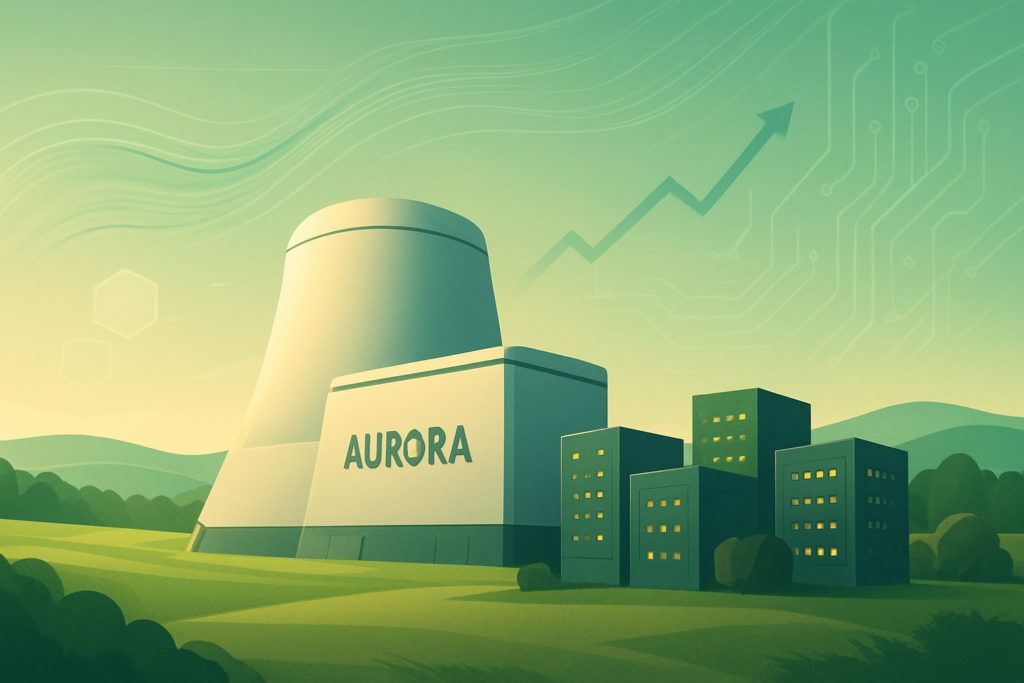
The flagship of Oklo’s portfolio is the Aurora powerhouse. Unlike traditional light-water reactors, the Aurora is a Liquid Metal Fast Reactor (LMFR).
- Passive Safety: The reactor uses heat pipes to move heat from the core, meaning it does not require pumps, valves, or active cooling systems that could fail during a power loss.
- Size and Scale: Units are designed to produce between 15 MW and 75 MW. Their modular nature allows them to be co-located; the Meta deal, for example, involves a "campus" of multiple units reaching 1.2 GW.
- Refueling: The Aurora is designed to run for up to 20 years without refueling, significantly reducing operational complexity and waste handling.
In late 2025, Oklo also broke ground on a $1.68 billion fuel recycling facility in Tennessee, a critical innovation intended to secure its own fuel supply chain.
Competitive Landscape
Oklo operates in an increasingly crowded SMR field:
- NuScale Power (NYSE: SMR): The first to get an NRC design certification, but focused on more traditional light-water technology.
- TerraPower: Bill Gates' venture, focused on the 345 MW "Natrium" reactor. While better capitalized, TerraPower is targeting grid-level utility replacement, whereas Oklo focuses on "behind-the-meter" industrial and data center applications.
- X-energy: Backed by Amazon (NASDAQ: AMZN), X-energy is a direct competitor for data center power, using pebble-bed reactor technology.
Oklo’s competitive edge lies in its smaller footprint and its unique business model that favors direct ownership over hardware sales.
Industry and Market Trends
The primary driver for Oklo is the "AI Power Gap." Hyperscalers like Meta, Google, and Microsoft have realized that the intermittent nature of solar and wind cannot support the 24/7 uptime required by AI superclusters. This has led to a "Nuclear Renaissance."
Furthermore, the global shift toward decarbonization is making nuclear the only viable option for fossil-fuel-free baseload power. Supply chain trends are also shifting toward domestic enrichment and fuel production to move away from Russian uranium dependency.
Risks and Challenges
Investing in Oklo is not without significant risks:
- Licensing: The NRC has historically been slow to approve non-light-water designs. While the process has been streamlined, any major regulatory "no" could be catastrophic for the stock.
- Execution: Building the "First-of-a-Kind" (FOAK) reactor is notoriously difficult. Construction delays and cost overruns are common in the nuclear industry.
- Fuel Supply: The availability of HALEU fuel remains a bottleneck. While Oklo is building its own recycling facility, the interim supply depends on government stocks and a developing commercial market.
Opportunities and Catalysts
The Meta deal is the most significant catalyst in the company’s history, providing both a massive revenue backlog and "project certainty" that will likely make it easier for Oklo to secure low-cost debt financing.
Near-term catalysts include:
- NRC License Submission: Expected in early 2026 for the Idaho National Laboratory site.
- Site Prep in Ohio: Groundbreaking for the 1.2 GW campus could begin by late 2026.
- Additional Hyperscaler Deals: Rumors suggest other major cloud providers are in active negotiations with Oklo for similar "power campus" arrangements.
Investor Sentiment and Analyst Coverage
Wall Street sentiment is polarized. Bulls view Oklo as the "Tesla of Energy," a disruptor that will define the next 50 years of power generation. As of January 2026, several top-tier analysts have "Buy" ratings with price targets averaging $110.
Conversely, bears point to the $15 billion valuation for a company that is years away from generating revenue. They argue the technical and regulatory hurdles are still underappreciated by retail investors who are swept up in the AI-nuclear narrative.
Regulatory, Policy, and Geopolitical Factors
The regulatory environment has turned decisively in Oklo's favor. The ADVANCE Act, signed into law in 2024, has drastically reduced NRC licensing fees and mandated the agency to prioritize the licensing of advanced microreactors.
Geopolitically, the U.S. government views the development of SMRs as a matter of national security, aiming to compete with Chinese and Russian nuclear exports. This has led to various DOE grants and loan guarantees that provide a "safety net" for the domestic nuclear industry.
Conclusion
Oklo Inc. stands at the intersection of the two most powerful investment themes of the decade: the AI revolution and the global energy transition. The landmark 1.2 GW deal with Meta validates the company's "Power as a Service" model and provides a clear roadmap for commercialization.
However, investors must weigh the undeniable growth potential against the execution risks inherent in pioneering a new nuclear technology. While the Meta deal provides a massive vote of confidence, Oklo's ultimate success depends on its ability to turn blueprints into operational reactors on schedule and within budget. For the patient investor, OKLO remains one of the most compelling—albeit high-risk—plays in the modern energy landscape.
This content is intended for informational purposes only and is not financial advice.